
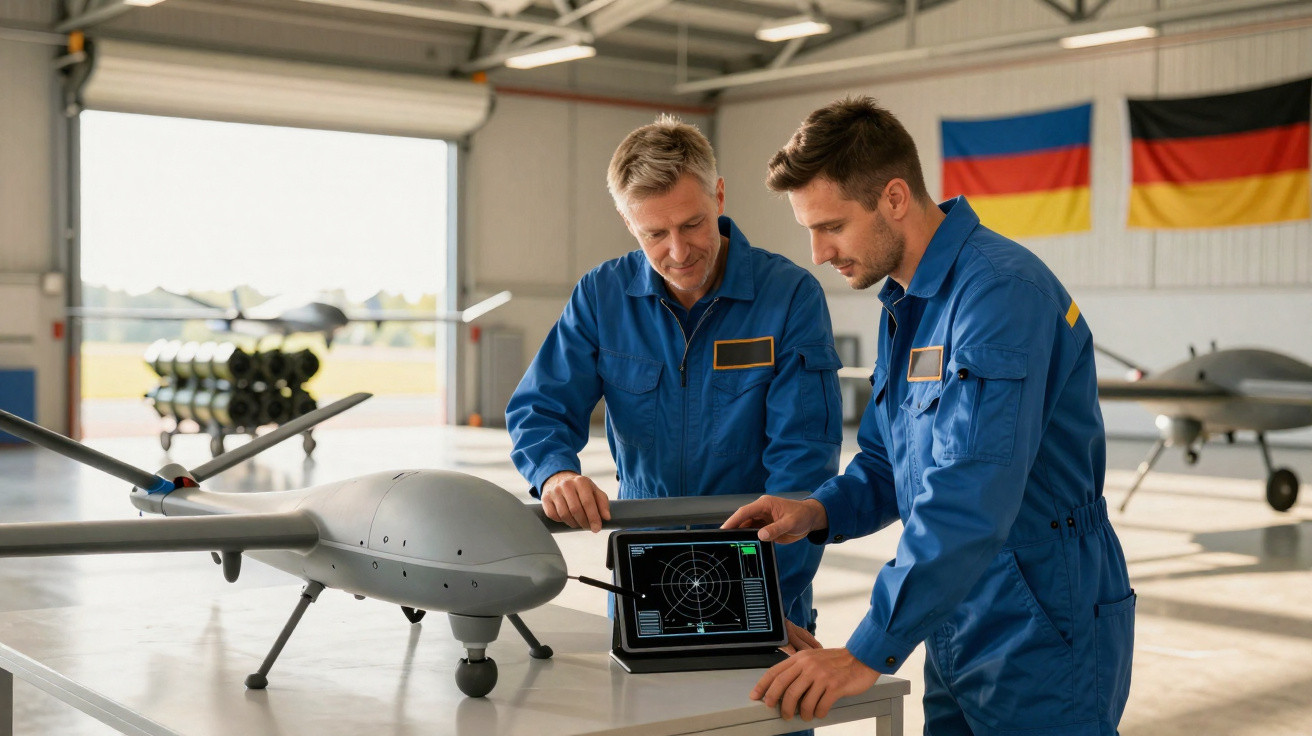
Alongside confirmation that Ukraine will buy new IRIS-T systems to bolster its air defence, Kyiv has also agreed with Germany to co-produce seven new types of combat drones intended for the Ukrainian Armed Forces. Official Ukrainian statements indicate that six of the projects are airborne platforms, while the seventh is a ground-support system, with production split between Ukrainian and German manufacturers.
Ukraine–Germany co-production of seven combat drones
Further details show that one of the seven projects is Linsa 3.0, jointly developed by Frontline Robotics and Quantum Systems. The companies describe it as a multi-purpose logistics drone able to carry up to 4 kilograms over distances of up to 15 kilometres, with an endurance of around 60 minutes. The Ukrainian government says more than 10,000 units will be built during the current year.
Also included is the FPV KOLIBRI, a programme designed both for strike tasks and for use as an interceptor.
New systems for interception, reconnaissance and strike
Ukraine’s forces are also set to receive the new STRILA interceptors to help bring down Russian airborne threats. These systems are built for defeating highly manoeuvrable targets and are stated to reach a maximum speed of 415 kilometres per hour.
Reinforcing battlefield intelligence, the new Babka drones are likewise expected to be taken into Ukrainian service to improve reconnaissance capabilities.
Strike capacity is due to grow with the arrival of Seth-X and Anubis drones. Seth-X is presented as a short-range asset aimed at engaging infantry units, light armoured vehicles and logistical support vehicles. Anubis, by contrast, is configured as a medium-range system; in addition to the same target types, it is described as suitable for attacking installations and larger armoured vehicles.
The single ground-based model selected is TerMit. Its all-terrain characteristics are intended to support evacuation and logistical support missions, with a stated range of 40 kilometres.
Industrial partnerships under “Build with Ukraine”
Beyond the seven systems listed, their manufacture is expected to involve substantial collaboration between German and Ukrainian firms, with more than six cooperation agreements already signed under the “Build with Ukraine” initiative.
Among the companies involved, Germany’s Diehl Defence and Ukraine’s FirePoint and Luch have agreed to widen technological cooperation. Separately, TAF Industries and Thyra have signed a memorandum of understanding focused on producing interceptors, alongside other examples.
Zelensky’s visit to Germany
These announcements unfolded as President Volodymyr Zelensky made an official trip to Germany. During the visit, he met Chancellor Friedrich Merz, viewed the new drones in a static display and discussed additional matters tied to the longer-term partnership.
German media reports say one topic raised was the increasing number of Ukrainian men travelling to Germany to avoid conscription, which reduces the strength of Ukraine’s Armed Forces and adds to social spending for its ally.
It was also reported that the two countries refreshed agreements connected to Ukraine’s post-war reconstruction, while seeking to demonstrate renewed German backing for Ukraine’s bid to join the European Union. Chancellor Merz described this as a “strategically important step toward greater security and prosperity in Europe,” though he tempered expectations of membership in the near term.
Other items discussed included proposals to deepen cooperation in the energy sector. Ukraine’s presidency also repeated its request for additional resources to expand weapons manufacturing, even stating that production could be doubled if partners provide increased support.
The search for more support in Europe
Alongside the Germany visit, Zelensky and his delegation conducted a wider tour of European capitals to secure further backing for Ukraine, which has been resisting the Russian invasion since 2022. As with the talks with Chancellor Merz, Zelensky emphasised cooperation arrangements focused on unmanned-system production and strengthened air defences-two central elements shaping the conflict.
Among the stops, the Ukrainian President travelled to Norway to meet national leaders, where the intention to pursue a broader strategic defence partnership and Oslo’s commitment to the PURL initiative were highlighted. Zelensky said Ukraine could help with reconfiguring European air-defence networks, pointing to Ukrainian forces’ extensive experience in modern combat and in technological developments aimed particularly at countering drones.
The delegation also visited Italy, meeting Defence Minister Guido Crosetto to examine new cooperation opportunities and the continuation of financial support from Rome. There, Zelensky underlined that Ukraine was prepared to pursue agreements at both bilateral and multilateral level, including those to be framed through the instrument known as SAFE. Shortly afterwards, he travelled to the Netherlands, where it was likewise agreed to advance joint production of drones, missiles and electronic warfare systems.
Finally, a notable defence-related development for Ukraine was also reported from the United Kingdom: the delivery of what is described as the largest drone package announced since the war began. As Escenario Mundial reported on April 15, it would comprise more than 120,000 unmanned systems for surveillance, strike and logistics, adding to the more than 85,000 units delivered over the last six months, purchased in exchange for around 600 million pounds.
Images used for illustrative purposes
You may also like: The Ukrainian Armed Forces attack the Russian frigate Admiral Makarov in Novorossiysk with drones





Comments
No comments yet. Be the first to comment!
Leave a Comment