
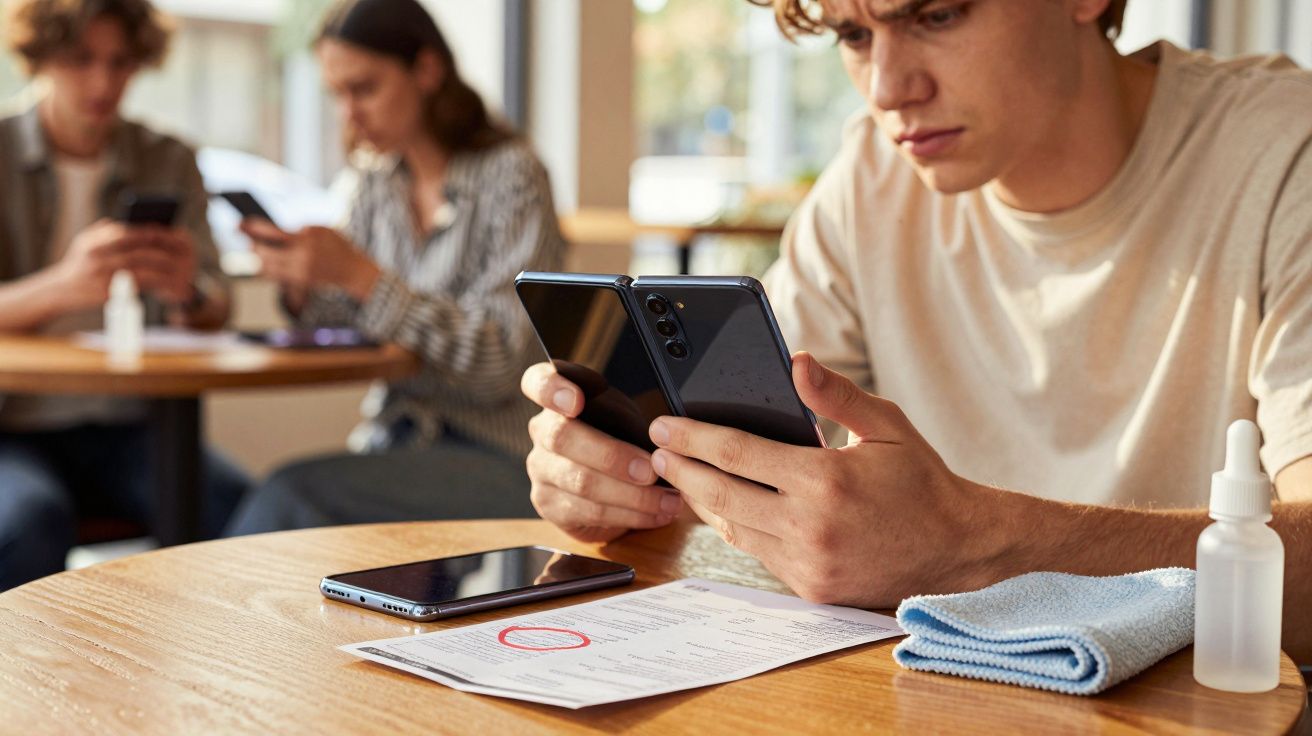
The first time the Galaxy Z Fold7 disappeared into my pocket, it genuinely felt as if I’d jumped a few months ahead. On the café table it didn’t merely lie there - it almost performed: half folded, display lit up, like a miniature sci‑fi notebook poised for the next twist. Mates leaned in to prod it, the barista asked, “Is that the new Fold?”, and for a short while I was the person with the cool phone - the one people tag in group chats for tech takes, the early adopter with the shiny new thing.
Three months on, that very same Fold7 is spending a rather suspicious amount of time in a drawer.
And yes - that drawer is packed with regrets as well.
When the honeymoon with the Galaxy Z Fold7 starts to crack
At the beginning, it was pure tech infatuation. The Fold7 would open with a subtle, pleasing resistance - like cracking open a hardback. The expansive inner display devoured Netflix episodes, sprawling email chains and endless doomscrolling without even flinching. I was hammering out messages with two thumbs like it was a tiny tablet, hopping between apps, dragging and dropping text as though the future had finally turned up in my hands. Suddenly, commutes felt shorter, waiting rooms felt less dull, and every YouTube rabbit hole was far more comfortable.
Then, almost imperceptibly, small annoyances began to stack up - one alert at a time.
It started with the cover screen. With the Fold7 shut, it’s tall and narrow, like someone stretched a standard phone in Photoshop and forgot to tick “constrain proportions”. Trying to fire off a quick reply on that slim front display feels like tiptoeing along a balance beam. Autocorrect is constantly in overdrive, my thumbs catch the edges, and I’ve sent far too many “okays” instead of “ok” for my liking. One evening, attempting to answer a simple Slack ping while walking, I gave up, unfolded the phone right there on the street - and nearly walked into a parked scooter.
Closed, it’s fiddly. Open, it’s brilliant… but only when you can pause and commit both hands.
That’s the central contradiction of folding phones. In theory, they offer the best of both worlds: a phone and a tablet in one device. In practice, the compromise bites in both directions. Shut, you’re left with an oddly proportioned phone that feels heavier than you expect, with a nagging “please don’t drop me” energy. Open, you get a gorgeous screen that demands your full attention, two hands, and quite often a flat surface. The Fold7 keeps putting the same question to you: “Are you now in big-screen mode or not?” After three months, I realised the question itself is tiring. A regular phone never quizzes you like that.
The daily friction nobody shows in the ads
Here’s the tiny action that slowly drained the wonder: unfolding and folding it back up. You do it dozens - possibly hundreds - of times per day. In the office, at lunch, on the Tube, on the sofa. Each time, your thumb or fingertip hunts for the edge, you lever it open, the hinge gives a mild resistance, and the centre crease shows up like a faint scar. Early on, that motion feels premium and tactile - satisfying, even. A few weeks later, it becomes admin. A constant micro-effort that simply doesn’t exist with a normal flat slab.
Before long, you find yourself bargaining: “Is this email worth unfolding for?” “Do I really need the big screen just to check Instagram?” It’s an odd conversation to have with something that costs more than a decent laptop.
There’s a social dimension no-one warns you about, too. At dinner, opening the Z Fold7 on the table can feel a bit like flipping open a laptop halfway through pudding. It’s big, bright, and draws eyes even when you’d rather it didn’t. On public transport, that wide inner display can feel like an open book other people can read. One afternoon on a packed bus, I was looking over some private documents on the inner screen and caught the person next to me plainly peering across. I snapped it shut with an awkward half-smile and spent the rest of the journey staring at the lock screen.
The outcome is oddly backwards: you buy a device built for multitasking, yet you sometimes avoid using its main superpower in public.
The underlying logic is ruthlessly straightforward: convenience wins. Phones succeed because they vanish into habit - take out, unlock, use, pocket, forget. The Z Fold7 refuses to vanish. It wants to be noticed, unfolded, and used in a very particular way. That’s enjoyable when you’re at home on the sofa, cable nearby, Wi‑Fi on. It’s much less enjoyable when one hand is full of shopping and the other is trying not to drop a £1,800 gadget. As my days got busier, I kept reaching for whatever demanded less from me. A “boring” flat phone started to feel like a relief.
Learning to live with a futuristic object you don’t quite trust
Over time, I ended up with a coping strategy: I used the Fold7 as little like a Fold as I could. It sounds absurd, but that’s where I landed. The outer screen became my default for messages, quick calls and maps. The inner display turned into a “special mode” for long emails, split-screen tasks, or watching a match. I put a soft case on it, cleaned it carefully each evening, and avoided any pocket that also held keys or coins. Every splash of water, every grain of grit, suddenly felt like an attacker. Owning the future means babysitting it more than you’d prefer.
The honest truth is I was always slightly worried about breaking it - and that low-level fear changes how you use any device.
If you’re considering a foldable, there’s a trap I wish somebody had flagged for me. You tell yourself, “I’ll finally use the big screen to work while I’m out, edit documents, read more, become properly productive.” It’s an enticing picture. Then real life barges in. You grab your phone to reply to three WhatsApp messages while crossing the road. You check the timetable in the rain. You take a chaotic photo at a party. Be realistic: hardly anyone restructures their entire day around a phone’s shape. You revert to your usual habits, and the extra features become occasional fireworks rather than daily tools.
That mismatch - between imagined use and actual use - is where the irritation grows.
At one point, a friend asked whether they should move to a foldable, and I caught myself pausing for a full five seconds before replying.
“Look,” I finally said, “it’s amazing when you actually use the big screen. But you need to accept that it’s heavier, more fragile, and that sometimes you’ll just be too tired to deal with it.”
- Try a foldable for at least 10–15 minutes in a shop before you buy, switching repeatedly between the outer and inner screens.
- Be honest about how often you genuinely sit down to read, watch, or work on your phone versus doing quick, one‑handed tasks.
- Think about where you use your phone most: public transport, the office, in bed, in the kitchen, outdoors.
- Decide whether you’re comfortable living with a more delicate object that needs extra care and attention.
- Compare it with a normal flagship at the same price and focus on what you’d truly use every day, not just once a week.
Maybe the future is folding, but the present is still flat
Three months with the Galaxy Z Fold7 left me with an odd blend of respect and weariness. When everything lines up - a quiet hour, a comfortable seat, two free hands - I adore what it can do. Watching a film on that larger screen, getting through long articles, editing photos with plenty of space for tools - it all feels genuinely next level. Some evenings I’d unfold it in bed, lower the brightness, and think, “Yes, this is the pocket computer from the future I always wanted.” Then the alarm would go off at 7 a.m., I’d pick up the heavy folded brick from the bedside table, squint at messages on the cramped outer screen and, half asleep, miss my old, simple flat phone all over again.
Most of us know that moment: a gadget looks flawless in reviews and unboxings, then trips over the realities of everyday life.
What folding phones like the Z Fold7 highlight more than anything is how stubborn our routines are. Technology can flex, displays can fold, hinges can improve - yet our phone habits stay strangely consistent. Quick checks, one‑handed swipes, clumsy typing while walking, late-night scrolling on your side. The Fold7 sparkles when you treat it according to its “ideal use cases”, and quietly irritates you when you don’t. And if we’re being honest, normal life rarely provides ideal conditions. It rains, hands get dirty, bags get cramped, kids grab your phone with sticky fingers.
Maybe that’s why my Fold7 now cycles between my pocket, my hand and - more often than I expected - that infamous drawer.
I don’t believe folding phones are a dead end. I think they’re an answer that isn’t finished yet. The Z Fold7 shows the tech works, the software can adapt, and a phone really can double as a small tablet. It also shows how high the bar is for something we touch hundreds of times a day without thinking. For some, the trade-offs will be worth it and they’ll never look back. For others - like me - the compromise still feels too heavy, too fragile, too demanding. The future may well fold, but for now plenty of us are quietly happiest with a flat, unexciting rectangle that blends into daily life instead of constantly asking to be accommodated.
| Key point | Detail | Value for the reader |
|---|---|---|
| Hidden daily friction | Opening and closing the Fold7 dozens of times a day feels like a chore over time | Helps you predict how the phone will feel after the initial excitement fades |
| Compromise in both modes | Narrow outer screen and “attention‑hungry” inner display create a constant trade‑off | Lets you see if this compromise matches your real habits |
| Emotional cost of fragility | Fear of damage changes how and where you dare to use the device | Shows the psychological side of owning an expensive, delicate gadget |
FAQ:
- Question 1: Is the Galaxy Z Fold7 good enough to use as your only phone every day?
- Question 2: Does the crease in the middle of the screen bother you after a while?
- Question 3: Is the Fold7 really more fragile than a normal flagship phone?
- Question 4: Will a foldable actually make me more productive?
- Question 5: Who should honestly avoid buying a folding phone right now?



Comments
No comments yet. Be the first to comment!
Leave a Comment