
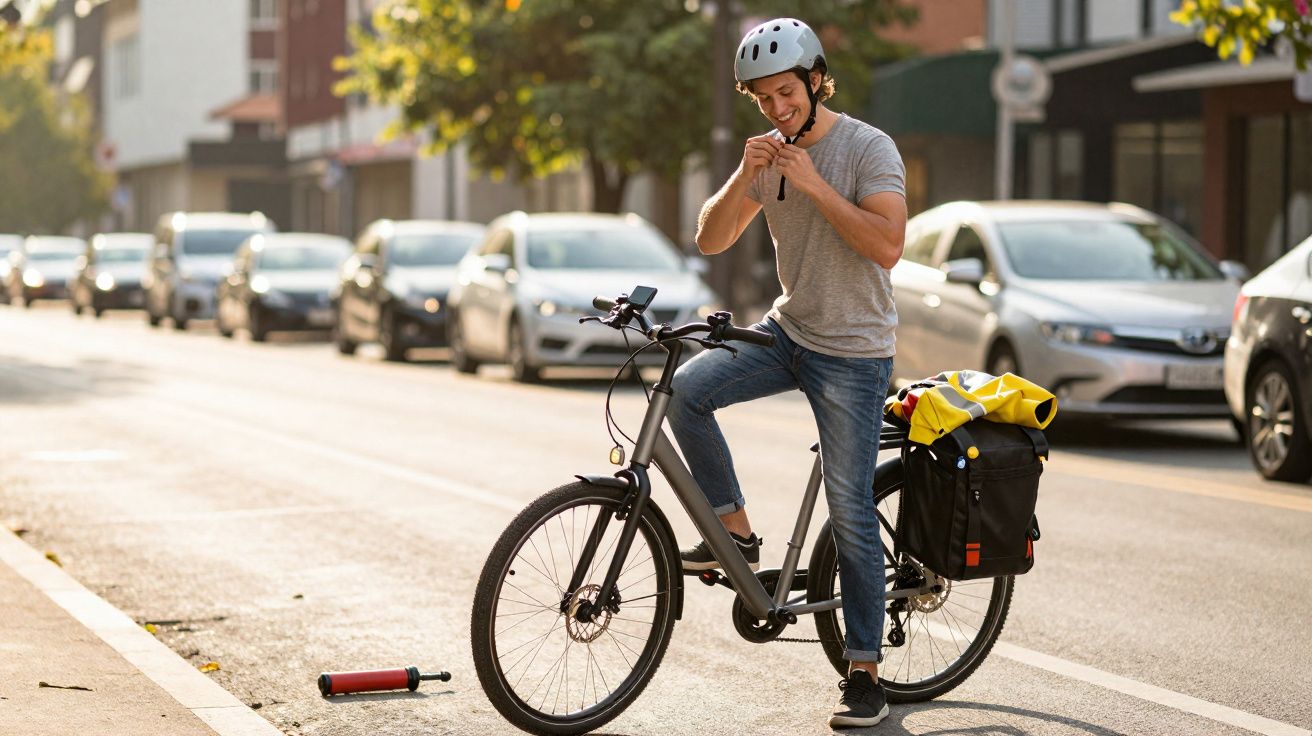
I could already see it: me slipping past the traffic, laptop in my rucksack, the city lights catching the frame as I rolled through. What never made it into that daydream was the icy rain, the saddle that got nicked, the horrible near-miss at a dim junction, or the way my hands went numb on a December commute.
In those early weeks, I treated the e-bike as the only “proper” expense and assumed everything else was basically optional. Helmet? I had an old one somewhere. Lock? I picked the cheapest one on the shelf. Lights? The built-in set-up looked adequate… right up until it wasn’t.
Three years on, I’m certain the bike was only part of what I was buying. The rest came from a slow-sometimes unpleasant-education in the accessories nobody had flagged. A few seem obvious to me now. Others still surprise me.
One of them probably kept me alive.
What I learned the hard way in my first year with an e-bike
The first thing an electric bike teaches you isn’t really speed; it’s exposure. Overnight you’re moving at 25 km/h among cars, buses, pedestrians and other cyclists, and you become acutely aware of how breakable you are next to all that metal and glass.
Yes, the motor smooths out hills-but it also nudges you into being bolder than you ought to be. You start choosing routes you’d have avoided on a normal bike: further trips, darker back roads, busier main streets. Because the ride feels easy, your brain forgets that it’s still your body paying the price if something goes wrong.
That’s exactly where accessories stop being “nice-to-haves”. They’re not gimmicks; they’re a quiet buffer between your bones and the tarmac.
One evening-around three months after buying the bike-I was heading home on a winter day that turned into night faster than expected. The integrated front light was only just strong enough to show the strip of road in front of my wheel, but it did nothing for side streets.
A car came in from the right and rolled through a stop sign. The driver didn’t register me until the last possible moment, and in truth I didn’t clock the car until its headlights washed across my handlebars. I grabbed the brakes hard enough that the rear wheel kicked out sideways. My body stopped, but my heart carried on.
We missed each other. Nobody got hurt. The driver wound his window down and said, “Sorry, I just didn’t see you.” I kept hearing that sentence the whole way home. He was right: I may as well have been invisible.
That week I bought a 1000-lumen front light, a bright rear blinker, and a reflective vest that made me feel slightly daft. The change was immediate and almost shocking. Drivers started giving me room at night. I could spot potholes and bits of glass well before I reached them. It dawned on me that I’d effectively been riding half-blind.
This is how e-bike accessories tend to show up in real life: not as fun extras, but as fixes for specific scares. A lorry squeezes past you? Suddenly mirrors and horns matter. You arrive at 8:15 a.m. with soaked jeans? Mudguards and rain trousers stop sounding optional.
We often frame electric bikes as clean, clever tech. Out on the road, though, they behave more like small vehicles. And vehicles need systems: security, visibility, carrying capacity, comfort. The motor changes how fast you move, and that quietly shifts your risk profile. Your set-up has to catch up.
Then there’s the brutal arithmetic of theft. E-bikes are pricey, heavy, and easy to shift on quickly. A flimsy cable lock is basically a “help yourself” sign on the frame. You don’t fully feel that vulnerability until you come out of a café and find an empty space where your bike used to be.
Treat your first few months with an e-bike like a live experiment. Every awkward, frightening or uncomfortable moment is information. And most of that information points towards an accessory you’ll later wish you’d bought sooner.
The accessories I’d buy on day one if I could start again
If I could rewind and begin my e-bike journey again tomorrow, the first purchase alongside the bike wouldn’t be a stylish pannier or a phone mount. It would be a proper security set-up: a solid U-lock, plus a thick chain or a folding lock to use with it.
I’d also add a small tracker tucked out of sight under the saddle or inside the frame. It sounds over-the-top until you meet the first colleague who has their e-bike stolen outside their own building in broad daylight. In any office, that kind of story spreads fast.
Second on my list would be decent lights. Not the token “included” ones that barely outperform a candle. I mean a front light powerful enough to illuminate the road properly, and a rear light with a pulsing mode that grabs attention from a distance. The first time you ride in heavy rain, you learn what “visibility” actually means.
Another turning point for me was figuring out how to carry things the right way. For months I hauled a heavy rucksack because I didn’t want to “ruin the look” of the bike with a rack. Then summer arrived. A 30-minute commute, a laptop on my back, and a shirt clinging to me like shrink wrap. I turned up at work looking like I’d done a marathon in a sauna.
Eventually I gave in and fitted a rear rack with simple panniers. Overnight, the bike shifted from “fun gadget” to genuine transport. Shopping? Easy. Work bag? Straight into the pannier. A quick stop at the bakery? Lock up, grab what I need, and ride home with my hands free.
This is what people don’t always tell you: accessories don’t only keep you safer-they expand what the bike can do. As soon as you can carry things without wrecking your back, the e-bike starts replacing car journeys, not just short walks.
The other big realisation is that comfort isn’t a luxury on an e-bike; it’s what keeps you riding after the novelty wears off. For me, that boiled down to three changes: proper gloves, a better saddle, and weather protection I actually liked enough to wear consistently.
Padded gloves turned winter commuting from an endurance test into something that could be almost calm. A slightly wider saddle-chosen with help at a proper bike shop-got rid of that background pain that quietly makes you ride less. And full-coverage mudguards? My shoes have never been more appreciative.
Let’s be honest: nobody maintains the perfect checklist and flawless routine every single day, whatever social media tries to sell. You’re tired, you’re late, and the sky looks “probably fine”. That’s precisely when the right kit saves you from your own optimism.
I still remember one ride where the forecast completely misled me. Blue skies in the morning; by late afternoon, heavy wind-driven rain. The sort of rain that feels personal. I pulled on my cheap, loud rain trousers and my hood that fits over a helmet, and while everyone else huddled under bus shelters, I simply… carried on.
Was it elegant? Not remotely. Did I get home dry, warm, and quietly pleased with myself? Absolutely. That’s the kind of low-key win that keeps you riding through an entire season, not just on the nice days.
“The gear you ‘don’t really need’ is exactly what decides whether you ride three months… or three years.”
Here’s the invisible starter pack I wish someone had handed me when I got the keys to my first e-bike:
- A serious lock setup (U-lock + secondary lock + tracker)
- Real lights (bright front, pulsing rear, plus some reflective bits)
- Full mudguards and basic rain gear you won’t hate wearing
- Rear rack + panniers to free your back and your hands
- Comfort upgrades (gloves, saddle, maybe a suspension seatpost)
The mindset shift that makes e-bikes truly replace cars
What genuinely transforms life with an e-bike isn’t only the motor-it’s the moment you begin organising your day around the bike the way you used to organise it around a car. That change doesn’t happen automatically. It arrives when you realise you can do the school run, the food shop and the commute without dreading any of them.
Accessories help trigger that mental shift. A strong lock that’s quick to use makes you far more likely to pop into a café on a whim. Panniers and a simple cargo net make last-minute grocery runs feel routine rather than like a logistics problem. A small pump and a repair kit tucked under the saddle turn a puncture into a nuisance, not a disaster.
The strange part is how fast your “life radius” grows once those pieces are in place. A mate asks if you can meet across town? You reach for your helmet without thinking, not your car keys.
You also begin to clock other e-bike riders properly: the reflective ankle straps, the battered-but-brilliant rain overtrousers, the tiny handlebar mirror that-once you try it-suddenly feels essential. There’s a quiet culture of adaptation you only notice from inside it.
On a freezing morning, you might spot someone adjusting their bar mitts at a red light, hands warm and loose. On a summer evening, another rider drops two heavy shopping bags into her panniers, clips them shut, and glides off almost silently. Without saying a word, we all understand that the technology beneath us is only half the story. The rest is the small choices that make riding not just possible, but genuinely appealing.
At a deeper level, the right kit gives you a kind of emotional safety net. You stop asking, “Is this ride going to be miserable?” and start asking, “What do I need to bring so it’s fine?” That tiny change makes it much easier to brush off excuses and actually ride.
On a screen, e-bikes are all specifications: watts, torque, battery range. On the street, they’re about trust. Trust that your bike will still be there when you come back. Trust that you’ll be visible after dark. Trust that a bit of rain or wind won’t wreck your day.
We’ve all had that thought: “If I’d just brought X, this would be so much easier.” For e-bike riders, X is rarely the motor or the battery. It’s the lock. The light. The bag. The extra layer. The little mirror that lets you spot the bus before you hear it.
The best bit is you don’t need everything on day one. You simply need to recognise that the bike itself isn’t the finish line of the purchase-it’s the starting point. Accessories aren’t an afterthought; they’re the quiet architecture of a life where two wheels and a small motor can genuinely replace a second car, or maybe even the first.
Three years in, I still find small upgrades that shift my everyday rides: a better bell, a phone mount that’s easier to use, a high-visibility cover for my rucksack. None of it is flashy. All of it makes it slightly easier to say “yes” to the bike, even when the weather app is screaming “no”.
Maybe that’s the real secret nobody told me at the start: an e-bike isn’t a one-off product you buy and forget. It’s a living set-up you quietly refine, ride after ride, until one day you realise your old habits no longer fit your life.
| Key point | Detail | Why it matters to the reader |
|---|---|---|
| Safety first | Combine a strong lock, a secondary lock and a hidden tracker | Dramatically lowers the chance of losing an expensive bike to theft |
| Be seen-properly | Powerful lights, flashing modes, reflective elements | Improves visibility at night and in heavy traffic |
| Comfort = consistency | Panniers, gloves, mudguards, rainwear and a well-fitted saddle | Turns an e-bike into reliable, year-round transport |
FAQ:
- Do I really need an expensive lock for my e-bike? Yes. E-bikes are prime targets, and a cheap lock is more decoration than defence. Think “how much hassle would I cause a thief?” rather than “is it technically locked?”.
- Are the built-in lights on e-bikes good enough? Often not. Many are made to tick a box, not to light your way in heavy rain or dark suburbs. A bright aftermarket front light and a pulsing rear light are worth every penny.
- What’s the first accessory I should buy after the helmet? For most people: a solid lock and a way to carry things (rack + pannier or a sturdy front basket). Those two alone can change how often you actually ride.
- Is rain gear really necessary for e-bike commuting? If you want to ride on more than perfect days, yes. Even a simple, breathable rain jacket, overtrousers and shoe covers can turn a potential “nope” day into a normal ride.
- How do I avoid buying useless accessories? Ride for a few weeks with a basic set-up and keep a mental note of what annoys you or scares you. Only buy accessories that solve those specific problems. Your real life is the best guide.




Comments
No comments yet. Be the first to comment!
Leave a Comment