
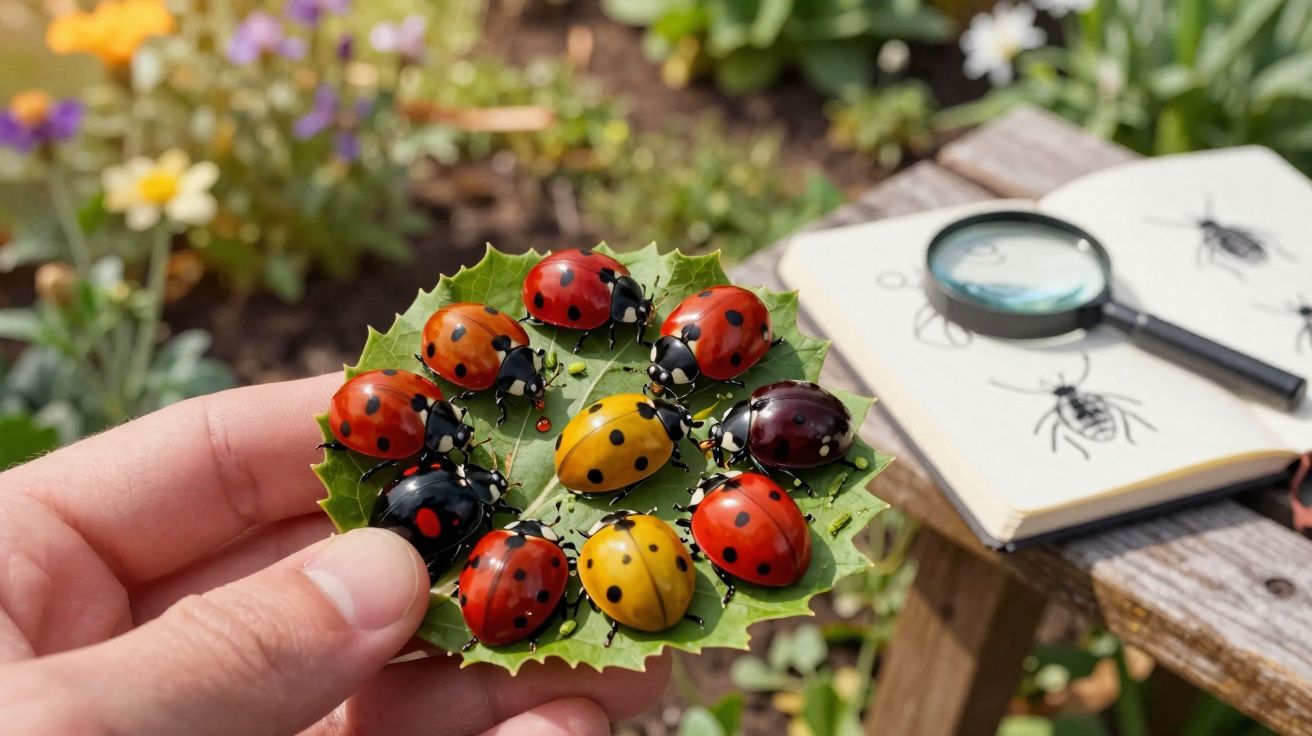
Ladybirds look like harmless nursery-room icons: round, colourful and friendly. In reality, they are highly specialised hunters, equipped with chemical defences and closely studied by scientists. Many of their tricks sound more like science fiction than a quaint beetle you spot on the balcony.
Colour spectrum: ladybirds aren’t just red with spots
The familiar image is clear: a red back with black spots. Out in the wild, the palette is far broader. Ladybirds can be yellow, orange, black, off-white or even pink. Some species carry large, sharply defined markings, while others have hardly any.
“A ladybird’s colour is more than decoration – it signals ‘keep away, I taste poisonous’.”
More than 5,000 species have been described worldwide. In Central Europe, you commonly come across, for example:
- Seven-spot ladybird: the classic red form with seven spots
- Two-spot ladybird: usually red with two spots, though black forms with red patches also occur
- Harlequin ladybird: extremely variable, from fully red with no spots to almost entirely black with lots of speckling
This bright variety is no accident. The striking colours are part of a warning system intended to deter predators. Birds and other hunters learn quickly: colourful beetle = unpleasant experience.
Chemical defence: when the beetle “bleeds”
If a ladybird is grabbed or threatened, it can resort to a surprisingly dramatic tactic. It squeezes out a yellowish droplet from its leg joints. Specialists refer to this as “reflex bleeding”.
The fluid smells unpleasant, tastes bitter and contains toxic alkaloids. Many birds spit the beetle out again after the first bite. Spiders and small mammals can also be sensitive to this chemical mix.
“The cute lucky beetle is extremely well armed chemically – those that eat it usually learn the lesson only once.”
For people, the secretion is generally harmless, but it can irritate the skin if you are very sensitive. Children therefore shouldn’t squash ladybirds for minutes on end or lick them - it happens, especially in summer gardens.
Eating machines in miniature
Despite their friendly reputation, ladybirds are ruthless predators. Their larvae, in particular, will eat whatever they can get their mouthparts on - with aphids as a clear favourite.
A single larva can consume well over 50 aphids a day. For gardeners and farmers, that is hugely valuable. Rather than spraying toxins, many operations rely on these natural pest controllers.
What ladybirds have on the menu
- Aphids
- Spider mites
- Mealybugs and scale insects
- Eggs of other insects
- in emergencies, even their own kind
Ladybirds are deliberately released, especially in greenhouses. This helps reduce the use of chemical pesticides - and, as a result, residues on fruit and vegetables.
Ladybirds on the move: surprising long-distance fliers
Some species cover distances you would never expect from such small animals. The Asian species that also turns up here can travel in swarms across many kilometres.
The trigger is falling temperatures or a shortage of food. Then thousands gather, let the wind carry them, and look for shared winter shelters - typically rock crevices and woodland, but also house walls or lofts.
“If you suddenly have a whole wall of beetles in the bedroom in autumn, you’re probably witnessing a ladybird winter community.”
Observations from North America indicate that these swarms can travel hundreds of kilometres across landscapes. For an animal that weighs scarcely more than about half a gram, that is an extraordinary feat.
A secret language made of scents
Ladybirds don’t “talk” with sounds; they communicate through chemistry. They release pheromones - scent signals that convey specific messages. These can attract mates, mark food sources or warn of danger.
Researchers are trying to decode these scent patterns in detail. The aim is to produce synthetic attractants. That would make it possible to “invite” ladybirds to particular fields or greenhouses, where they can clear pests.
Surprisingly long-lived for their size
Many insects survive only for a few weeks. Ladybirds manage far longer. On average they reach around a year, and in protected, favourable conditions they can live up to three years.
One reason is what is known as diapause. During the cold season, ladybirds sharply reduce their metabolism and remain motionless in winter quarters. This saves energy and helps them endure frost.
| Factor | Effect on lifespan |
|---|---|
| Food availability | Well-fed individuals live longer and are more resilient |
| Temperature | Mild winters increase survival chances; extreme heat weakens them |
| Hiding places | Gaps in houses, sheds or tree bark protect against predators |
From church to nursery rhyme: the ladybird myth
In many languages, there is a religious link - including in German, where “Marien”-käfer points to the Virgin Mary. As far back as the Middle Ages, farmers noticed that fields with plenty of ladybirds suffered less from pests.
“Because the beetles saved the harvest, they were seen as gifts from heaven.”
From this, countless customs grew. Children blow a ladybird from their hand and make a wish. In some regions, the number of spots is said to reveal how many good months lie ahead in the year. Scientifically that is, of course, nonsense - culturally, it shows just how firmly this small beetle is rooted in everyday belief.
When the good-luck charm eats its own relatives
As cute as they look, ladybirds can become cannibalistic. Larvae, in particular, will nibble unhatched eggs or weaker larvae when other food is scarce.
This harsh mechanism helps ensure that at least part of the population makes it through. The strongest and best-adapted individuals survive - a classic selection process in miniature.
Colour changes over a lifetime
People watching newly emerged ladybirds are often surprised: many start out pale, yellowish or brownish, with hardly any visible spots. Only after a few hours to a few days does the colour deepen and the typical pattern appear.
As they age, the beetle may darken further or fade slightly. Temperature, humidity and diet all play a part. In cooler regions, some individuals look noticeably darker - an effect that helps the body warm up.
Ladybirds in the lab: small animals, big insights
Biologists have used ladybirds as model organisms for years. They are well suited to studying predator–prey relationships, genetic colour variants and chemical defence strategies.
“Anyone who studies ladybirds also learns a great deal about biodiversity, climate impacts and sustainable agriculture.”
The invasive harlequin species, in particular, fuels debate in research. It spreads rapidly and can partially displace native species. Scientists analyse why it is so successful and how a balance could be restored.
What gardeners can do in practice
If you want to support ladybirds, you don’t need to spend much. A few straightforward steps are often enough:
- In autumn, leave some piles of leaves and leftover perennial stems - overwintering beetles hide there.
- Avoid broad-spectrum insecticides, especially in vegetable beds and on balconies.
- Plant species that attract aphids, such as roses or beans - they provide food for ladybirds.
- Put up insect hotels or leave cracks and gaps in wood and stone as refuges.
If you look closely, you’ll spot plenty of fascinating details among all those spots: larvae that resemble tiny crocodiles, pupae hanging motionless from leaves, and swarms drifting over fields on warm days. For children, it’s an ideal introduction to insects - visible with the naked eye, right on the doorstep.
At the same time, introduced species deserve a critical eye. The harlequin ladybird, for instance, is considered problematic in many areas because it displaces native species and gathers in large numbers inside homes. Experts therefore advise respecting the insects while also keeping a close watch on their populations - that, too, is part of modern nature observation.






Comments
No comments yet. Be the first to comment!
Leave a Comment