
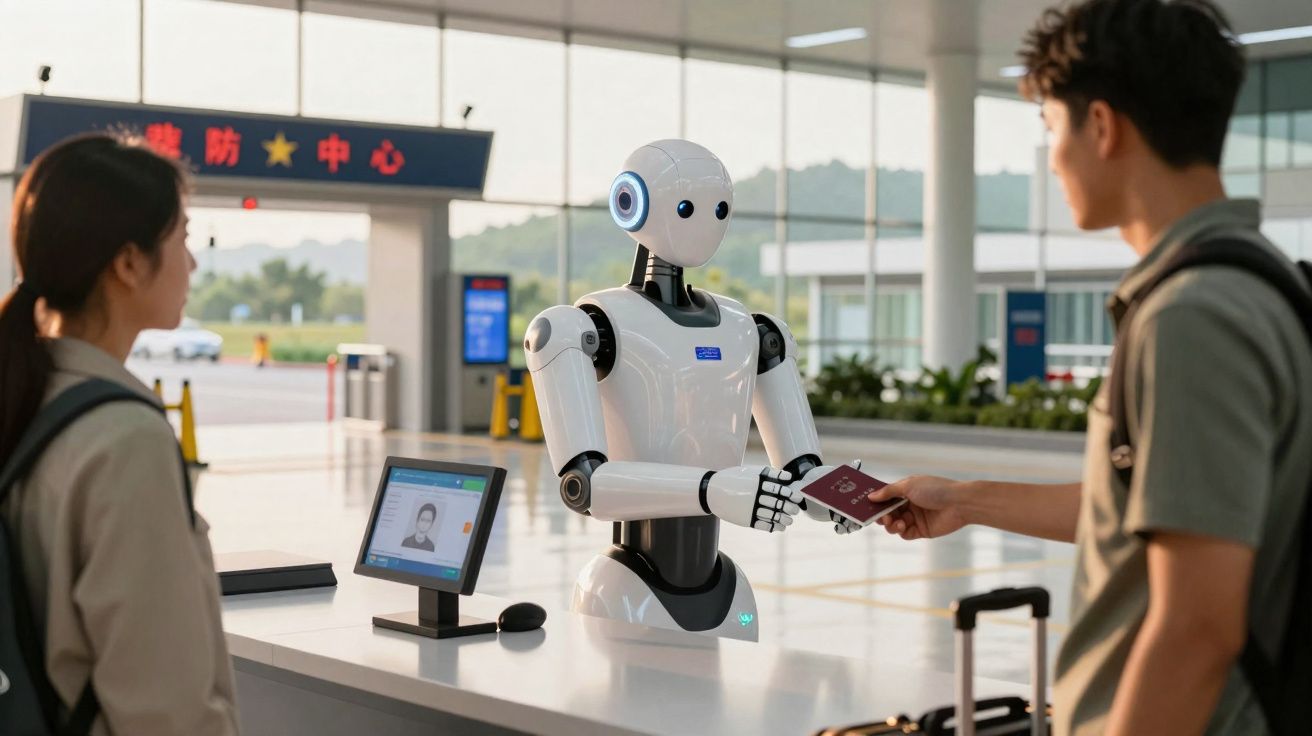
Chapo: At an unremarkable border crossing in southern China, a trial is under way that could reshape day-to-day operations at borders around the world.
In the port city of Fangchenggang on the Vietnam border, officials are currently testing something that feels lifted from science fiction: humanoid robots working alongside border guards to process lorries, coaches and travellers. What might sound like a publicity stunt is, in fact, a multi‑million‑euro pilot - and potentially an early glimpse of what the border post of the future could look like.
Why China is using humanoid robots in this particular location
Fangchenggang sits in Guangxi in southern China, only a few kilometres from Vietnam. Every day, convoys of HGVs carrying goods, tourist coaches and small traders with day visas pass through the crossing. For Chinese border officials, that translates into constant pressure: checking paperwork, answering questions, managing queues and inspecting cargo.
This is exactly where a new system is now being introduced. Authorities have ordered Walker S2 humanoid robots from the manufacturer Ubtech Robotics. The contract is worth the equivalent of around €37 million. Initial units have already arrived and are currently being trialled.
China is using a busy border crossing as a live test site to see whether humanoid robots can reliably support everyday work in public authorities.
What the new robots are doing at the border in practical terms
The Walker S2 models are roughly the height of an adult. They move on two legs, can grasp objects and use sensors, cameras and built-in AI to respond to what is happening around them. In the pilot scheme, they are primarily assigned to tasks that repeat constantly.
Typical uses in the passenger area
- Managing the flow of people: The robots direct travellers to the appropriate counters and help prevent queues merging into confusion.
- Providing guidance: They handle standard questions such as “Where is passport control?” or “Which documents do I need?” using prepared, multilingual responses.
- Repeating announcements: Instead of staff having to deliver the same message dozens of times a day, the robot issues clear instructions about documents, luggage or security checks.
- Maintaining a visible presence: Patrols through waiting halls and corridors are intended to defuse tension and intercept minor disputes early.
Some of the robots are earmarked for the freight area. There, they move through storage and inspection zones, examine containers using cameras and sensors, and report irregularities back to control centres.
How deeply the AI is involved - and where limits remain
The robots rely on a blend of image analysis, language processing and pre-programmed routines. For example, they can detect when a queue is becoming dangerously congested or when a traveller is heading into the wrong area. When that happens, they intervene - either through spoken prompts or by positioning themselves clearly in the way and indicating an alternative route.
Decisions with legal consequences - such as refusing entry, making arrests or carrying out detailed customs checks - remain the responsibility of human officers. At this stage, the robots are designed to amplify capacity rather than replace staff.
The border crossing as a stress test for Ubtech
For Ubtech Robotics, the deployment at the Vietnam border is a large-scale trial with worldwide signalling power. The company previously drew international attention with a video showing lines of humanoid robots. Now it must prove the machines do more than look impressive - they have to perform in the harsher reality of day-to-day government operations.
If the day-to-day trial works, follow-on orders could follow - not only from China, but also from airports, ports and security authorities worldwide.
The reasoning is straightforward: if travellers and lorry drivers accept the robots, and border staff genuinely feel the workload ease, other border posts - and other sectors - may adopt similar systems. If, however, the pilot phase is characterised by glitches, acceptance problems or disruptions, the programme could quickly be dismissed as an expensive prestige experiment.
How authorities will judge success
Although no precise metrics have been made public, several assessment criteria are easy to identify:
| Criterion | Expected effect |
|---|---|
| Processing time per person | Shorter waiting times at counters and checkpoints |
| Workload for officers | Fewer routine tasks, more focus on complex cases |
| Frequency of incidents | Fewer disputes about waiting times and procedures |
| Technical failures | Low susceptibility to faults despite continuous operation |
What border robots could mean for travellers
For people crossing the border, the change is hard to miss. Instead of an extra member of staff in a high‑visibility vest, there may be a white, humanoid robot politely pointing the way. That can spark curiosity - but it can also feel unsettling.
International travellers, in particular, could benefit from the technology. Systems like this can be loaded with multiple languages. A robot that speaks German, English, Vietnamese and Mandarin can reduce pressure in situations where misunderstandings at a border can quickly become sensitive.
At the same time, new obstacles appear. Not everyone feels comfortable answering personal questions to a machine. And anyone who already has a strained relationship with public authorities may react suspiciously to additional technology operating close to uniformed staff.
Limits of automation: control, ethics and an appetite for data
Humanoid robots at a border inevitably raise questions. They are equipped with cameras, microphones and sensors that could technically be used to collect large volumes of data with ease. In China, such systems fall under state control; from the outside, it is difficult to assess how extensively recorded data might be analysed.
Ethical concerns also come into play: a machine that maintains a constant presence can quickly feel like an added layer of surveillance. People adjust their behaviour, even if - in this pilot - the robot is mainly handling organisational duties.
Manufacturers and authorities point to potential security gains: a machine may be better at spotting suspicious patterns in crowd movement or cargo. Critics, however, question whether the technical advantage truly justifies possible intrusions into privacy.
What is driving the trend towards humanoid assistants in public services
The Fangchenggang trial fits a broader shift. Public bodies around the world are testing AI-supported technology in routine operations - from chatbots in tax offices to robots in police stations. Humanoid designs can offer a psychological edge: they feel more familiar than a purely screen-based machine.
At the same time, these systems are costly to procure. The €37 million contract underlines that China is willing to spend heavily in pursuit of efficiency gains. If the investment pays off, similar models could soon appear in airports, exhibition centres or major railway stations.
Terms worth knowing
- Humanoid robot: A machine whose body broadly resembles a human, with a head, torso, arms and legs.
- AI / Artificial intelligence: Software that recognises patterns, supports decisions and learns from data without being individually programmed for every scenario.
- Freight inspection: Checking containers and lorry loads for prohibited or incorrectly declared goods.
How quickly these technologies become part of everyday life depends on several factors: real-world reliability under continuous use, public acceptance and how strictly governments define data protection and deployment rules. That makes the China–Vietnam border crossing a proving ground for a development that public authorities in Europe are watching closely.






Comments
No comments yet. Be the first to comment!
Leave a Comment