
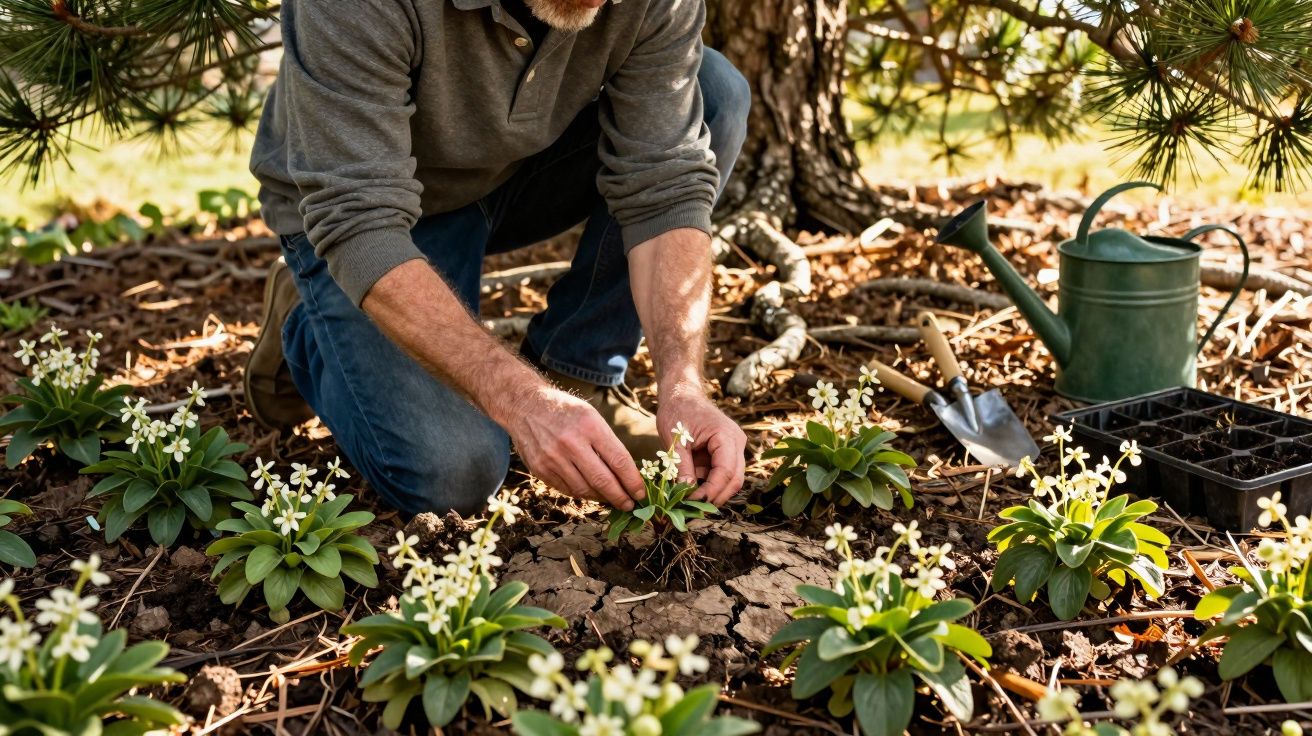
A modest-looking ground cover can work a small miracle exactly where many gardeners have already given up.
Many keen gardeners eventually throw in the towel on those “impossible corners” in the garden. Nothing seems to take, everything dries out, and every fresh attempt ends the same way. Yet the real issue is usually not a lack of skill, but exceptionally difficult growing conditions. That is precisely where a particular, often overlooked perennial shows its value: it turns dry shade into a dense green carpet without needing constant watering.
Why nothing seems to grow beneath pines and oaks
Anyone who has tried to establish turf or ordinary perennials directly under a pine, oak or dense hedge will know the scene: yellowing blades, sparse growth and soil that feels almost concrete-hard. Garden specialists call this dry shade - one of the toughest positions anywhere in the garden.
The reason is fairly straightforward: large trees work against any new planting.
- Roots absorb the water so young plants receive very little moisture.
- The canopy blocks the light - often leaving fewer than two hours of direct sun per day.
- The soil becomes compacted by root pressure and a lack of soil life.
- Leaves, needles and tannins can make it much harder for other plants to get established.
Research in tree biology and soil ecology points to another effect as well: some tree species release substances into the soil that slow down competing plants nearby. Combined with a shortage of light and water, this creates a zone where even tough perennials quickly struggle.
If you plant beneath mature trees by simply hoping for the best, you are not battling a weak gardening instinct - you are up against a highly efficient tree-based competition system.
Why popular shade plants often fail despite the promises
On paper and in photographs, they look idyllic: hostas with huge leaves, airy astilbe plumes and elegant fern fronds. All of them are sold as shade lovers. The catch is that they do not want dry shade; they prefer fresh to moist conditions and humus-rich, deep soil.
Under a broad, established tree, almost none of those requirements are met:
- The soil is densely packed with roots rather than deeply cultivated.
- Organic matter breaks down more slowly, so humus is often scarce.
- Summer dryness can dominate the root zone for months on end.
The result is familiar year after year: scorched leaves, meagre flowers and, eventually, bare ground. Many people simply abandon these areas - or use them only as a place to park pots and garden tools.
Epimedium: the quiet problem-solver for dry shade
This is exactly the niche where a perennial that often sits unnoticed on the back shelf at the garden centre truly excels: Epimedium, known in English as elf flower. It is a long-lived, clump-forming perennial that gradually forms a dense carpet.
What makes it so special?
- It copes remarkably well with root competition from large trees.
- Once established, it thrives in dry shade.
- It forms a low, dense carpet that suppresses weeds almost completely.
- It is often semi-evergreen or evergreen, or it sprouts again very early in the year.
- It flowers in spring with delicate blooms in white, yellow, pink or copper-orange.
The flowers seem to float above the foliage and bring a refined touch even to the dull base of an old tree. Through the season, many varieties also develop subtle red or bronze tones, adding extra movement and texture to the planting.
Epimedium is not a loud, showy plant. It is more like an understated specialist that succeeds exactly where the usual stars have already given up.
How to turn a problem area into a green oasis
Timing matters if you want success
Anyone hoping to establish Epimedium in dry shade should not simply plant it on a whim in June. The best time is when the soil is warm but not parched and there is some rain to help from above. The most favourable windows are:
- The first wetter weeks of autumn, once summer stress has eased.
- Alternatively, a mild spell in spring, while the soil still holds some residual moisture.
The advantage is clear: the plants can build roots in peace without needing to be watered every day. That early establishment phase is especially important in the tangled root network of mature trees.
Prepare the soil - gently
Nobody should attack the ground beneath an old tree with a spade and pickaxe. Damaging large roots harms the tree and weakens the whole system. Much gentler methods work far better:
- Loosen the top 5 to 10 centimetres with a hand fork or claw hoe.
- Avoid large structural roots deliberately and only open the spaces between them.
- Add a thin layer of leaf mould or fine leaf compost to imitate natural woodland soil.
Before planting, it is worth doing something many people overlook: place the small Epimedium pots in a bucket of water for around 15 minutes, until no more air bubbles rise. That ensures the root ball is fully soaked and does not dry out immediately in the hard, root-filled soil beneath the tree.
Plant spacing, aftercare and the route to a closed carpet
To let this ground cover perform at its best, the plants need structure and space. A proven approach is:
- Plant spacing: about 30 centimetres, staggered rather than in straight lines, so gaps close evenly.
- Water thoroughly after planting, properly and deeply - not just a quick splash.
- During the first year, bridge any longer dry spell with an extra watering session.
A light leaf mulch between young plants helps in two ways: it holds moisture and, over time, supplies nutrients. Thick bark mulch is less suitable because it can cool the soil too much and leave it impoverished.
Once established, Epimedium needs surprisingly little care. Many gardeners simply cut back the oldest, untidy leaves close to ground level at the end of winter so that the fresh shoots and flowers show to better effect.
The best companion plants for more light and colour in shade
A bed made up of Epimedium alone looks calm and cohesive, but it can also feel a little one-note. With the right companions, you can add light effects and colour accents without pushing the site beyond its limits.
Alchemilla mollis: soft yellow-green clouds
The lady’s mantle Alchemilla mollis forms rounded cushions with soft, slightly hairy leaves. Rain and dew bead beautifully on the foliage, which looks especially attractive in partial shade.
In early summer, countless yellow-green flower sprays appear and brighten gloomy corners visually. The colour acts like a natural spotlight in front of dark bark or an evergreen backdrop.
Vinca minor: a tough filler for the edge
For the transition zone towards the sunnier part of the garden, Vinca minor, or lesser periwinkle, is a useful choice. It grows lower than many ground covers, sends creeping shoots across the soil and soon creates a continuous cover.
- It copes very well with root pressure.
- It can manage poor soils.
- It flowers from spring to autumn in purple or white.
Combined with Epimedium, this creates a layered carpet: dense, low-maintenance and far more lively than a bare, cracked patch of earth.
Where there were once only needles, dust and roots, the right planting can create a kind of miniature woodland floor - stable, green and pleasing to the eye.
A practical example: from dead tree base to elegant shade planting
A classic situation: under an old pine, the lawn has been failing for years, the soil has become baked and compacted, and thick roots are partly exposed. Rather than scattering grass seed again, it is better to follow a clear plan:
- Loosen the topsoil gently and avoid the thicker root runs.
- Apply a thin layer of leaf mould or mature compost.
- Plant Epimedium in a staggered pattern at roughly 30-centimetre intervals.
- Place lady’s mantle in small groups at the edge, with lesser periwinkle as a border towards the open garden.
- Water generously, then keep topping up moisture in the first growing year during dry periods.
After just one season, the difference is usually obvious: the first joined-up patches of carpet, more green and far less dust. By the second year, the area looks much more cohesive. The spring flowers of the elf flower add soft colour accents, and the whole space begins to resemble a naturally formed woodland edge rather than a trouble spot.
Useful tips for long-term success in dry shade
Anyone redesigning these areas needs patience. Ground covers such as Epimedium are more marathon runners than sprinters - but they reward you with lasting results.
| Aspect | Recommendation |
|---|---|
| Feeding | A little leaf compost once a year is usually enough; heavy mineral fertilisers are not needed. |
| Watering | Water intensively in the planting year, then only during exceptional dry spells. |
| Leaf fall from above | Some of it can be left in place; remove excessively thick layers in late winter if needed. |
| Spread | Epimedium expands at a moderate pace and can be renewed and multiplied easily by division. |
A useful side effect is that greening the base of trees with robust perennials and ground cover also helps protect roots from drying out and reduces soil erosion. The microclimate improves, the soil stays looser, and the tree itself benefits over the long term.
For many gardens, choosing elf flower marks a subtle change in strategy: away from short-lived pot displays and towards plants that are suited to the site and reliable year after year. That is what eventually turns apparently hopeless shady corners into some of the most interesting parts of the whole garden.



Comments
No comments yet. Be the first to comment!
Leave a Comment