
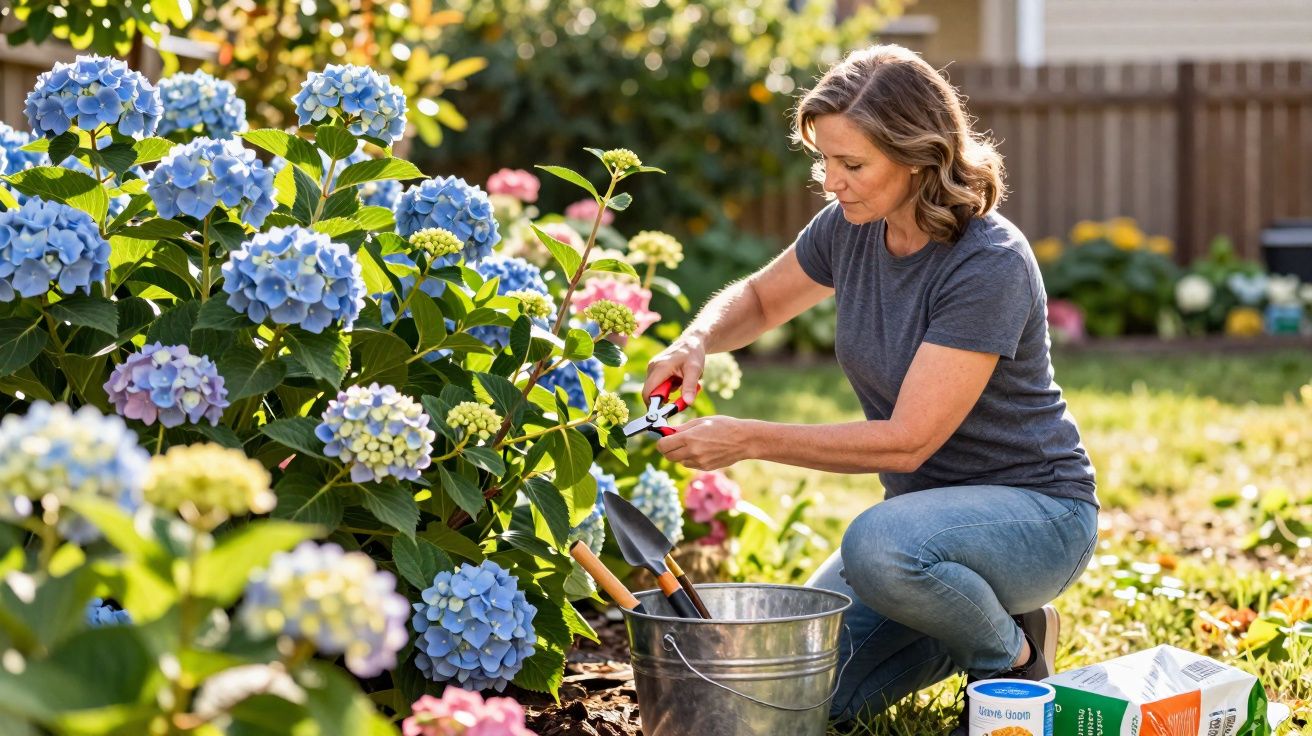
If you give hydrangeas a little thought in late winter, the reward can last all season. The timing and method of pruning decide whether vivid, rounded flower heads appear throughout the summer - not just once, but year after year.
The right time in spring for hydrangea pruning
The best window runs from the end of winter to the very start of spring, usually from late February to early March. By then, the harshest frosts are over, the buds are swelling, but they have not yet opened. At this stage, it is easy to assess the shoots without putting fresh flower buds at risk. Autumn is a poor choice, because new growth would be left exposed and could be cut back by frost.
Between late February and early March, the decision is made: prune according to the type now, and you set up generous flowering for many years.
What hydrangeas bloom on: old wood or new wood
Hydrangeas are not all pruned in the same way. Some varieties produce their flowers on wood formed the previous year, while others set buds only on fresh shoots.
- Flowering on last year’s wood: Hydrangea macrophylla (bigleaf hydrangea), serrata, quercifolia (oakleaf hydrangea), and climbing hydrangeas.
- Flowering on this year’s shoots: Hydrangea paniculata (panicle hydrangea) and Hydrangea arborescens, including the well-known garden cultivar ‘Annabelle’.
This distinction is the key point. If you cut too hard on varieties that bloom on old wood, you remove the entire display for that year. By contrast, plants that flower on new growth can be pruned much more firmly.
A simple way to identify an unfamiliar shrub is to watch where the first buds appear after winter and to remember which stems carried flowers last season. Keeping a small garden note each year can make pruning decisions much easier the following spring.
Three simple pruning moves for years of flowers
Hydrangeas that bloom on old wood
For bigleaf, plate and oakleaf hydrangeas, the rule is to be gentle.
- Remove only the old flower heads, cutting back to just above the first strong pair of buds.
- Take out weak, dried-out or dead shoots completely.
- Once a year, remove one to three very old basal shoots close to the ground to renew the shrub.
This keeps the plant’s natural shape intact and protects the buds that were formed the previous year.
How to cut back panicle hydrangeas and ‘Annabelle’
Panicle hydrangeas can be pruned more strongly. Shorten the shoots by around one third to one half, always cutting just above an outward-facing pair of buds. This encourages a sturdy framework and good air circulation. ‘Annabelle’ can even be cut down to about 20 cm above the ground. Fewer buds left behind usually mean fewer flower heads, but the individual blooms become much larger.
| Group | Flowering wood | Pruning severity | Aim |
|---|---|---|---|
| Bigleaf, plate, oakleaf hydrangeas, climbing hydrangeas | Last year’s wood | Light, just deadhead and thin out | Protect buds and keep the shape |
| Panicle hydrangeas (H. paniculata) | New growth | Moderate, by one third to one half | A stable, well-branched framework |
| H. arborescens (‘Annabelle’) | New growth | Hard, to about 20 cm | Large, striking flower heads |
Care after pruning: soil, water and protection
Once the pruning is done, attention turns to the root zone. A few minutes now can pay off for years.
- Clear away leaves and any diseased plant material thoroughly so fungal spores do not get an early advantage.
- Apply a layer of well-rotted compost or a specialist hydrangea feed, then lightly work it in.
- Mulch with bark chips or shredded leaves so the soil stays moist for longer.
- Water deeply and thoroughly if conditions have been dry, especially for young plants and container-grown specimens.
- Keep an eye on late frosts: if freezing temperatures are forecast, cover the plant in the evening with garden fleece or a light bucket, then uncover it again in the morning.
- Remove black, cracked or damaged shoots immediately, cutting back to healthy wood.
Careful pruning, a modest supply of nutrients and protection from late frost - that combination keeps hydrangeas flowering reliably.
Hydrangea site, feeding and colour tricks
Hydrangeas prefer semi-shaded positions with morning or evening sun and a spot sheltered from strong winds. In full midday sun, leaves and buds suffer; in persistently dark places, flowering tends to be sparse. The soil should be rich in humus, evenly moist and slightly acidic.
Anyone wanting to influence the flower colour of bigleaf hydrangeas should pay attention to pH. Pink varieties can turn bluer in more acidic soil if enough aluminium is available. That can be encouraged with rhododendron compost, a moderate amount of acidic mulch material, or alum products from the garden centre. Hard water with a high lime content can lead to chlorosis: yellow leaves with green veins. In that case, rainwater is the best solution, and an iron supplement can help if needed.
When it comes to feeding, the key is balance. Never overdo it. Too much nitrogen drives leaf growth but slows flowering. A hydrangea or rhododendron feed with a stronger potassium content helps strengthen tissues and buds. Feed in spring, then give a second, lighter application by June at the latest, and stop after that so the shoots can ripen properly.
Typical mistakes and emergency tips
The most common mistake is a severe cut-back on varieties that bloom on old wood. If flowering fails after such a setback, patience is the only remedy. The following year, go back to removing only the old flower heads and take out just a few mature shoots near the base each season.
Late frost can damage swollen buds. Brown, glassy tips should simply be cut back to healthy green tissue. In hard frosts, a quick cover made from fleece, cardboard or fir branches is worthwhile. Container-grown hydrangeas are best kept near a house wall during cold spells.
There are also reblooming types such as Endless Summer, which flower on both last year’s and this year’s wood. These varieties tolerate heavier pruning more readily and can form new buds again in summer. If you are unsure about a plant, watch it for one season: where do the first buds appear, and from which wood do the strongest flowers develop?
Practical details for neat work
A sharp, clean pair of secateurs is essential. Always cut just above a bud, and do so at a slight angle so rainwater can run off. Disinfect tools before starting and when moving between plants to prevent disease from spreading. Work on frost-free days and, whenever possible, on dry wood so the cuts heal more quickly.
Heavy flower heads may also benefit from discreet support. ‘Annabelle’, in particular, often flops after summer thunderstorms. Three or four unobtrusive perennial rings or bamboo canes, put in early in the year, will hold the shoots upright without spoiling the look of the plant.
When to water and how much
Hydrangeas are called water-thirsty plants for good reason. Their soil should never dry out completely. It is better to water deeply and less often than to give small amounts all the time. A mulch layer reduces evaporation, while in pots a larger container with water retention helps. Morning watering is ideal because it allows the leaves to dry during the day.
Keeping an eye on diseases and pests
Aphids and spider mites usually appear when plants are under drought stress. A sharp jet of water or a soap-based treatment that is gentle on beneficial insects can deal with them quickly. Fungal spots are reduced by a more open canopy and careful removal of fallen leaves. Yellowing leaves often point to lime stress, in which case rainwater is the simplest adjustment.
If you follow these points, you give hydrangeas everything they need: the correct spring timing, a cut suited to the variety, and proper aftercare at the roots. The shrub stays vigorous, the flowering remains abundant, and the summer garden becomes more colourful every year.



Comments
No comments yet. Be the first to comment!
Leave a Comment