
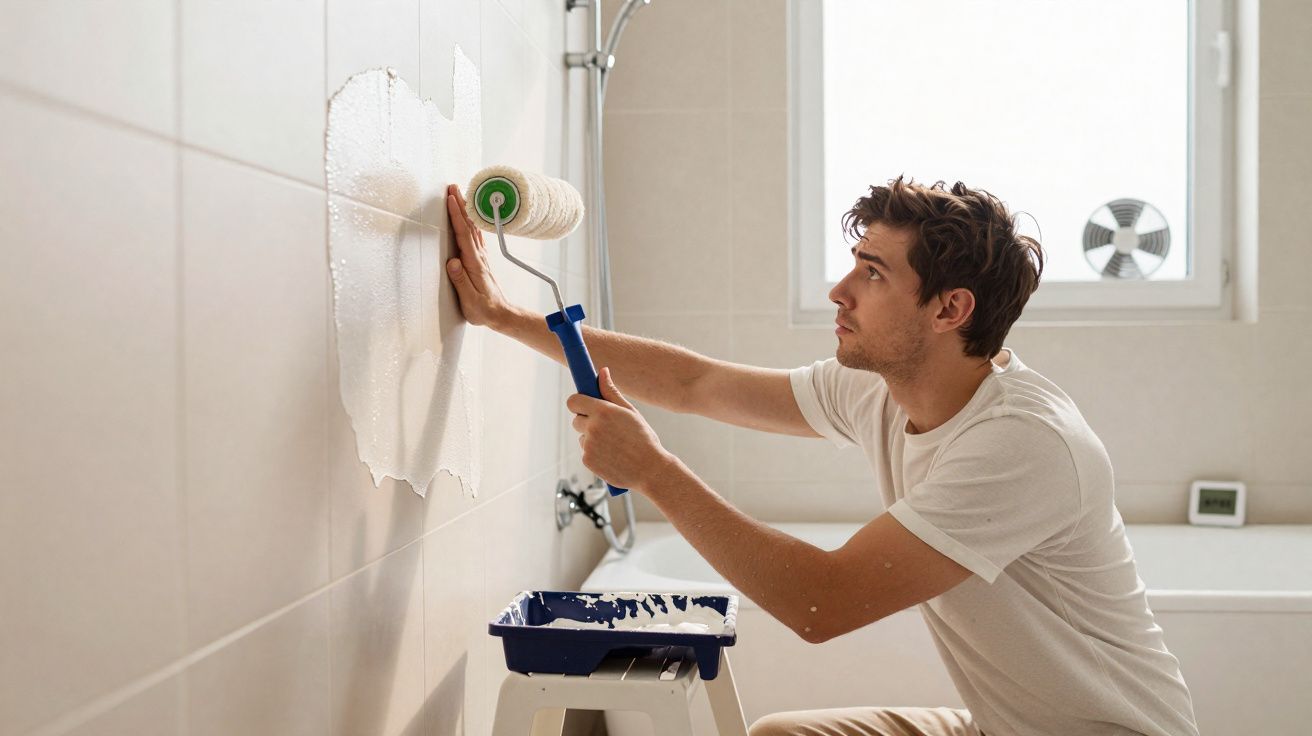
Spring brings fresh colour and a wave of optimism - yet a year later, the dream of a flawless bathroom renovation can quite literally fall apart.
Many DIY enthusiasts grab a paint roller, cover the bathroom in one go and are delighted at first. Smooth surfaces, rich colour, everything looks brand new. But in moisture-prone rooms, that kind of rushed job often comes back to haunt you much later - sometimes only after six, twelve or eighteen months. Only then does it become clear whether the choice of paint, preparation and technique was genuinely sound, or merely looked the part.
From pride after painting to an embarrassing problem area
Why a freshly painted bathroom looks perfect at first
Straight after painting, everything seems fine. The roller glides across the wall, stains disappear and the finish looks uniform. In small bathrooms especially, the transformation is dramatic: brighter, cleaner, bigger. If you also managed to buy the paint during a special offer at a DIY store, you may even feel doubly clever.
That is exactly where the real trap lies. Many people reach for any ordinary interior wall paint, often one intended specifically for “living spaces” or “dry areas”. The tin rarely carries a prominent warning such as “not suitable for bathrooms”, so it ends up on the walls and ceiling of the bathroom anyway. The first few weeks pass and everything stays put. That confirms the initial sense of success: “It worked brilliantly - why buy expensive specialist paint?”
The problem in the bathroom rarely appears immediately - the real damage is quietly being prepared with every shower.
When the first bubbles appear: the typical timeline
Between the sixth and the eighteenth month, the façade starts to fail. Small blisters appear first, usually on the ceiling or on the wall opposite the shower. Over time, these turn into proper bulges that you can spot even while standing at the sink and brushing your teeth.
These areas have one thing in common: they receive the most moisture. In a small bathroom with poor ventilation, humidity levels above 80 per cent after a shower are not unusual. Ordinary interior paint is simply not designed for that. It absorbs moisture, loses its grip and then peels away from the wall or ceiling in larger flakes.
What is really behind the peeling
How water vapour bursts the paint from within
Every shower creates a dense cloud of warm water vapour. That moist air does not just settle on mirrors and tiles - it works its way into every tiny gap. Once moisture gets behind the paint film, a physical process begins that is difficult to stop.
- Water vapour passes through the paint layer or tiny hairline cracks.
- The substrate absorbs moisture and swells slightly.
- The paint layer detaches from the surface, creating voids.
- More moisture collects in those voids.
- Visible blisters form and eventually burst or flake off.
If you then scratch at a blister, you often pull away entire strips of paint. Beneath it, a patchy surface appears, sometimes even slightly softened plaster or plasterboard. At that point, “touching up” is no longer enough - the whole area has to be rebuilt properly.
Moisture-resistant bathroom paint: what the professionals look for
Professionals rarely use just any interior paint in a bathroom. They look for labels indicating that a product is approved for humid rooms or wet areas. Across many European markets, EN 13300 is used as a reference point. What matters most is that the paint offers very high resistance to moisture and abrasion.
For DIY users, that means choosing a clearly specified moisture-resistant paint or a special waterproof latex or lacquer-based coating. Modern acrylic paints designed explicitly for bathrooms and kitchens also work well. They contain resins and binders that can resist water vapour much more effectively.
Using a general-purpose interior paint in a bathroom is setting a time bomb - the question is not whether it will fail, but when.
How to rescue a damaged bathroom for the long term
The essential rebuild in several stages
If blisters and flaking have already appeared, there is no avoiding a thorough refurbishment. Half-measures will only buy a few months of peace. A solid repair plan usually looks like this:
- Scrape off or sand away all loose paint completely.
- Allow the surface to dry out, if necessary over several days.
- Fill and smooth any damaged areas.
- Apply a moisture-blocking adhesion primer.
- Finish with two coats of suitable moisture-resistant bathroom paint in a crosswise application.
The primer plays a crucial role here. It penetrates the substrate, strengthens it and reduces its absorbency. At the same time, it forms a kind of buffer between the wall and the final paint layer, making it much harder for moisture to seep in.
A careful check of the underlying surface is just as important. If there is mould, salt deposits, persistent damp or cracked filler beneath the paint, the new coating will only fail again. In problem bathrooms, it is worth using a moisture meter before repainting, especially on external walls, around window reveals and near shower enclosures.
Proper ventilation and dehumidifying: no technology, no chance
Even the best bathroom paint will not last forever if the air remains too humid. If you are careless with ventilation - or have no ventilation system at all - you are creating ideal conditions for mould and peeling paint.
The ideal solution is controlled ventilation that automatically removes used, moist air. In many flats, this is handled by an electric fan that runs with the light switch or continues for a short period after the light is turned off. As a rough guide, an average bathroom should be able to exchange around 30 cubic metres of air per hour. The target is for humidity to drop back well below 65 per cent after showering.
| Problem | Typical cause | Sensible fix |
|---|---|---|
| Bubbles forming on the ceiling | ordinary interior paint, poor ventilation | moisture-resistant paint, retrofit an extractor fan |
| Paint peeling on the shower wall | no primer, direct splash zone | adhesion primer, partial tiling if needed, specialist coating |
| Grey patches in corners | persistent damp, condensation | ventilate, heat the room, check for cold bridges |
The golden rule when painting a bathroom
Two coats, crosswise application and patience
Anyone who wants to protect a bathroom properly has to ask more of the roller than just a quick once-over. The classic professional approach is two full coats applied crosswise - in other words, the first coat more vertically, the second more horizontally. There should be at least a full day of drying time between coats.
That pause may feel tedious, but it pays off. During that time, the paint can fully cure and form a stable, as closed as possible surface. If you paint over it too soon, you smear the film, trap residual moisture and weaken the entire coating structure.
How to avoid mistakes before the roller even comes out
The most important step happens before you buy anything in the DIY store or online. Spending a few minutes choosing the right product prevents most future problems on the wall:
- Use only products explicitly approved for bathrooms, kitchens or humid rooms.
- Pay attention to information on abrasion class and moisture resistance.
- In splash zones directly around the shower or bathtub, use tiles, special coatings or particularly robust systems instead.
- Before painting, check for draughts, cold bridges or persistently damp corners.
Practical tips for long-lasting walls in moist rooms
What many people underestimate: daily habits matter more than the product
Even with perfect paint, a bathroom can be ruined if the daily routine is wrong. If you simply shut the door after showering, do not use an extractor fan and leave wet towels hanging in the room, you create a tropical climate. Under those conditions, the paint has little chance of staying intact for long.
Useful everyday habits:
- After showering, ventilate strongly for at least ten minutes or let the extractor fan run on.
- Do not dry wet towels in a closed bathroom.
- Leave the door slightly open so moisture can escape the room.
- In very small bathrooms without windows, use a hygrometer regularly to keep an eye on humidity.
Anyone who has already had to redo an apparently successful bathroom renovation because of bubbling and flaking will no longer dismiss these details as minor. In the end, this is not just about appearance, but also about protecting the building fabric. Damp walls can develop mould over time, soften plasterboard and, in the worst cases, even attack structural components.
A modern bathroom also benefits from a sensible combination of materials. Tiles, sealed joints, moisture-resistant plaster and the right paint system work together far better than any single product on its own. If one element is neglected, the whole surface system becomes vulnerable.
Especially in spring, it is worth taking a critical look up at the ceiling and into the corners of your bathroom. Small blisters, dull patches or fine hairline cracks are often the first signs of bigger damage. If you respond in time with suitable paint, primer and better ventilation, you can avoid a full strip-out later - and approach the next change of colour with a much calmer conscience.

Comments
No comments yet. Be the first to comment!
Leave a Comment