
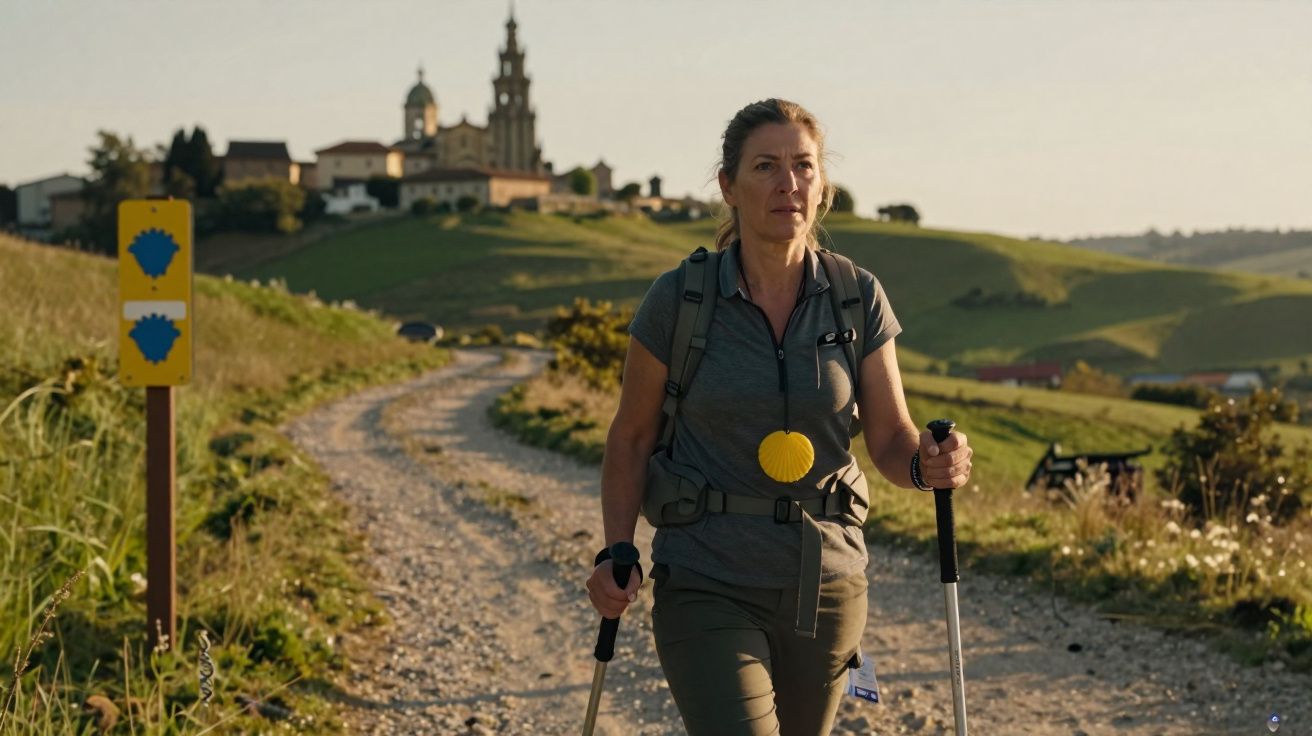
Helen Newton is walking 300 kilometres from Porto to Santiago de Compostela. The British fundraiser says she was inspired, looking out over the Portuguese sea, to take on a journey that combines fundraising with public awareness for a rare genetic mutation so little known it still has no proper name.
Helen Newton’s 300-kilometre Camino from Porto to Santiago de Compostela
Helen set off on 1 May from Porto, turning an idea into a challenge that first took shape in August last year at the SLC6A1 Symposium. SLC6A1 is a rare genetic mutation that disrupts the correct transport of the brain’s main inhibitory neurotransmitter, leading to a complex neurodevelopmental disorder. "If each person raises one thousand pounds, we can move forward with much more research," she said.
Her motivation is personal. "We knew from the age of two that my son was autistic. He had developmental delay, he didn’t speak, he didn’t walk. He started having seizures every day and that has continued throughout his life, to this day," Helen recalled. Multiple conditions in one body, across one lifetime.
About two years ago, a diagnosis finally brought the different signs together into one explanation-something Mathew’s parents had long suspected. "We always said there had to be something connecting everything, a common cause. When we did more in-depth genetic tests, they told us he had SLC6A1," Helen added.
Helen has divided the 300 kilometres into 15 stages, using the Camino to keep attention on SLC6A1 and to encourage donations.
Fundraising and raising awareness on the Coastal Route
She is taking on the challenge roughly a year after knee surgery. "Children with SLC6A1 fight every day with autism, epilepsy, communication problems and movement disorders. If they can face all that every day, then I also have to push myself," she argued.
"I’m not someone who likes walking, I don’t usually do much exercise, so I’m stepping out of my comfort zone," Helen said. She is following the Coastal Route of the Camino de Santiago with a dual aim: to raise money by handing out business cards with a QR code that links to a GoFundMe donation page open to everyone, and to draw attention to an illness that remains almost unknown.
Many cases may be going undiagnosed
Because it has only been identified in recent years, it not only lacks a commonly used name, it is known mainly by an abbreviation-one that could be masking hundreds or even thousands of cases. That is why, for Helen, putting SLC6A1 in front of as many people as possible matters.
"And also in the doctor’s awareness. If they read about it, they might remember to test children with the same symptoms." She stresses that testing is straightforward. "It’s a blood test. Because they already know which gene to look for, the process is relatively quick," she explained, noting that in the UK and elsewhere children are being tested earlier and earlier.
"At the Symposium, there was a Nordic family with a small child with this condition. That happens because tests are done much earlier and, in that way, they can start treatments and therapies earlier," Helen added.
Walking with Mathew’s former PE teacher, Jane
Helen is not walking alone: she is accompanied by Jane, Mathew’s former physical education teacher. The two had not seen each other since 2018, separated by Jane’s retirement and the end of Mathew’s time in school. They ran into each other by chance in a shopping centre, and their conversation turned into a plan.
"I readily agreed to do the Camino," Jane said, describing a former pupil she has never really lost sight of. "I’ve seen him a few times since then, because he plays tennis in the park near my house. He does a lot of activities, he’s very active," the teacher added.
"Jane was the person who got my son skiing, as his PE teacher at school," Helen emphasised. A school ski trip to Italy in 2008 was the first of 10 that followed, on a path that eventually took Mathew to the Paralympic Games.
"I think he has done an extraordinary job to keep going with everything and I’m very proud of his skiing, because I had an influence in that, as did the family, and other families with children with special needs. He has a great life. He’s doing really well. I think he has the best life possible, given his condition," Jane said.
The oldest patient offers hope to younger parents
Mathew’s progress has become a source of reassurance to other parents who worry about what lies ahead for their young children. "He also didn’t speak as a child and now he talks. He even talks too much sometimes," Helen said.
Like many children with this condition, he also could not walk at first. "Now he can walk relatively well. However, he still has seizures every day, so he has 24-hour care," she added.
Mathew lives in his own flat with carers. He has a job and works, but on a zero-hours contract-one week he might do eight hours, another week none at all. "He would like to work more. He likes skiing, he’s very good at skiing. He likes sport, but he always needs someone with him," Helen explained.
She also acknowledges that the support available through the National Health Service (NHS) is not found in many countries. "Otherwise he would have to go into an institution. And we didn’t want him to go into a home. He’s a young man, 31, who wants to be active and do things, but he needs support to be able to do it," she said.






Comments
No comments yet. Be the first to comment!
Leave a Comment