
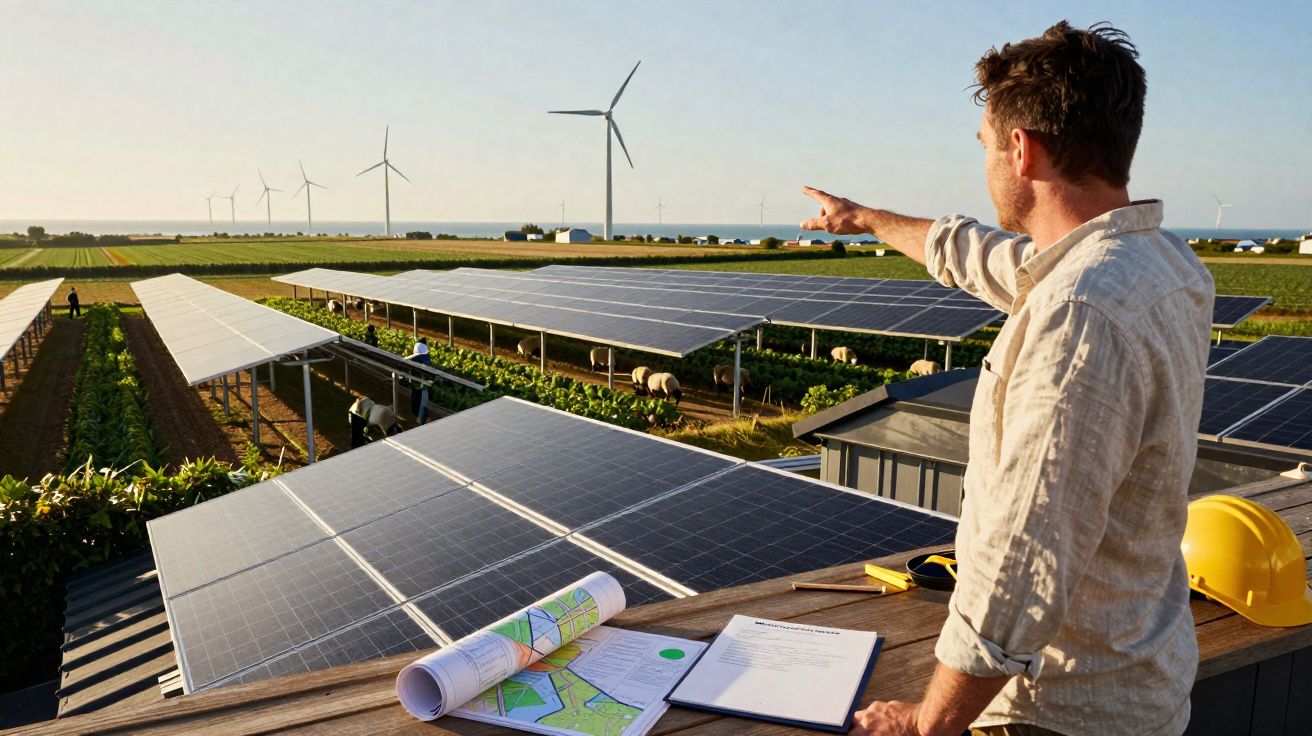
By 2035, France’s skyline and coastlines could look markedly different, as solar panels and wind turbines steadily rework the electricity system.
In meeting rooms in Paris and Brussels, energy strategists are updating plans, adjusting regulations and accelerating tenders as France gears up for a decisive move away from its decades-long dependence on nuclear as the sole centrepiece.
France gets serious about a renewable growth sprint
Fresh forecasts from consultancy GlobalData indicate that France’s installed renewable power capacity may rise from 59.1 GW in 2024 to 163.1 GW in 2035. In practical terms, that is close to a threefold increase in just eleven years, implying average annual growth of almost 10 percent.
By 2035, nearly three‑quarters of France’s installed electricity capacity could come from renewable sources, led by solar and wind.
This transition is not expected to remove nuclear from the mix. Instead, nuclear is set to be repositioned as the system’s backbone, while renewables take on much of the additional demand, the need for flexibility and the climate obligations embedded in EU legislation.
Solar takes the lead in France’s new power mix
The most visible change is likely to appear on roofs, across open land and above car parks. French solar capacity is projected to climb from 30.5 GW in 2024 to about 111.2 GW in 2035. If realised, that expansion would make solar the largest single source of newly added power capacity in France.
From rooftops to agrivoltaics: how solar scales up
Government backing underpins most of the build-out. Policy now encourages photovoltaic growth along three main tracks:
- Utility-scale solar parks, particularly in the south and south-west
- Canopy installations over car parks and distribution or logistics sites
- Agrivoltaics and rooftop self-consumption for farms, homes and warehouses
Agrivoltaics-systems that combine panels with crops or grazing on the same land-are central to the strategy. They provide farmers with an extra revenue stream and can help shelter vulnerable crops from heat and hail. As temperatures rise, that blend of electricity generation and climate resilience is appealing to both landowners and decision-makers.
Large car-park canopies at hypermarkets, stadiums and commercial zones also deliver rapid gains. These locations are typically already grid-connected, reduce land-use conflicts and often support local aims around air quality and reducing urban heat.
Solar would leap from a secondary player behind nuclear and hydro to a central pillar of French power, reshaping how and where electricity is produced.
Wind power: steady gains on land, a leap at sea
Even as solar accelerates, wind power continues to cement its role in France’s system. Onshore wind is expected to increase more gradually, from 22.9 GW today to around 36 GW in 2035, while offshore wind accounts for the largest proportional rise.
Onshore wind: repowering beats greenfield megaprojects
Brand-new onshore wind projects still encounter strong local resistance, ranging from concerns over landscape impacts to biodiversity disputes and issues linked to military radar. Consenting remains slow, and in several areas the best windy sites are already heavily developed.
Consequently, a significant share of future progress is expected to come from “repowering” existing sites. In practice, developers remove older, smaller turbines and install fewer, higher-output machines. This delivers more generation from the same-or even a reduced-footprint and can be simpler to agree with communities already living near wind farms.
Areas including Hauts‑de‑France, Grand Est and Occitanie remain important to this effort, supported by reliable wind resources and established grid links, even though local opposition continues to influence design choices and delivery schedules.
Offshore wind: Brittany and Normandy head out to sea
Offshore wind is set for the most dramatic expansion. From a modest 1.5 GW today, installed capacity could reach roughly 10.7 GW by 2035 as large projects come online along Atlantic and Channel coastlines.
To support this build-out, the French state is relying on contracts for difference (CfDs) to provide offshore developers with revenue stability. By locking in a strike price, CfDs reduce exposure to wholesale price volatility and help make long-life assets financeable.
Key zones off Brittany and Normandy are expected to underpin the programme, combining consistent maritime winds with deep-water ports and an increasingly capable domestic supply chain for foundations, cables and substations.
Floating offshore wind, still in its early phase, could follow fixed‑bottom projects and open deeper waters to turbines in the 2030s.
Nuclear holds steady while the grid transforms
A largely stable nuclear fleet
GlobalData anticipates only a small increase in French nuclear capacity, from 61.4 GW in 2024 to around 63 GW in 2035. That is marginal change, reflecting life-extension and replacement rather than a major new build wave.
The Grand Carénage programme, initiated ten years ago, is designed to extend many operating reactors towards 50 or even 60 years, subject to safety approvals. Alongside this, France has pledged to construct six new EPR2 reactors, although the schedule remains uncertain given previous delays and cost overruns in the nuclear industry.
Because of nuclear’s high capacity factor, it is still likely to dominate actual electricity output. However, as solar and wind capacity expands nationwide, nuclear’s share of installed capacity is expected to decline.
From single‑pillar to multi‑pillar system
Historically, France has depended on a single primary pillar: nuclear. The system now taking shape resembles a three-legged structure. Nuclear provides baseload and stability, renewables supply low-cost low-carbon kilowatt-hours, and flexible resources (storage, demand response, interconnectors and hydropower) manage peaks and weather-driven variation.
Rather than choosing between nuclear and renewables, France is trying to orchestrate both technologies in one wider, more flexible power system.
A clearer strategy, but stubborn bottlenecks
Policy alignment narrows the investment gap
France’s updated National Energy and Climate Plan (NECP 2024), together with revised multi-year energy programming, offers investors a more legible pathway. Support schemes are moving away from fixed feed-in tariffs towards competitive auctions using CfDs, aligning more closely with approaches already used in Germany, the UK and Spain.
A €7 billion hydrogen plan is intended to back electrolysers supplied by low-carbon electricity, while grid operator RTE is investing substantially in high-voltage lines, digital control systems and interconnectors. The objective is to bring more variable renewables onto the system without undermining security of supply.
Permits, lawsuits and curtailment slow the rollout
Even so, entrenched constraints persist. Consenting continues to take too long, particularly for onshore wind, where schemes can spend years tied up in court due to local objections or environmental challenges.
Grid connections are also behind schedule in several high-activity areas such as Occitanie and Nouvelle‑Aquitaine. In these regions, solar parks and wind farms frequently wait on substation reinforcement or new transmission lines. Where generation growth outstrips network capacity, operators are forced to curtail output-wasting available wind and sunlight because the grid cannot carry it away.
Rising curtailment signals a paradox: renewable projects move faster than the cables and substations meant to carry their electricity.
How France compares with its European neighbours
France aims to rank among Europe’s strongest performers in renewables, but the field is crowded. A number of EU member states began their transitions earlier and have advanced at a quicker pace.
Projected renewable capacity in 2035 (selected countries)
| Country | Renewables in 2024 (GW) | Renewables in 2035 (GW) | Main sources |
|---|---|---|---|
| France | 59.1 | 163.1 | Solar, wind, hydro |
| Germany | 147 | 215 | Solar, onshore wind |
| Spain | 73 | 160 | Solar, wind, storage |
| Italy | 63 | 130 | Solar, wind, bioenergy |
| Netherlands | 37 | 70 | Offshore wind, solar |
| Denmark | 12 | 35 | Onshore and offshore wind |
Germany remains ahead in total installed capacity and is planning sizeable additions in both solar and onshore wind. Spain is progressing rapidly, particularly with utility-scale solar linked to battery storage. The Netherlands and Denmark, although smaller markets, punch above their weight offshore, supported by strong maritime industries and broad acceptance of turbines at sea.
France’s approach is distinctive: build on its nuclear legacy while accelerating wind and solar and continuing to use hydropower as a stabilising asset. If the projections are accurate, France shifts from mid-table to the leading group on total renewable capacity, even if it does not necessarily take the top spot.
What this means for bills, jobs and industry
Impacts on consumers and local economies
A higher share of renewables changes more than the generation mix-it also changes who captures the value. Families and firms that install rooftop solar or participate in energy communities can reduce exposure to volatile market pricing. Farmers who host agrivoltaic schemes gain an additional income source that can help smooth finances in years with weak yields.
Regionally, ports such as Le Havre, Saint‑Nazaire and Brest are positioning themselves to secure offshore wind manufacturing, assembly and maintenance work. That could translate into new industrial employment, training initiatives and opportunities to repurpose former fossil-fuel sites around low-carbon technologies.
Risks and open questions
This pace of expansion is not without hazards. Supply chains for turbines, panels, transformers and grid components remain constrained, and heavy dependence on imports from Asia leaves Europe vulnerable to trade frictions. Resistance to large developments could also intensify if communities feel shut out of decisions or see little financial upside.
Managing such a high proportion of variable wind and solar will demand more storage, more sophisticated demand response and stronger interconnectors with neighbours such as Spain, Germany and the UK. Upgrades to hydropower and the deployment of flexible biogas plants can contribute, but they will not eliminate the need for additional balancing solutions.
For now, the projections point to a real reconfiguration of France’s energy landscape. The coming decade will test whether policy changes, nuclear life-extension and rapid renewable deployment can arrive on schedule, without overloading the grid or provoking a political backlash.




Comments
No comments yet. Be the first to comment!
Leave a Comment