
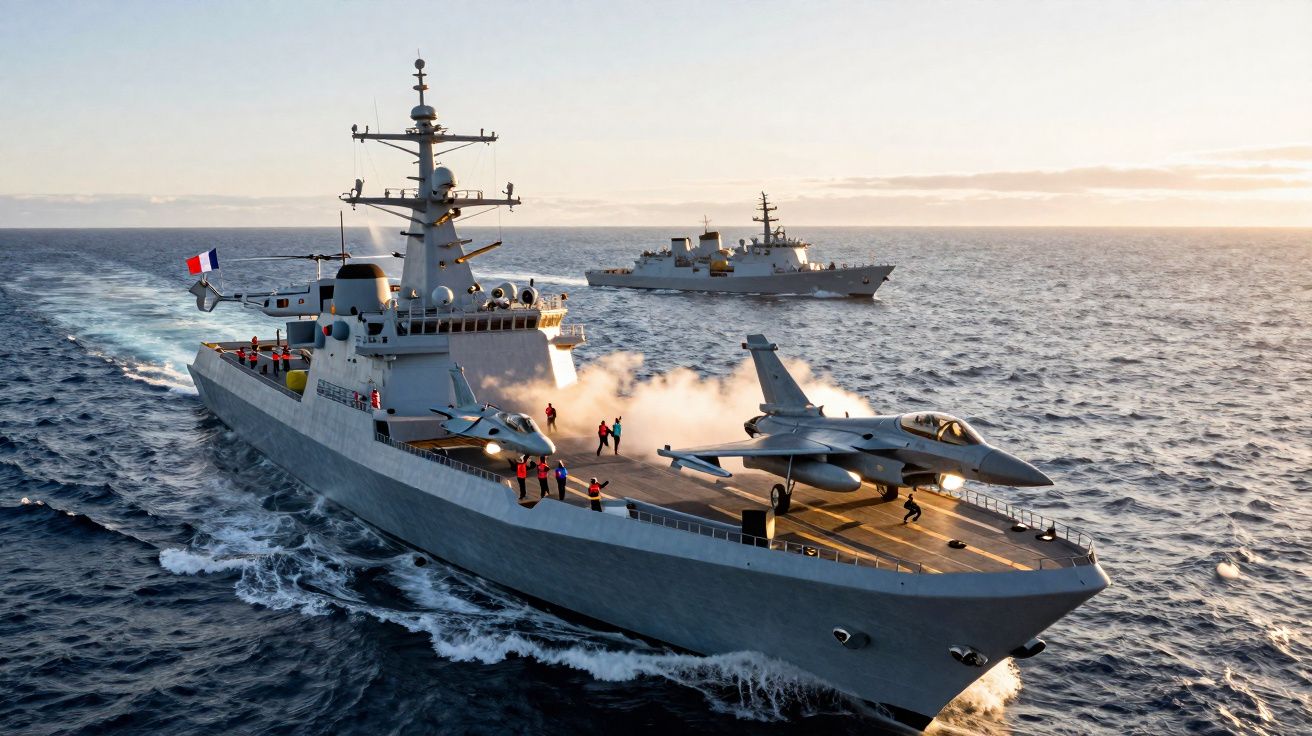
The French Navy (Marine Nationale) is progressing with the readiness phase for the nuclear-powered aircraft carrier Charles de Gaulle, operating alongside its escorting warships and auxiliary vessels, ahead of its participation in Operation Orion 26. Having sailed from the naval base in Toulon, the carrier strike group entered a demanding programme of training in the Mediterranean, before continuing its transit towards the North Atlantic and the Arctic, where it is set to conduct high-intensity manoeuvres with allied forces.
Orion 26: scale, purpose and command structure
Exercise Orion 26 is set to be one of the French Armed Forces’ principal training events and a key milestone for strategic power projection. Built as a joint and combined operation, it is intended to bring in allied nations and prepare participating units for complex, multi-domain combat scenarios, integrating air, land, maritime, space and cyber capabilities.
In total, the operation will mobilise more than 12,000 personnel, 25 ships, 140 aircraft, and ground units deployed across several regions of France. It will be led by the French Joint Staff and conducted in close coordination with NATO.
French Navy Charles de Gaulle “warm-up” training in the Mediterranean
As part of the initial stage-described as the “warm-up”-the carrier air group centred on Charles de Gaulle carried out air and maritime control drills in the Mediterranean. The training also included Italian Navy F-35B and AV-8B Harrier aircraft.
These activities are aimed at improving interoperability and reinforcing cohesion among allied forces before they are fully integrated into the multinational task force that will operate in the Atlantic.
Escort forces and multinational contributions
The make-up of the Charles de Gaulle carrier strike group highlights the wide international cooperation underpinning the exercise. In addition to French Navy frigates and support ships, the escort also includes the Spanish Navy frigate F-101 Álvaro de Bazán. Its involvement will run until 18 February, with combined activity planned in the Bay of Biscay, the Cantabrian Sea and parts of the North Atlantic, contributing surveillance, air-defence and anti-submarine warfare capabilities.
Further allied participation is also scheduled, including an amphibious force and Brazilian Marine Corps units embarked aboard the amphibious assault ship Mistral (PHA). These combined manoeuvres offer an important opportunity to deepen multinational interoperability and to consolidate a coordinated response to high-intensity crisis or conflict scenarios.
Image credits: CECMED.
You may also be interested in: *France plans to acquire a third electromagnetic catapult system from the United States for the future PA-NG nuclear aircraft carrier of the French Navy***




Comments
No comments yet. Be the first to comment!
Leave a Comment