
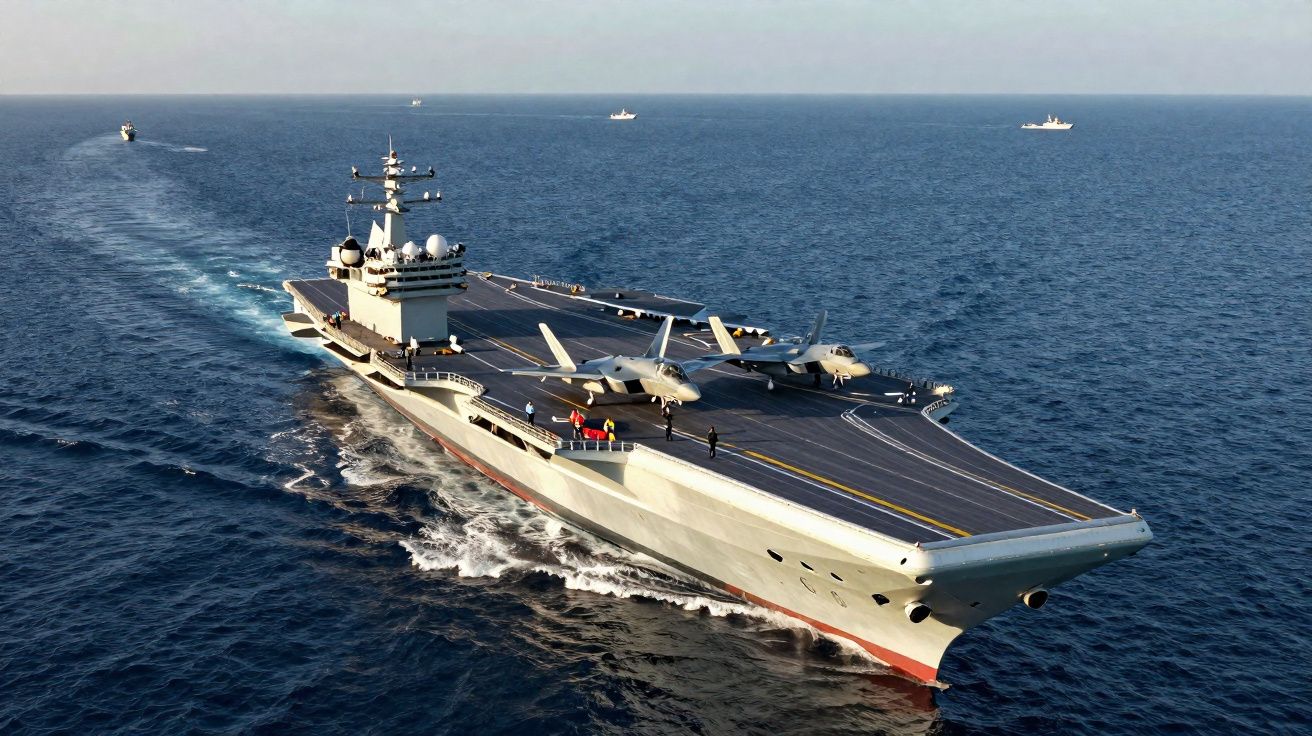
Newly released satellite imagery indicates that China is pressing ahead with the construction of what is currently referred to as the People’s Liberation Army Navy’s fourth aircraft carrier, the Type 004. Although it has not been officially confirmed whether the ship will be nuclear-powered, the accompanying description of the images states that work is taking place at the Dalian shipyards, where a substantial section of the keel can already be seen in place.
Type 004 aircraft carrier: size, displacement and design direction
For the time being, both the design and the build programme remain tightly classified. Even so, early assessments cited by Western analysts suggest a displacement in the region of 100,000 to 120,000 tonnes. If accurate, that would put the Type 004 broadly comparable in size to the US Navy’s Gerald R. Ford class, and larger than the Fujian, the most recently introduced aircraft carrier in Chinese naval service.
It is also anticipated that the Type 004 will incorporate experience gained from the Fujian. This would ease the adoption of electromagnetic catapult systems on the flight deck and mark a definitive shift away from the ski-jump arrangement used on the Liaoning and Shandong.
Flight deck systems and the carrier air wing
This aspect matters in particular because the ship is expected to operate a sizeable carrier air wing. Key aircraft are likely to include the J-15T fighters (derived from the Russian Flanker) and the J-15D variant tailored for electronic warfare, alongside China’s newer, more stealth-oriented J-35 fighters.
In addition, the carrier is expected to be capable of operating the KJ-600 airborne early warning and control aircraft, expanding the range of missions and operational effects the group could deliver.
Nuclear propulsion: still unconfirmed
On the question of nuclear propulsion, the option has been discussed for months in commentary from both Chinese and Western analysts. However, the newly published imagery does not yet make it possible to determine clearly whether this feature will ultimately be adopted.
Although Beijing may intend to make the transition with the Type 004, an incremental path also remains plausible. Under that approach, the ship could initially enter service with conventional propulsion, acting as an interim step while a suitable reactor is finalised.
Wider implications for China’s carrier plans
Whatever the final technical choices, China’s progress in building aircraft carriers has already prompted concern from its principal geopolitical competitor. As reported last December, a U.S. Naval Institute assessment said Beijing was on course to build a fleet of nine aircraft carriers by 2035.
Such numbers would underpin a strong force-projection capability in the Indo-Pacific and other strategically significant areas, particularly when paired with the development of the Type 076 amphibious assault ships, whose design is expected to support the deployment of a substantial number of complementary drones.
Images used for illustrative purposes.
You may also like: The first of the new Type 054B stealth frigates of the Chinese Navy would already be fully operational






Comments
No comments yet. Be the first to comment!
Leave a Comment