
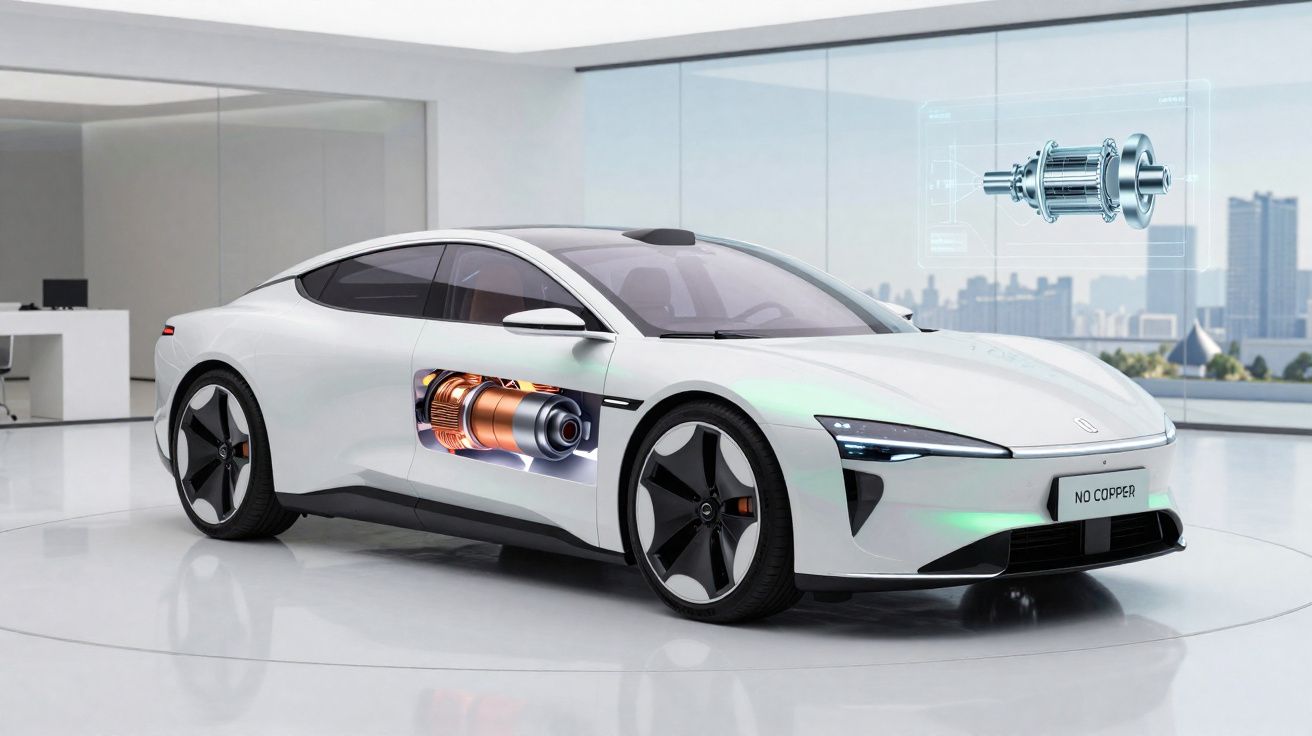
Copper is one of the core materials used in electric motors - but what if you could build an electric motor without copper? It would be a game-changer, and that possibility has just moved a major step closer.
Researchers at KIST (Korea Institute of Science and Technology) have created a prototype copper-free electric motor, replacing traditional metal windings with a set of cables made from carbon nanotubes.
This approach could make key components such as electric motors substantially lighter, while also offering a route to sharply lower the emissions linked to manufacturing motors for electric cars.
KIST prototype and performance tests
KIST has already carried out practical trials using a small-scale model car fitted with a prototype of this copper-free electric motor, aiming to demonstrate that the concept is workable.
In testing, the motor reached 3420 rpm at 3 Volts - a figure that looks modest next to the 18 120 rpm achieved by an equivalent copper-based electric motor.
Powered by a 3 V battery, the scale model travelled 10 metres in 25s. That may not sound dramatic, but it matches the project’s main purpose: to prove there is a functioning alternative to copper that also comes with a weight advantage.
Weight and conductivity comparison
Weight reduction is one of the standout benefits. The density of carbon nanotube wiring is around 1.7 g/cm³, compared with 8.9 g/cm³ for copper.
Even with lower absolute electrical conductivity - 7.7 million S/m (Siemens per metre) versus ~59 million S/m for copper - the specific speed per unit mass ends up in broadly comparable territory. For electric cars, where every gram matters, that difference could be decisive.
Why a copper-free electric motor could change everything
Beyond cutting mass, another major advantage is sustainability. Manufacturing requires less metal, and carbon nanotube fibres can be recycled with almost no loss of properties, which helps reduce production-related emissions.
Even so, significant hurdles remain: producing long, uniform cables; improving contact resistance between fibres (junctions between filaments create electrical losses that lower overall system efficiency); and bringing the technology into line with safety and cooling requirements. And, naturally, costs are still high.
All the same, the potential is clear. If costs come down and reliability is proven, this copper-free electric motor technology would not just stay a lab experiment - it could reshape electric mobility with a solution that is lighter, efficient and more sustainable. And it does not have to be limited to cars.






Comments
No comments yet. Be the first to comment!
Leave a Comment