
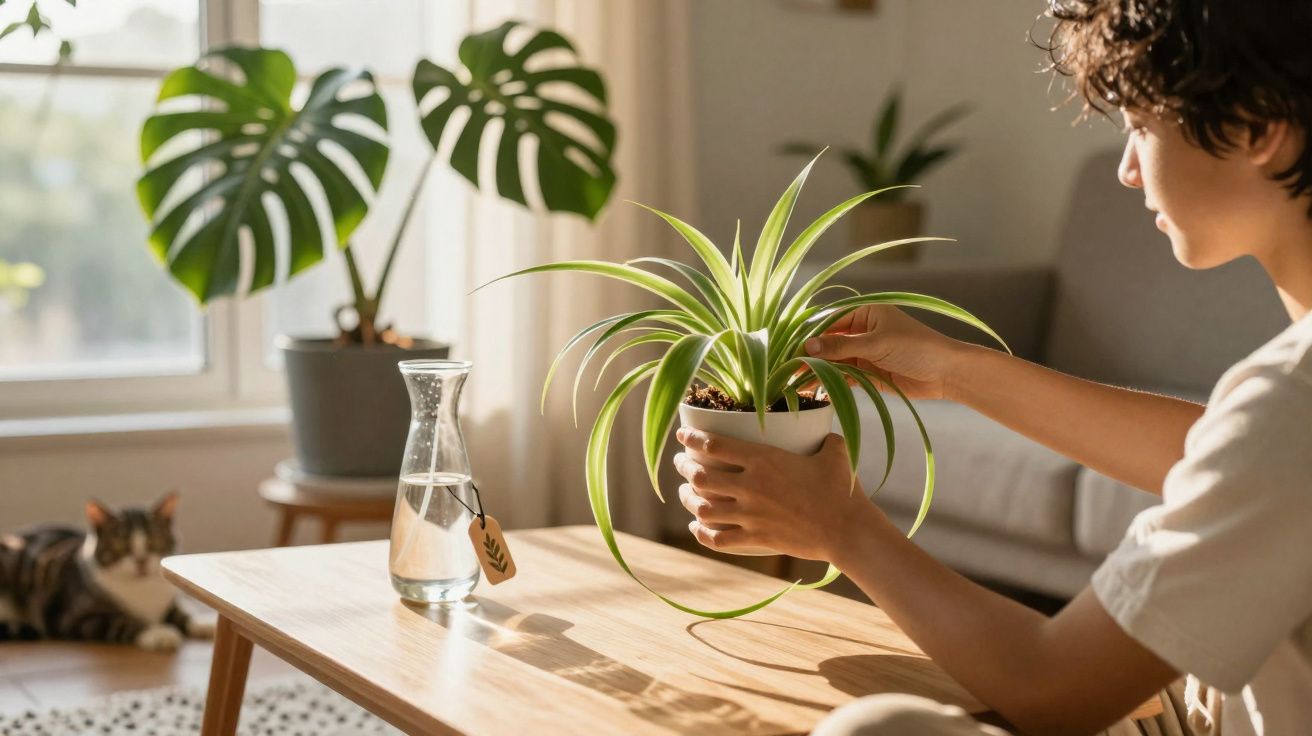
Monstera plants have taken over our feeds. Yet the plant that genuinely comes through for you tends to be the one in the background, quietly getting on with things where the light is weak and the room stays cool.
I won’t pretend I didn’t fall for it: those split leaves catching a gentle glow, the look of a thousand saved posts. But then I looked to the other side of the room-the corner where the air feels colder and sunlight hardly ever lands. In that spot, a slightly scruffy spider plant was spilling plantlets over the rim like a green cascade, still looking lively after a week I’d rather not relive.
Most of us have experienced it: the so-called “Instagram plant” collapses the moment real life happens. The spider plant didn’t flinch. It carried on pushing out runners and, in its own low-key way, cleaning up the air in the spaces we actually occupy.
There was something in that which felt more honest.
The overlooked hero: spider plant vs. the Monstera myth
Monstera deliciosa is the poster child of plant Instagram-maximum drama, oversized leaves, and a taste for bright conditions. The spider plant (Chlorophytum comosum) is more like the no-fuss relative: a bit unruly, less glossy, but tougher than it looks. It does well in the places influencers rarely photograph: a draughty hallway, a bedroom corner that never reaches midday brightness, an office where the blinds stay half drawn.
NASA’s well-known (if dated) research still gets cited for ranking spider plants among the quickest at removing certain VOCs-such as formaldehyde and xylene-from sealed test chambers. Of course, a real home isn’t sealed: air circulates, people cook, windows get opened. Even so, if you keep a spider plant near a desk with flat-pack furniture or beside a printer, the improvement can feel noticeable over time. It’s not a miracle cure. It’s more like a reliable broom.
Monstera generally wants bright, indirect light, warmth, and room to climb. Spider plants, by contrast, cope with cooler air-down to about 15°C (high 50s°F)-and manage low to medium light with almost cheeky resilience. They grow quickly, divide easily into new plants, and keep going in conditions where “designer” plants tend to sulk. That makes them far better suited to real flats than styled photoshoots. It’s the plant you can neglect for a week and still return to something green.
How to make a spider plant thrive in low light and cool rooms
Think of spider plants as endurance types rather than sprinters. Give them bright shade or soft indirect light, but don’t worry-they’ll cope with low light as well. Water only when the top 2–3 cm (about 1 inch) of compost feels dry; don’t water by the calendar. Every few weeks, rinse the leaves in the sink to shift dust so they can breathe properly. Turn the pot a quarter turn on pay day. That’s it.
The usual pitfalls? Too much water, overly heavy containers, and tap water with lots of fluoride or chlorine. Brown tips are often linked to water quality and mineral build-up. If it bothers you, use rainwater, filtered water, or simply leave tap water out overnight before watering. Spider plants also prefer being slightly root-bound, so only repot once roots are circling the pot and starting to push the plant upwards. Let’s be frank: no one is checking that daily.
There’s a small, satisfying rhythm to spider plants: they respond to modest, consistent attention.
“I stopped chasing the perfect plant for my feed and started noticing the plant that made my apartment feel better,” a friend told me, pointing to a shaggy spider plant above her radiator.
Try these easy, low-effort improvements:
- In low-light rooms, hang it higher to catch whatever stray brightness it can.
- Snip off a baby runner and root it in a glass of water; pot it up once roots reach about 2–3 cm (around 1 inch).
- Stick to a simple, free-draining mix-compost plus perlite-and ignore the fancy add-ons.
- Feed sparingly in spring and early summer. Half-strength, general-purpose feed is plenty.
Air that feels easier, rooms that feel lived-in
Does a spider plant “purify” the air? Under laboratory conditions, yes-and impressively. In day-to-day rooms, the effect is smaller, but still noticeable near VOC sources such as fresh paint, laminated desks, older carpet, or a laser printer. The plant becomes a quiet counterbalance to what modern life brings indoors, and it doesn’t give up when the temperature drops.
The reason it comes out on top isn’t magic; it’s practicality. A plant that tolerates a draughty corner can sit exactly where support is needed. A plant that grows quickly and produces babies multiplies without another trip to the shop. A plant that forgives our routines-late nights, cold mornings, missed waterings-keeps its place long after the novelty wears off.
Spider plants don’t demand perfection to deliver benefits. They want a bit of light, occasional water, and a home that isn’t trying to be flawless. Monstera will nearly always look better in photos. The spider plant will nearly always turn up.
| Key point | Detail | Why it matters to you |
|---|---|---|
| Spider plant thrives where Monstera sulks | Tolerates cooler rooms (~15–24°C) and low to medium light | Fewer miserable corners, more dependable greenery in real homes |
| Air-cleaning advantage | Top performer in NASA-style VOC removal tests; steady near-source support in real rooms | Practical comfort near desks, printers, and freshly painted walls |
| Easy propagation and care | Runners root in water; minimal feeding; prefers light, infrequent watering | Low-cost, scalable greenery without high-maintenance routines |
FAQ:
- Is a spider plant really better than Monstera for air cleaning? In sealed lab tests, spider plants ranked among the fastest at removing certain VOCs. In homes, the impact is subtler, but they’re still a strong helper near the source.
- Will a spider plant survive a chilly hallway? Yes, within reason. They tolerate cooler spots down to about 15°C (high 50s°F), and perk up again when the room warms.
- Why are the tips of my spider plant’s leaves brown? Often mineral build-up or fluoride in tap water. Try rainwater, filtered water, or leave tap water out overnight before watering.
- How often should I water it? Water when the top 2–3 cm (about 1 inch) feels dry. In low light and cooler rooms, that may be every 10–14 days. Slightly dry is safer than soggy.
- Can I grow new plants from the babies? Yes. Cut off a plantlet, root it in water until you have about 2–3 cm (around 1 inch) of roots, then pot it into a light, well-draining mix.




Comments
No comments yet. Be the first to comment!
Leave a Comment