
If you’ve been getting gel, acrylic or BIAB infills at the salon for years, you’ll know the trade-off all too well: gorgeous nails on top, but underneath, brittle, thin, irritated keratin nail plates. This is exactly where the Japanese manicure comes in. Rather than building yet another layer, it focuses on reinforcing the natural nail - using waxes, minerals and vitamins that leave a soft, pearly sheen. That understated finish fits perfectly with spring 2026, which is shaping up to be noticeably more natural overall.
What a Japanese manicure really is
The technique comes from professional nail salons in Japan, where hands that look impeccably cared for - but never showy - have long been seen as a status symbol. The point isn’t bold nail design; it’s a nail that looks healthy in its own right.
"A Japanese manicure is less about cosmetics and more about a treatment - it tackles the cause instead of merely covering up the surface."
At the heart of the ritual are two key products: a particularly rich paste and a fine powder, both worked into the nail plate. Common ingredients include:
- Beeswax: seals the surface, helps prevent dehydration, and adds shine
- Keratin: supports the nail’s natural structure
- Minerals such as silicon: reinforce and make the surface more resilient
- Vitamins (often A, E, H/biotin): nourish the nail and cuticle
The finish is a delicate, pinky nude shimmer - it doesn’t look painted, more like a “polished natural state”.
Japanese manicure: step-by-step
The process may look straightforward, but it’s far more intensive than a classic express manicure.
1. Preparing the natural nail
It always starts with a careful assessment: ridges, discolouration, fragile tips - all of it informs what the nail needs. After that, you can expect:
- Gentle trimming and shaping (usually softly rounded or soft square)
- Careful cuticle work without aggressive electric filing
- Lightly buffing the surface to help it absorb the treatment
The nail plate should never be “filed down” the way it can be during some gel removals. The guiding principle is: remove as little as possible.
2. Massaging in the treatment paste
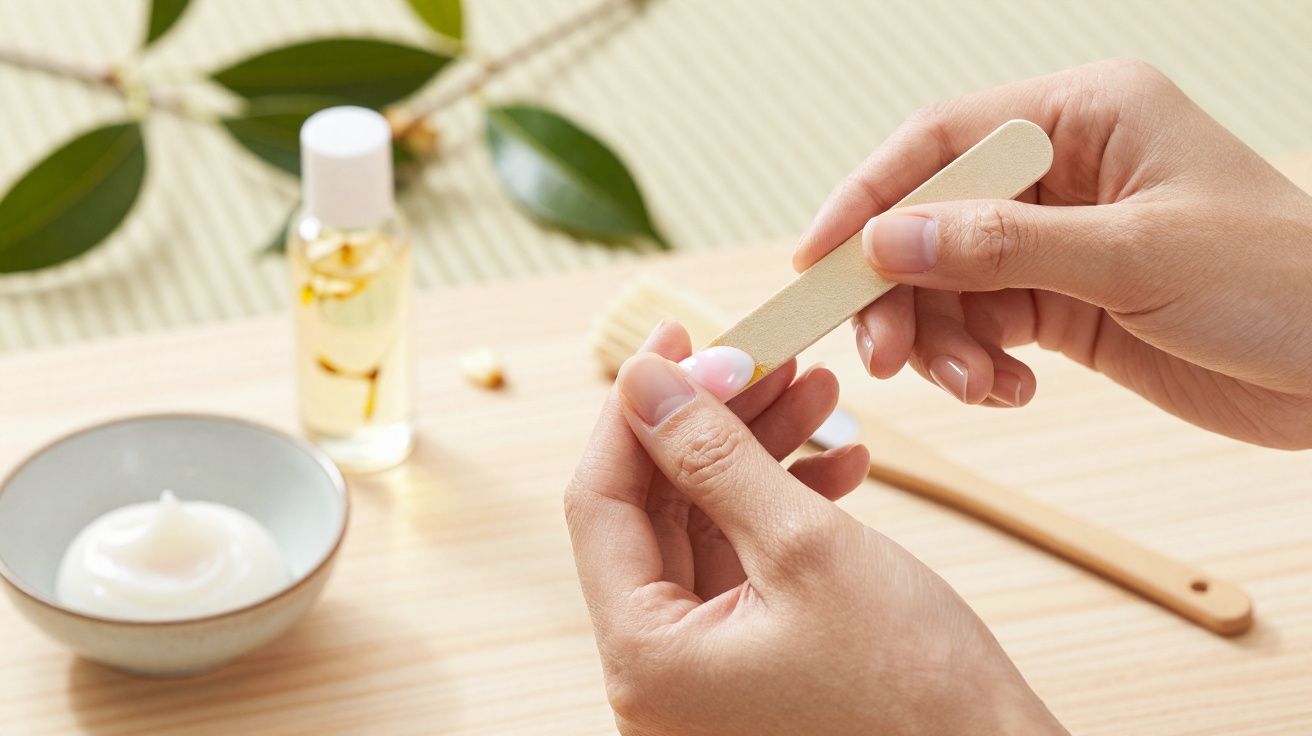
The treatment itself begins with a thicker, wax-like paste. It’s applied using a special spatula or a fine buffing file and then thoroughly worked in. With pressure and the warmth of the fingers, the paste softens slightly and can penetrate the uppermost layers of the nail more effectively.
Afterwards, the nails don’t feel sticky - more like they’ve been lightly oiled, but without any visible coating.
3. Sealing with powder
Next comes a fine powder, usually with a subtle shimmer. Using a second polishing tool, it’s rubbed into the nail. The powder “locks in” the ingredients from the paste and creates the signature shine.
"The shine doesn’t come from a layer of polish - it comes from a compacted, smoothed nail surface that reflects the light."
Once polished, the nail looks firmer and smoother, with that pearly yet extremely discreet glow - a look many describe as “your nails, but better”.
Why so many people are switching from gel to a Japanese manicure
Salons are seeing it more and more: clients with stressed, thin nails are actively asking for alternatives. The reasons are obvious.
| Gel / Acrylic / BIAB | Japanese manicure |
|---|---|
| Artificial layer on the nail | Care worked directly into the natural nail |
| Removal often requires an e-file or solvents | No filing off needed; it simply grows out |
| UV or LED lamp for curing | No lamp - just polishing |
| If done poorly: lifting forces, cracks, thinning | Strengthening and rebuilding over repeated sessions |
| Typically a more noticeable, “done” look | Very natural, neat appearance |
For anyone who needs a break from enhancements, it can feel like a rehabilitation programme. The massage may improve circulation and encourage growth, fine splits are less likely to travel further, and nails tend to peel less.
Who a Japanese manicure is (and isn’t) for
This approach is particularly well suited to people who:
- have brittle, peeling nails after a long period of gel wear,
- can’t wear bold colours at work,
- have sensitive skin or a tendency towards allergies with traditional nail products,
- want to avoid harsh chemicals during pregnancy or while breastfeeding,
- prefer a polished look that stays understated.
It’s less ideal for anyone expecting extreme length, sculpted shapes or statement nail art. Your nails remain close to their natural length, with only subtle reinforcement from shaping and care - there’s no “enhancement effect”.
How long it lasts, and how often to top it up
The shine from a Japanese manicure usually stays visible for two to three weeks - sometimes longer - depending on how quickly your nails grow and how much daily wear your hands take (washing up, cleaning products, frequent sanitising).
Unlike polish, nothing chips. The finish simply moves forward along the nail plate as it grows. If you want to build stronger nails long term, booking every three to four weeks is ideal. After several sessions, many people report that the nail feels noticeably denser and more stable.
Can you do a Japanese manicure at home?
Home kits are now widely available online. In principle, you can replicate the steps - but two things make all the difference:
- The quality of the paste and powder (cheaper options sometimes include synthetic additives after all)
- The polishing technique (too much pressure or the wrong file can thin the nail)
If your nails are very sensitive or already badly damaged, it’s best to start in a professional salon and learn the technique properly. Later, a high-quality kit can work well as a form of “in-between maintenance” at home.
How the Japanese manicure reflects the wider beauty trend
The buzz around it fits into a bigger shift: away from pure aesthetics and towards rituals that strengthen skin, hair and nails over time. Skincare is prioritising barrier support instead of harsh peels; in haircare, bonding treatments have replaced the old bleach overload. Nails are now following the same path.
"In spring 2026, hands are all about ‘clean, light, cared-for’ - bold colours fade into the background, while subtle shine and natural shapes take centre stage."
What’s more, the look works in an office setting too. Nails appear tidy and professional, without colleagues immediately asking which neon shade you’re wearing. At the same time, many people avoid the constant salon appointments and the cost of a full new set.
Tips to help the results last
To get more from a Japanese manicure, a few everyday habits can make a real difference:
- Wear gloves when cleaning so detergents don’t dry out the nail plate.
- Apply a nourishing cuticle oil or a hand cream containing urea in the evening.
- Don’t tear at split corners - file them straight away.
- For a few months, skip harsh metal files and use glass or emery boards instead.
If you stick to these basics, you’ll feel the treatment benefits for longer. Combined with a balanced diet - protein, minerals and enough fluids - nails can completely change their appearance within a few months.
All in all, the Japanese manicure signals a clear change in direction: away from dramatic reshaping and lengthening, and towards caring for your own nails. Especially as the warmer season begins, that quiet, well-groomed shine often looks more current than even the most elaborate neon manicure.




Comments
No comments yet. Be the first to comment!
Leave a Comment