
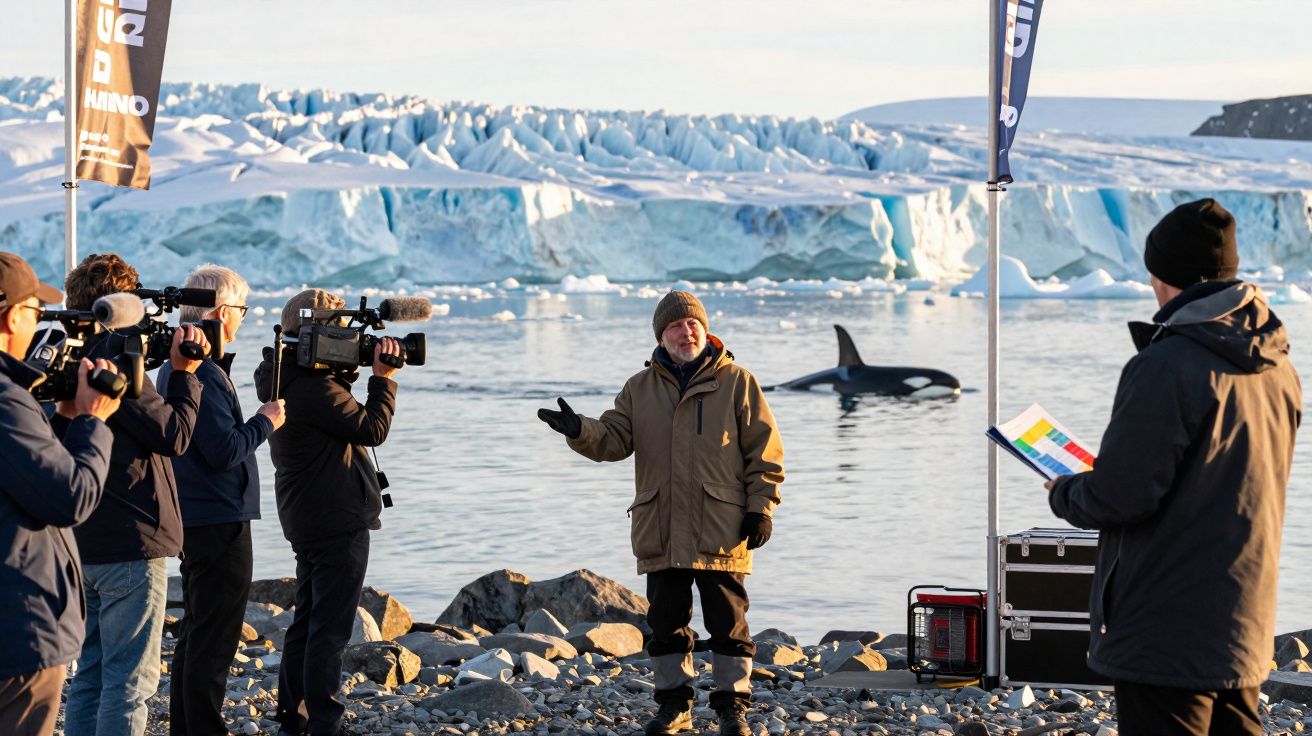
The sea ice snapped like aged porcelain each time the boat eased ahead. Out on the horizon, black dorsal fins sliced the steel-grey water, looping around a slab of splintered ice shelf that locals said used to be “solid as a church floor.” A Greenlandic fisherman called Jon rested on the rail, eyes narrowed, tracking the orcas as they patrolled the floe’s edge, poised for a seal to misstep. Just behind him, a visiting camera crew recorded everything, fishing for dramatic soundbites about “apocalypse at the top of the world.”
Back on land, local election posters rattled against metal poles in the wind, all stamped with some version of the same promise: climate chaos, vote for order.
That gap-between lived reality and imported drama-is what people here are really arguing over.
When the ice becomes a stage set for other people’s stories
In Ilulissat on a clear August afternoon, the brightness can feel almost unnatural. The bay is packed with jagged ice, like a cityscape after a blast, and in the channels between floes, orcas thread smooth, deliberate routes that pull tourists’ phones as if by magnet. Each time a fin breaks the surface near a calving front, there’s a gasp, a flurry of filming, and someone murmurs “climate change” as though naming a spirit.
For a lot of Greenlanders, that scene increasingly feels like a production authored elsewhere: their town turned into scenery, their routines edited down into B-roll for punchy headlines.
Down by the harbour, you hear the complaint quickly. A young hunter, Peter, shrugs while he drags seal meat from his boat, even as a foreign documentary crew interviews a scientist only a few metres away. The researcher talks about “imminent collapse” and “tipping points,” waving at the ice as if it has already disappeared.
Later, over coffee in a small kitchen scented with fish and laundry soap, Peter scrolls on his phone and pulls up a clip from the same bay, cut for social media: orcas circling “a dying glacier,” overlaid with text about “Greenland on the brink.” He laughs, but his jaw stays set. “They talk like we’re the first ones who will vanish,” he says. “We’re still here. We’re not props.”
What irritates people most, they say, isn’t the idea that the climate is shifting. They can see it for themselves: thinner ice, seasons that don’t behave as expected, unfamiliar species appearing in the fjords. It’s the catastrophe vocabulary pushed into every microphone-the countdown style that implies nothing in their world will outlast the next news cycle.
They hear “collapse” and “doomsday,” and something tightens. The slow work of adaptation-learning the sea again, bit by bit-never fits into a 90-second segment. The version of the story that travels is always the one with the highest panic-per-minute.
Between fear and survival: how people actually live with melting ice
Spend a few days in a coastal settlement and you start to see a different storyline. People recalibrate, improvise, and probe new routes across thinning ice with careful steps, guided by experience that still matters. An engine splutters into life a month earlier than it would have ten years ago, because the winter sea route by sled now feels too dangerous. Children learn to check weather apps alongside learning how to read the wind.
The most common practical habit is simple: constant recalculation. Where can we hunt safely today. Where can we fish. How do we weigh satellite images, elders’ advice, and what the water looks like right now.
Locals say the biggest error is treating everything as an extreme: either all-or-nothing apocalypse, or blanket denial. Many Greenlanders occupy a more complicated middle. They don’t wave away climate science, but they object when it lands like a script written over their heads.
In Nuuk, an older woman, Anna, tells me about a television panel she once appeared on. She explained how her family had shifted from dogsled hunting to small boats, how they were trialling new fisheries, how her grandson was learning both coding and seal-skin work. “They cut all that,” she says. “They kept the part where I cried about the old days.” Then she adds, quietly, “We’re not only losing things. We’re learning new ways, too.”
What scientists describe as “early warning signs” is, for someone else, the route to work or a familiar hunting ground. Living with both truths at once fuels the frustration some call fearmongering. When an orca pod beside a weakening ice shelf becomes an international TV emblem of collapse, the people steering boats through that same channel are left asking who gets to define risk-and on whose timeline.
Let’s be honest: hardly anyone lives as if each day is the final one before a tipping point. People carry on as though there’s a school run tomorrow, another fishing trip, another campaign poster to put up or pull down. The real friction sits exactly there-between survival mode and alarm mode-and it doesn’t compress neatly into a tweet.
How politics feeds on panic while people ask for something else
Walk through Nuuk during campaign season and climate messaging is everywhere, yet it rarely means the same thing from one poster to the next. One party pledges to “defend Greenland from foreign green colonialism,” accusing outside NGOs and researchers of turning the island into a moral billboard. Another promotes glossy proposals for green hydrogen and rare earth mining, wrapped in language about “urgent transition” and a “last chance for prosperity.”
The manoeuvre is quietly effective: fear about melting ice can be reframed as fear of missing out. Politicians know how to turn collapsing shelves and circling orcas into arguments for votes, contracts, or accelerated permits.
People describe a particular kind of fatigue. It’s not weariness with climate change as a topic; it’s exhaustion at being told that panic is the only responsible feeling. A teacher in Ilulissat says her pupils flick past yet another clip of blood-red sunsets over fractured ice and ask, “So what are we supposed to do, just be scared?”
That question is where a quieter pushback shows itself. It’s the decision not to have every groan of a glacier instantly translated into spectacle. It’s the refusal to let fear become the only currency in public debate. Greenlanders understand urgency; they live it when storms arrive sooner than forecast, or when a hunting season flips without warning. They simply don’t want the risks of everyday life turned into somebody else’s endless cliffhanger.
One local activist, who often collaborates with scientists, put it this way:
“We don’t want less science, we want less theater. Tell the truth, but stop talking like we’re already ghosts.”
Around kitchen tables, three requests surface again and again, almost like a shared checklist:
- Local voices on screen when ice, orcas, or “collapse” are discussed
- Straightforward explanations of what’s known, what’s inferred, and what remains uncertain
- Climate funding and research projects that leave practical tools or training behind
They’re not demands for drama. They’re calls for respect-and for moving from fear as spectacle to risk as something communities can actually work with.
Living with a slow crisis in a fast-news world
Spend long enough watching a calving front and you notice what most viral clips leave out: extended, uneventful stretches when nothing happens at all. Then, without warning, a thundercrack-an entire wall of ice gives way-and everyone nearby reaches for a phone. Our attention is tuned to drama, and Greenland’s climate story has been shaped to match that instinct.
But the people who live here can’t switch off between the exciting moments. Children still need internet, boats still need fuel, elders still need food delivered across ice that won’t stay put. They want the world to grasp what’s at stake without turning their home into a permanent disaster film.
Many Greenlanders I spoke with aren’t dismissing the science; they’re rejecting the soundtrack. They want a slower, steadier narrative that respects both danger and resilience. One where orcas circling a collapsing ice shelf aren’t only symbols of doom, but also part of a complicated, shifting ecosystem that people are trying to interpret, day after day.
They know the ice is changing. They’re not asking anyone to look away. They’re asking for a gaze that can hold panic and patience at the same time, without always grabbing for the loudest word. That’s a harder story to tell, but a truer one to live with.
| Key point | Detail | Value for the reader |
|---|---|---|
| Local anger at “fear talk” | Greenlanders feel their lives are used as disaster scenery for climate campaigns and the media | Helps readers question sensational climate narratives and seek out local voices |
| Politics using climate chaos | Parties turn melting ice and orcas into arguments for votes, mining deals, or nationalist slogans | Shows how climate fear can be weaponised in democratic debates worldwide |
| Beyond panic vs denial | Communities balance adaptation, tradition, and modern tools rather than living in constant apocalypse mode | Offers a more relatable way to think about living with long-term climate change |
FAQ:
- Are Greenlanders denying climate change? Most are not. They see the changes daily, from thinner ice to shifting animal patterns. What many criticise is the exaggeration of tone, the constant talk of total collapse that erases their efforts to adapt and stay.
- Why are orcas suddenly part of the story? Orcas have become a striking image: black fins against crumbling white ice, perfect for dramatic headlines. They do reflect shifting ecosystems, but locals say the focus on orcas often overshadows deeper day‑to‑day changes in fisheries and hunting routes.
- Do scientists really “fearmonger,” or is that media framing? Some researchers use very strong language, especially in interviews, but much of the amplification happens in editing rooms and newsrooms. Greenlanders tend to blame the whole chain: funding agencies, media, NGOs, and only then individual scientists.
- How are politicians exploiting the situation? By tying climate fear to promises of quick money, stricter borders, or “saving” Greenland through mining and mega‑projects. Melting ice becomes a talking point to justify policies that might not actually help local communities adapt.
- What do Greenlanders say they want instead? They ask for shared decision‑making on research, honest talk about uncertainty, investment in local skills, and narratives that show both loss and ingenuity. Less drama, more partnership – and a recognition that they’re not just victims on a melting stage.





Comments
No comments yet. Be the first to comment!
Leave a Comment