
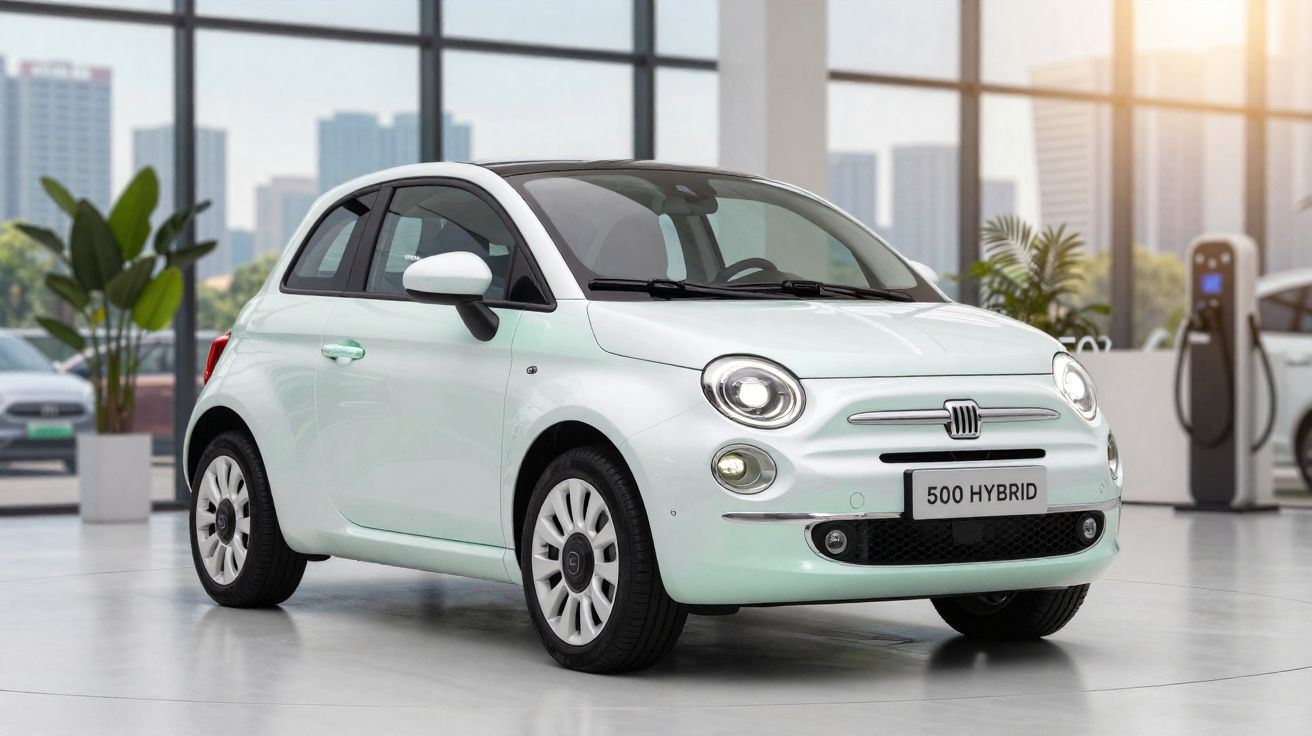
For the time being, going 100% electric may not be the best move. That is why the “new” FIAT 500 now comes with a petrol engine as part of a hybrid set-up. Is it any better?
The third generation of the FIAT 500 was launched with a very straightforward mission: it would be electric-only. And when the Italian city car arrived in 2021, it was genuinely well received.
The past few years, however, have proved tougher. Sales of the 500e (the electric version) fell off a cliff and never really bounced back. Thankfully, FIAT showed some old-school adaptability and rethought its plan.
The outcome is clear, and it has a name: FIAT 500 Hybrid. The “new” FIAT 500 that we had only seen as a full EV now gains a hybrid system. It brings back the familiar internal-combustion engine and tackles what was arguably one of this model’s biggest drawbacks: the price.
In the A-segment (city cars), the price tag is often one of the strongest selling points. So that is exactly where it makes sense to start.
The FIAT 500 with the hybrid system starts at 20 850 euros, roughly seven thousand euros cheaper than the 500e. And, in typical Portuguese fashion, seven thousand euros buys a lot of petrol.
Even so, price alone should not - and cannot - be the only argument for a modern car. This new FIAT 500 Hybrid is proof of that, and it left me pleasantly surprised.
What changes in the FIAT 500 Hybrid?
First, you almost need to play a game of “spot the differences”, because the changes are few and very subtle. Up front, for instance, there is a new air intake just beneath the “500” badge, there to cool the combustion engine now living under the bonnet.
At the other end, the only real giveaway is the “Hybrid” badge on the boot lid, announcing the FIAT 500’s hybrid system. Inside, the biggest shift is the arrival of a manual gear lever for the six-speed gearbox and - believe it or not - a third pedal: the clutch.
Interior space does the job
Beyond that, the FIAT 500 Hybrid sticks closely to the original “recipe” that has served the Italian brand so well over recent decades. The FIAT 500 keeps the compact footprint that makes it easy to place in town - about 3.6 m long, 1.68 m wide, 1.53 m tall and 2.32 m in wheelbase - and a cabin that, while not class-leading for space, is also far from disappointing.
With four seats, the rear ones are, predictably, better suited to anyone under 1.70 m tall. Access could also be easier, but with only two doors into the cabin, there are limits. For that purpose, the 3+1 body style for this generation - due in March 2026 - should be the more sensible option.
Round the back, the boot matches the 500e for capacity: 183 litres. It does not sound like much - because it isn’t - but for day-to-day use it works perfectly well.
From the driver’s seat, you sit a little higher, as you would expect in a city car, but the driver’s seat does not offer height adjustment. Beyond fore-and-aft movement, you can only change the backrest angle, plus adjust the steering column for height and reach.
On the tech front, the new FIAT 500 Hybrid mirrors the 500e’s solutions: a digital instrument cluster with a 7″ display and, on higher-spec versions, a 10.25″ central touchscreen with Apple CarPlay and Android Auto connectivity.
In its natural habitat
In town, the new FIAT 500 Hybrid feels completely at home. Its compact dimensions give it plenty of agility and make it easy to manoeuvre, especially on the tighter streets found in city centres.
That is backed up by controls that are very straightforward to use, including the steering, the clutch pedal and the manual gearshift.
They may not be the most communicative, but the reality is you do not buy a FIAT 500 for rich steering feel - you buy it for an easy-going, simple driving experience. And on that front, the Italian city car earns top marks.
When it comes to comfort, the FIAT 500 Hybrid also impressed me. Even with a relatively short wheelbase (2.32 metres) and 16″ wheels, it delivers a notably comfortable ride. This matters even more when you compare it with the electric 500, which is heavier by 264 kg: 1066 kg versus 1330 kg.
Are 65 hp and 92 Nm enough?
Under the bonnet, the engine in the new FIAT 500 Hybrid is not really new at all. It is the very same Firefly 1.0-litre three-cylinder petrol unit used in the previous generation of the 500, paired with a 12 V mild-hybrid system.
Output is slightly lower, though: 65 hp and 92 Nm of torque - 4 hp less than before. According to the brand’s engineers, that reduction is down to meeting ever-tougher emissions regulations.
And while 65 hp is more than adequate in everyday driving, it is less convincing when you are in a hurry. Still, it is worth remembering this engine was designed with efficiency in mind, and on that score the FIAT 500’s hybrid system seems to do its job very effectively.
On the planned route during the launch in Turin, I recorded an average of 5.0 l/100 km. That said, the little 500 Hybrid will not escape a more serious consumption test once it reaches home soil.
7000 euros cheaper
As mentioned earlier, the FIAT 500 Hybrid undercuts the fully electric version by 7000 euros, which is one of the biggest surprises here. Pricing for the hybrid 500 starts at 20 850 euros for the entry-level Pop version.
The test car, however, was fitted with the Torino equipment level, which moves the base price to 21 350 euros. To see the full line-up, just take a look at this article:





Comments
No comments yet. Be the first to comment!
Leave a Comment