
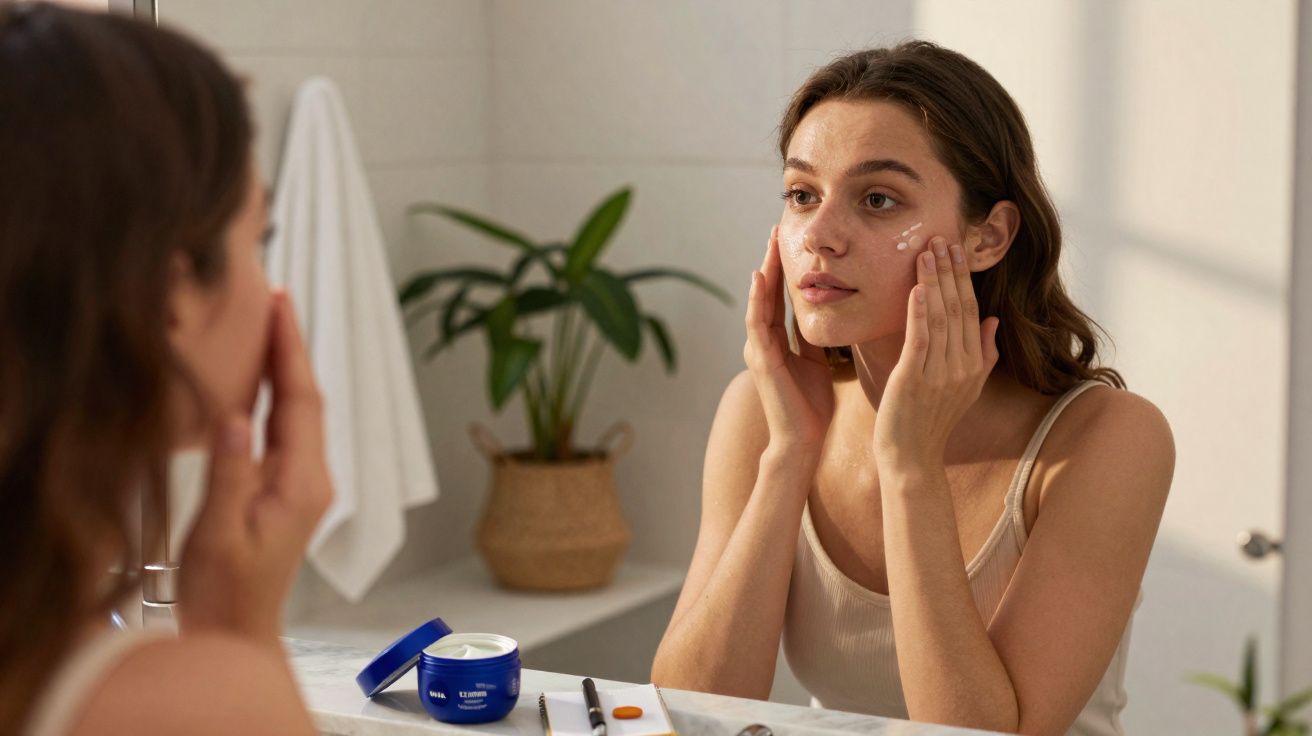
The classic Nivea Cream in the blue tin is a staple many people remember from a parent’s or grandparent’s bathroom shelf. It’s often used as a do-it-all product for elbows, hands, or any dry patches. But what happens if you use it deliberately on the face-every night, as a thick layer, and only on one side? That’s exactly what this small self-test explored, offering some revealing clues about how well the cream moisturises and where it can fall short.
The idea behind the blue Nivea self-test
For decades, Nivea Cream has been a household classic. The scent is instantly recognisable, the tin is iconic, and the promise is straightforward: rich care for skin and body. Online, you’ll find countless suggestions for what to do with it-from a makeshift after-sun to a treatment for dry hair ends, or soothing care after shaving.
It gets more interesting when you bring it back to a more traditional purpose: locking moisture into facial skin. In an era of serums, retinol, niacinamide, and layered routines, the question becomes: is this thick, old-school cream still useful-or is it more effective than people give it credit for?
"The test: for one week, the blue cream is applied every evening to only one half of the face-over the normal skincare, like an occlusive overnight mask."
How the experiment was carried out
The tester started by keeping their usual evening routine unchanged. That routine included:
- a thorough two-step cleanse
- a facial serum
- an eye product
- a light, standard moisturiser
Only then came the key step: a clearly visible layer of Nivea Cream was applied to one side of the face-almost like a mask left on to work overnight. The other side stayed with the usual routine, without the “Nivea top layer”.
The aim was to compare both sides in the morning mirror as precisely as possible-looking at moisture levels, smoothness, and overall skin feel.
Noticeable changes after just a few nights
A consistent pattern appeared after the first few nights. On waking, the side treated with the blue cream looked and felt:
- noticeably plumper
- softer to the touch
- generally smoother, especially where fine dehydration lines showed up
Because the cream is so rich, it sat on the skin like a protective film. That helped prevent excessive overnight water loss-something many people underestimate, particularly during the heating season or in rooms with very dry air.
"The treated half of the face felt much better hydrated in the morning, while the other side seemed more ‘normal’-not dramatically dry, but also not as deeply nourished."
Since the skin’s natural overnight renewal is especially active, that kind of barrier layer can amplify the benefits of whatever skincare sits underneath. In principle, this is exactly what many modern “sleeping masks” do-Nivea simply plays a similar role, just in a much simpler and cheaper way.
Slugging with Nivea: effective, but not an every-night habit
What’s often referred to as “slugging” describes this same concept: putting a very rich, sealing layer on top of your usual skincare to hold moisture in the skin. With Nivea, this seemed to work surprisingly well-the immediate moisturising impact in the test was hard to miss.
However, a drawback appeared after a few days. With daily use, the T-zone-forehead, nose, and chin-on the Nivea side started reacting with small blemishes. In those areas, the skin began to feel slightly “blocked”.
"The method works, but on the face it should be used like a treatment-rather than as a new daily standard routine."
How often makes sense?
Based on the test, a practical schedule looks like this:
- for normal skin: around once a week as an overnight mask
- for dry skin: once or twice a week, depending on tolerance
- for oily or blemish-prone skin: at most every two weeks, and only in targeted areas-preferably dry cheeks
If you notice more tiny spots or clogged pores, it’s best to increase the gaps between uses or restrict the cream to very dry patches only.
What Nivea Cream can do-and what it can’t
The test makes one thing clear: the blue cream is not a miracle solution for wrinkles or pigmentation marks. Its main strength is intensive occlusion-essentially creating a “covering” that helps keep water in the skin. That leads to several effects that can be genuinely useful day to day.
Strengths of classic Nivea
- A shield against dryness: wind, cold, and central heating can strip moisture from skin-using a thicker layer of Nivea in the evening can help counter that.
- Ideal for rough areas: the edges of the lips, sore nostrils after a cold, or chapped cheeks can benefit a lot.
- A budget-friendly booster: if you already have a good serum, sealing it in with Nivea can enhance the feel of results without buying an expensive specialist product.
Where the cream reaches its limits
- It doesn’t provide modern active ingredients such as retinol, vitamin C, or niacinamide.
- If you’re prone to breakouts, it can weigh on pores-especially with thick, daily use.
- It isn’t a replacement for a well-chosen routine tailored to your skin type.
Who is the Nivea overnight mask actually for?
People with dry or more mature skin-especially where the skin barrier is weakened-are likely to benefit most. In those cases, the cream can act like a coat that reduces water loss, leaving skin looking fresher by morning.
If you’re more likely to get blackheads and blemishes, a more cautious approach is sensible. It may work better as a targeted product-for example, on dry cheek areas-while avoiding the forehead and nose.
| Skin type | Recommendation for Nivea overnight |
|---|---|
| Dry skin | 1–2 times per week over the whole face (avoid the eye area) |
| Normal skin | About 1 time per week or as needed, especially in winter |
| Combination skin | Only on dry areas; leave out the T-zone |
| Oily, blemish-prone skin | Use very sparingly, more as a spot treatment on dry patches |
What to watch out for when using it
If you want to try the method, a few points can help prevent overloading your skin:
- always apply on clean, thoroughly cleansed skin
- don’t rub the cream into the eyes; the formula isn’t designed for that area
- the layer can be visible, but it shouldn’t be so thick that it slides around
- if you get burning, strong tightness, or lots of new spots: stop using it
Sensitive skin can react unpredictably. Starting carefully-perhaps on a weekend when you don’t have an important event-can make it easier to judge your personal tolerance.
Why the old cream in the bathroom cabinet is making a comeback
While social media channels constantly promote new and expensive products, this simple one-side Nivea test highlights something more down to earth: sometimes a classic is enough to deliver a visible moisturising effect. The cream won’t replace a thoughtful facial routine, but it can complement one in a targeted way.
If you already have a solid base routine with a gentle cleanser and products suited to your skin type, you can experiment with Nivea as an occasional overnight mask-particularly in colder months or after days with lots of sun and wind. The key is not to overdo it and to take your skin’s response seriously.
After a week of comparing both halves of the face, one thing stood out: yes, the blue tin can make a difference on facial skin. What matters is using it like a tool-not like a universal fix that replaces everything else.





Comments
No comments yet. Be the first to comment!
Leave a Comment