
The capacity to create art has long been treated as one of the defining traits of our species.
More than a century ago, some prehistorians struggled to accept that Upper Palaeolithic modern humans (between 45,000 and 12,000 years ago) could have produced work with genuine artistic flair.
That scepticism did not survive for long. Unequivocally ancient artworks found in European caves and rockshelters quickly put such doubts to rest.
Neanderthals and the question of cave art
What, though, of the Neanderthals - a large-brained, ancient sister group to our own species? We now have good reason to say that they, too, made art.
So far, however, every confirmed Neanderthal example is non-figurative: there are no images of animals, humans included.
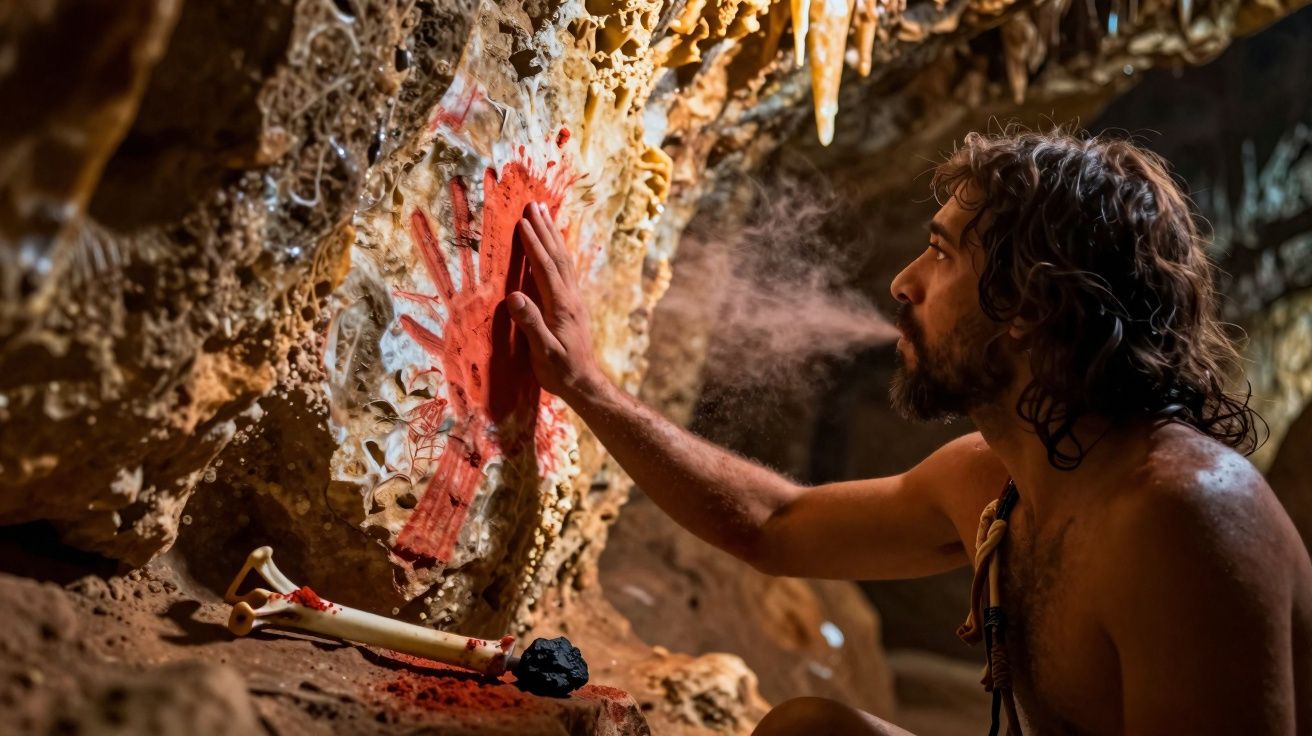
This sort of figurative representation may have been unique to Homo sapiens. In contrast, the Neanderthal record is made up of hand stencils (created by blowing pigment over a hand), finger flutings (formed when fingers were pressed into a soft surface), and geometric marks.
Neanderthals lived across western Eurasia from about 400,000 years ago until they disappeared roughly 40,000 years ago, and they have frequently been reduced to the stereotype of the archetypal "cavemen".
Debate about their cognitive and behavioural complexity has never fully faded, and whether they produced art sits right at the centre of that discussion.
Even though we already know Neanderthals could make jewellery and use coloured pigments, many have resisted the idea that they ventured deep underground and left art on cave walls.
Confirmed Neanderthal art in Spain and France
Recent research has, though, established beyond reasonable doubt that they did exactly that. In three caves in Spain - La Pasiega in Cantabria, Maltravieso in Extremadura, and Ardales in Malaga - Neanderthals used pigments to produce linear signs, geometric forms, hand stencils, and handprints.
In France, at La Roche Cotard in the Loire Valley, they left multiple lines and shapes in finger flutings (the trails fingers leave when drawn across a soft surface).
Further south-west, deep inside Bruniquel cave, they snapped stalactites into segments of similar length and arranged them into a large oval wall, lighting fires on top.
This was not a dwelling but something stranger; if the same structure appeared in a modern gallery, we would likely label it installation art.
Now that clear examples of Neanderthal cave-wall art are established in France and Spain, further finds are likely. Yet identifying them is difficult because determining the age of Palaeolithic cave art is notoriously challenging - and often a point of heated disagreement among specialists.
How Palaeolithic cave art is dated
Approaches based on relative dating - using stylistic traits and subject matter, alongside comparisons with objects excavated from archaeological levels that can be dated - can help, but they only go so far.
To obtain actual ages, at least one of three conditions needs to apply.
First, the art may include charcoal pigment, which can be dated with radiocarbon methods. This reveals when the charcoal was formed (that is, when the wood from which it derived died). The difficulty is that many black pigments are mineral (manganese), meaning a substantial amount of black cave art simply cannot be dated in this way.
There is also a further complication: the charcoal itself may not be the same age as the moment it was used as pigment. I might pick up some 30,000-year-old charcoal from a cave floor and write "Paul was here" on a cave wall. The radiocarbon result would not date when my graffiti was actually produced.
Second, calcite flowstones (stalactites and stalagmites) can form on top of the art. If it is clear that the calcite grew over a motif, then the calcite must be younger than the underlying image.
A technique based on the decay of uranium into an isotope - a particular form - of thorium can date when these flowstones formed, giving a minimum age for the art beneath them.
Minimum ages: 64,000 years in Iberia, and sealed caves at 54,000
I was part of a team that applied this method to flowstones covering red-pigment art in the three Spanish caves mentioned above. The results showed that the hand stencils, dots, and colour washes must be older than 64,000 years. Because the calcite provides only a minimum, the images themselves could be far older.
Even taking the youngest possible age implied by the dates, these images still precede the earliest appearance of modern humans (Homo sapiens) in Iberia by at least 22,000 years. As Middle Palaeolithic archaeology - the Neanderthals’ calling card - is found in all three caves, the simplest reading of the evidence is that Neanderthals made the images.
Criticisms of our findings set aside supporting information we had already published. Were the dated samples genuinely on top of the art? They were. Is the method reliable? It has been used for half a century.
The third condition has now strengthened the case for Neanderthal artistic behaviour. In Roche Cotard, winding lines made by fingers tracing through soft wall mud show another way of engaging with this enigmatic underground world. The markings include wavy, parallel, and curved lines, arranged in organised patterns that indicate deliberate creation.
Dating of sediments that accumulated over the cave entrance indicates it was fully sealed by no later than 54,000 years ago - and probably earlier. As with the Spanish caves, this predates the arrival of Homo sapiens in the area by a long margin, and the cave holds only tools made by Neanderthals. It therefore adds yet another form of art to the Neanderthal repertoire.
Even committed sceptics must accept that these data plainly demonstrate artistic activity deep in caves that can only have been carried out by Neanderthals.
Such art may reflect Neanderthal individuals developing a heightened sense of their own agency in the world. It may even be our earliest evidence of engagement with an imagined realm. In the years ahead, there will undoubtedly be more discoveries - and more to argue about.
Paul Pettitt, Professor in the Department of Archaeology, Durham University
This article is republished from The Conversation under a Creative Commons licence. Read the original article.






Comments
No comments yet. Be the first to comment!
Leave a Comment