
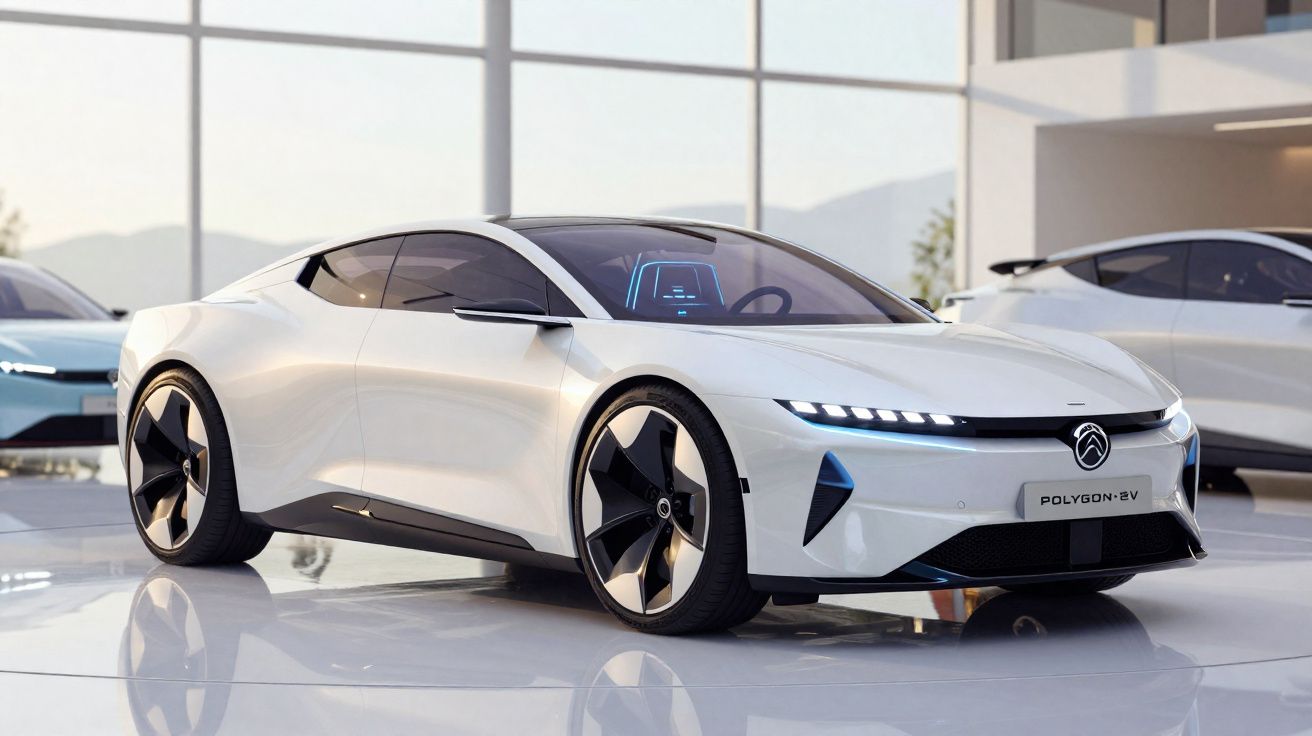
The car industry is going through a strange phase: electrification on its own is no longer enough. The new battleground is rethinking what driving feels like.
That is exactly what the Peugeot Polygon sets out to explore. It is a compact concept car measuring under four metres, yet it is packed with ideas that point to the brand’s next steps in design, technology and sustainability.
Agile, Fun and Future-Proof are the three themes that shaped the Polygon, and Peugeot wants them to become the foundations of its next generation of compact cars - starting with the successor to the 208.
The end of the steering wheel as we know it
Peugeot has created the Polygon Concept as a moving laboratory: a functional prototype designed to trial technologies expected to reach production models from 2027 - which may also hint at when the next 208 will arrive.
The standout innovations are Steer-by-Wire, which removes the mechanical link between steering and the front wheels, and Hypersquare, a rectangular steering control that breaks with more than a century of convention.
With the two systems working together, Peugeot is promising unprecedented “hyper-agility”. During manoeuvres, Hypersquare needs less than one full turn (170º), making parking and three-point turns easier. On the open road, the steering ratio is reduced so small inputs are enough to fine-tune the line, while the brand claims accurate responses and a light steering feel. For a definitive verdict, we will have to wait until… 2027.
Peugeot argues that Steer-by-Wire - a system currently used only by the Tesla Cybertruck - is about far more than low-speed convenience. With no physical connection between steering and wheels, the brand says the driving experience can become more immediate and engaging, thanks to removing the friction and latency found in conventional set-ups.
Road feel is delivered electronically, but Peugeot says it will be tuned to keep the surface information you want while filtering out unwanted vibrations. In theory, this is the future of steering. In practice, the road will have the final say.
Personalisation taken to extremes
For the Peugeot Polygon, “Fun” is essentially shorthand for customisation - and lots of it. Almost everything is configurable, from interior colours and lighting to wheels, trim finishes and even the Hypersquare itself. The concept is built around modular, quick-fit parts that can be swapped in minutes - as shown in the video below:
The tyres, developed with Goodyear, follow the same direction. Laser engraving on the sidewalls allows different patterns and colours to match the selected driving mode. Even the exterior lighting can sync with the cabin atmosphere.
This is the most emotional side of the concept, and where Peugeot wants to prove there is still room for driving pleasure in the electric era. How much of it makes it into the future Peugeot 208 remains to be seen.
Peugeot Polygon future-proofed
The Polygon’s third pillar is sustainability, with Peugeot setting out a clear commitment to durability and circularity across its future models.
Both structure and cabin rely on recycled inputs: the floor and panels are covered in forged textiles made from seats taken from older Peugeots; the seats themselves are 3D-printed using recycled plastic (R-PET); and the interior paint uses pigments derived from end-of-life tyres.
Peugeot has also cut the number of parts - each seat, for example, is made up of just three main pieces - simplifying production, lowering weight and making recycling easier. In Peugeot’s view, less really is more: fewer parts, less impact and, potentially, a longer service life.
A design manifesto
As striking as the images are, the Polygon is also a statement of intent for Peugeot’s next design chapter. Expect clean lines, geometric surfaces and a front end lit by micro-LEDs that reinterpret the “three claws” signature - now arranged horizontally.
With its gullwing doors, the Peugeot Polygon is obviously far from showroom reality, but it is intended to act as a reference point for the future Peugeot 208 in terms of proportions, design language and styling details.
More than a styling exercise, the Polygon is a manifesto for what Peugeot believes the car of this century should be: emotional, interactive and sustainable.




Comments
No comments yet. Be the first to comment!
Leave a Comment