
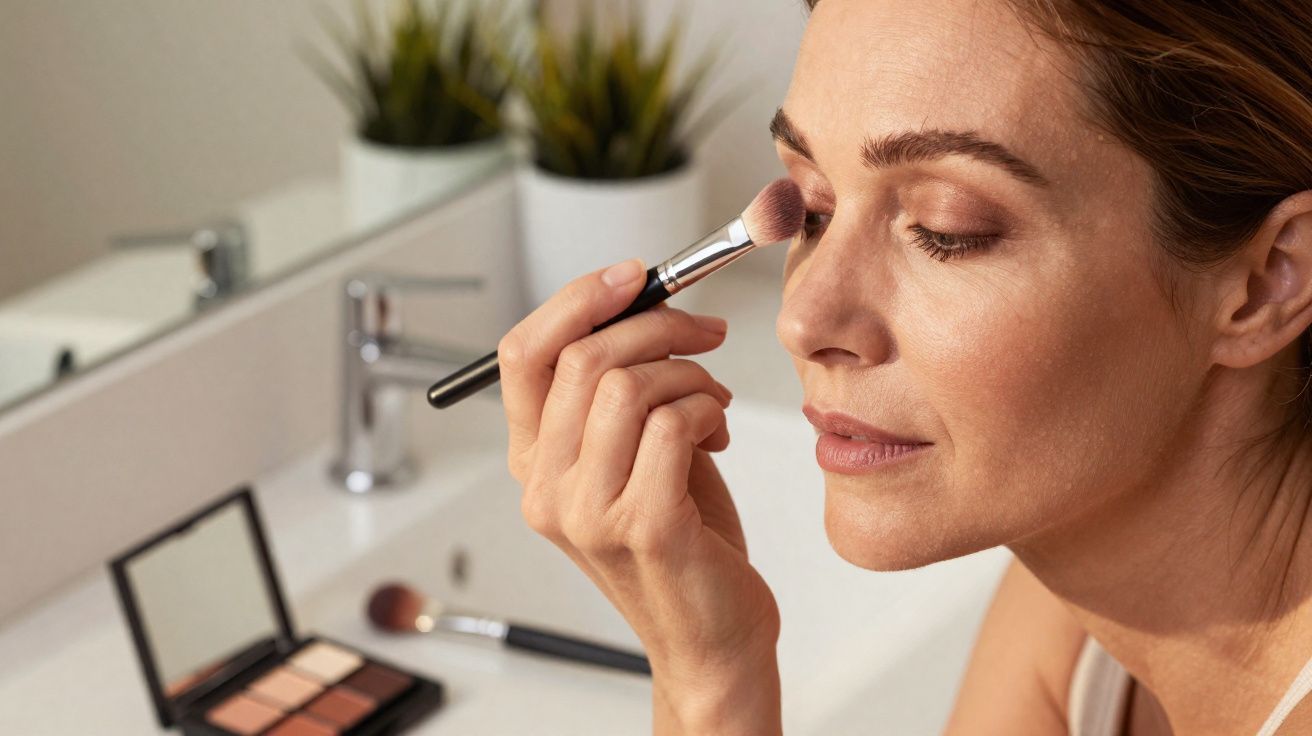
If you struggle with hooded eyes, eye make-up can feel like a losing battle. Shades disappear into the fold shadow, and the eyes can end up looking more tired than refreshed. There’s a simple pro technique that uses a smartly placed eyeshadow effect to lift the eyes visually - no surgery, and it takes only a few minutes.
What hooded eyes do to your eyeshadow
Hooded lids aren’t unusual - they’re more the norm, especially from around 50 onwards, when skin naturally loses firmness. The upper crease sits more heavily over the mobile lid, the skin looks softer, and fine lines can appear.
That’s exactly where make-up becomes tricky: you carefully apply shadow to the mobile lid, blend multiple tones, maybe even create a gentle gradient - and the moment you open your eyes, hardly any of that work is visible.
"The eyeshadow disappears into the shadow of the crease - and if it’s placed in the wrong spot, it can weigh the eyes down even more."
Many people then notice several things happening at once:
- With eyes open, the eyeshadow is barely visible.
- Dark shades slip into fine lines and emphasise them.
- The eyes can look smaller and heavier rather than brighter.
- The natural lid shape can appear even more “droopy”.
That often leads to the decision: “I’ll just stop wearing eyeshadow.” But you don’t have to - as long as you change one thing: placement.
The most important pro trick: place eyeshadow higher than your natural crease
Professional make-up artists approach hooded eyes very differently from a “classic” eye shape. Instead of following the existing crease, they create a new one - visually.
The idea is straightforward, yet extremely effective:
"The colour doesn’t go into the natural fold, but slightly above it - where you can actually see it with your eyes open."
So rather than tracing the natural line, you place your shadow a little higher. This creates the impression of a more open, lifted eye. Use the brow bone as your guide: where you can feel the bone when you lightly sweep your finger over it is where the colour can sit.
Step-by-step: the “lift effect”
- Keep your eyes open normally. Don’t raise your brows in the mirror - otherwise you’ll be applying make-up to a shape you won’t have in real life.
- Hold your brush up and check in the mirror exactly where you’re placing the colour. Aim for a visible area above the natural fold.
- Place the shadow in a slightly raised, oval shape above the crease, not directly inside the fold.
- Towards the outer corner, let the colour drift softly upwards instead of dragging it down.
- Then briefly close your eyes and blend the edges until smooth - the shape stays, but looks softer.
Used this way, eyeshadow acts like an optical “brace” that pulls the eye upward rather than reinforcing a downward pull.
Why the right brush makes all the difference for hooded eyes
The tool matters almost as much as the technique. A flat, stiff brush tends to create harsh edges - and on hooded lids that can quickly look severe or patchy.
That’s why make-up artists usually reach for a very specific type: a soft, fluffy blending brush, often slightly tapered.
"An airy brush diffuses colour more like a shadow than a line - and that’s far more flattering on mature skin."
The best brush options at a glance
| Brush type | Suitability for hooded eyes |
|---|---|
| Fluffy blending brush | Perfect for soft transitions, no harsh lines, ideal for the “new” crease |
| Flat eyeshadow brush | Good for packing colour onto the mobile lid, less suitable for blending above the crease |
| Very small precision brush | Use only in small areas (e.g. along the lash line); otherwise edges can look too sharp |
With a soft blending brush, you can build colour using gentle sweeping motions. Instead of drawing a line, you create a light veil of shadow in the right spot, and it naturally melts into the skin.
Which colours make the eyes look more youthful
Especially after 50, it’s worth rethinking your shade choices. Very glittery finishes or extremely dark colours tend to settle into fine lines and highlight texture.
More flattering options include:
- Silky, semi-matte shades in beige, rose, taupe, or soft plum-brown.
- Mid-light tones that don’t contrast too harshly with your skin.
- Lightly satin highlights placed right at the inner corner for a fresher look.
Very deep eyeshadow can make hooded eyes look heavier very quickly. If you don’t want to give it up, keep it close to the lash line and blend it softly upwards, rather than darkening large areas.
What an everyday “lifting look” actually looks like
To make the method easier to picture, here’s a simple daytime eye look that works especially well on mature skin:
- Prep the lid: A thin layer of eyeshadow primer or a touch of concealer helps stop colour collecting in the crease.
- Light base shade: Sweep a neutral, light tone across the entire mobile lid.
- Create the “new” crease: With a mid-tone shade and a soft blending brush, work just above the natural fold using small circular motions.
- Lift the outer V: Angle the colour slightly upwards at the outer corner, not down towards the cheek.
- Soft highlight: Add a lighter tone under the highest point of the brow, without pulling it all the way to the bridge of the nose.
- Emphasise lashes: A mascara that separates well opens the eyes further - especially when focused on the outer third.
If you like, you can gently tightline the upper lash line with a soft kohl. With hooded eyes it looks far more balanced when the line subtly lifts upwards at the outer edge.
Practical extra tips for more mature eyes
Eyeshadow is only one part of the overall effect. A few small tweaks around it can noticeably enhance the freshening result:
- Shape the brows: A slightly lifted, well-groomed brow can act like a natural frame lift.
- Avoid overly harsh definition: For both brows and eyeliner, smudge softly rather than drawing heavy, solid lines.
- Keep the lower lash line subtle: Too much darkness underneath pulls the eye down visually.
- Watch texture: Creamy products that aren’t too dry tend to sit more smoothly over fine lines.
If your lids are very sensitive or dry, introduce new products sparingly at first. Strongly fragranced formulas can irritate delicate skin and increase redness - exactly what you’re trying to avoid with a “fresh look”.
Why this technique suits natural ageing so well
Hooded eyes aren’t a flaw; they’re simply an anatomical variation - and for most people they become more noticeable over time. This eyeshadow approach works with that change rather than trying to fight it.
By placing colour where the lid is actually visible, you deliberately outsmart the shadow created by the fold. The outcome stays subtle yet noticeable: the eyes look more open, more awake, and often friendlier. After practising a few times, it quickly becomes part of a daily routine - without spending ages on “Instagram make-up”.
The result is make-up that doesn’t try to make you look younger than you are, but respects your natural eye shape and brings out the best in it with a few smart, well-placed steps.






Comments
No comments yet. Be the first to comment!
Leave a Comment