
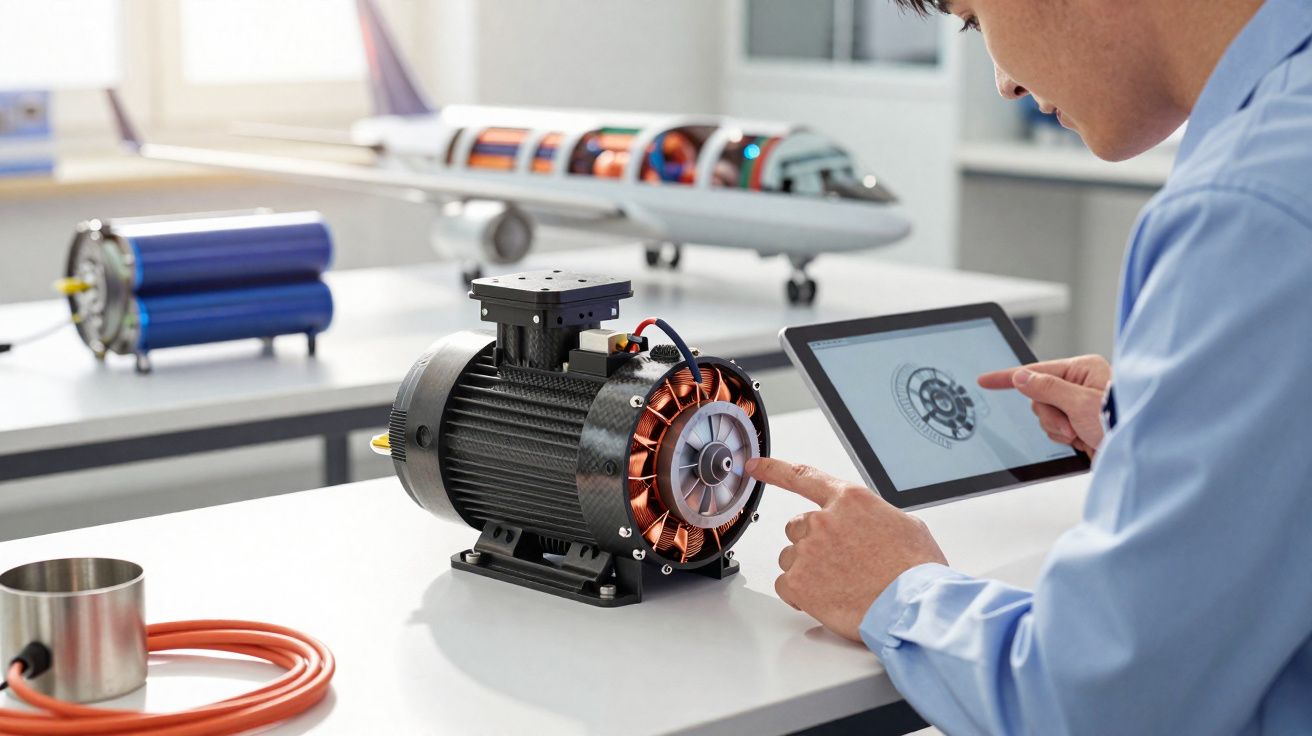
Fraunhofer IISB motor in the Clean Aviation AMBER project for hydrogen fuel cell hybrids
Fraunhofer’s Institute for Integrated Systems and Device Technology (Fraunhofer IISB) has built a new electric motor intended for aviation and hybrid-electric architectures using hydrogen fuel cells. The unit delivers 1,000 horsepower while weighing just 94 kg, with overall dimensions comparable to a 12.5 kg gas cylinder. That equates to a power density of 8 kW/kg, well above the 2–4 kW/kg typically seen in electric-car motors and even ahead of advanced aircraft electric motors, which are often around 5–6 kW/kg.
To put the headline output into context, a Tesla Model S Plaid uses three motors to reach roughly 1,020 horsepower, whereas this design achieves nearly the same result with a single motor.
Key design features: hairpin windings and direct oil-spray cooling
These figures are enabled by an unconventional layout using four three-phase hairpin windings. Instead of flexible round wire, the conductors are rigid copper busbars (rods) bent into a “hairpin” U-shape. This approach packs more copper into the same volume, increasing current and available power, while also improving cooling performance and mechanical robustness.
Heat is removed via direct cooling using an oil spray, which pulls thermal energy out effectively and allows higher continuous power without overheating. The compact packaging is particularly attractive for aircraft, where both space and mass are critical constraints.
Thin NO15 electrical steel, high speed, and a fault-tolerant architecture
A further notable choice is the use of NO15 electrical steel that is only 0.15 mm thick-around half the thickness used in most electric motors. The thinner steel reduces eddy currents, cutting heating losses and improving efficiency, especially at high rotational speeds. The motor is designed to operate at approximately 21,000 rpm.
The machine is divided into four independent sections, and each section has its own winding, inverter, and control system. This segmentation is intended to deliver high reliability: if one section fails, the remaining sections can continue operating-an important consideration for aviation use.
Development took place under the AMBER project within the European Union’s Clean Aviation programme, which targets hybrid-electric systems with hydrogen fuel cells for regional aircraft. The programme’s aim is to reduce aviation carbon dioxide emissions by at least 30% relative to 2020 levels. Other participants include Avio Aero with the Catalyst turboprop engine and GE Aerospace; however, Fraunhofer IISB developed the electric motor end-to-end, from the initial concept through to validation in line with aviation standards.
Even with the impressive combination of 94 kg mass and 1,000 horsepower output, moving from a laboratory prototype to certified flight hardware remains difficult. There is also still an open question over whether hydrogen fuel cells can provide the level of reliability needed for regional-route operations.
Even so, in an industry where progress is often measured over decades, this motor stands out as a substantial engineering milestone.






Comments
No comments yet. Be the first to comment!
Leave a Comment