
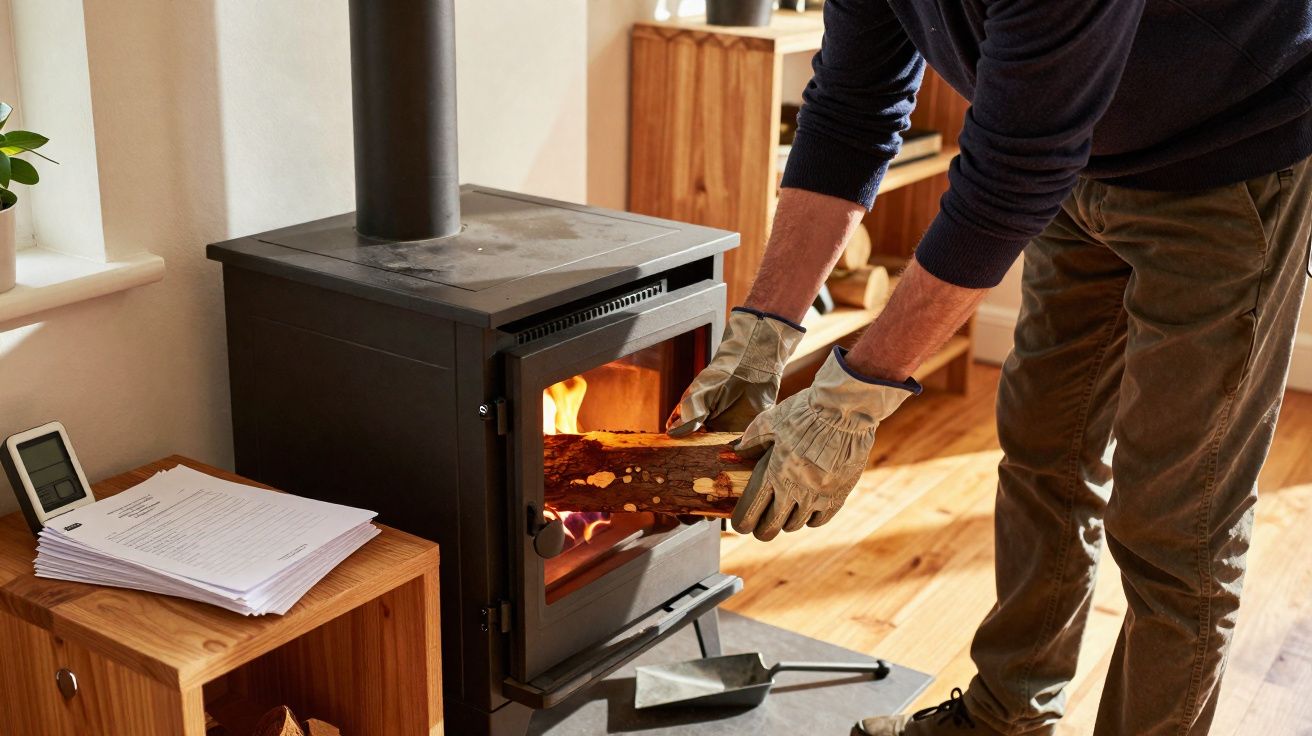
The man behind the counter in the hardware shop looked genuinely taken aback. “What do you mean, new law? I’ve always heated with wood. My father did. My grandfather did.”
Around him, the queue edged along, everyone holding stove catalogues, bags of pellets, and quotes printed in tiny type.
Outside, the morning was bitterly cold - and oddly clear for winter. No faint blue haze hovering over the rooftops, no familiar tang of damp logs. Just that slightly unreal sensation you get when something ordinary, something woven into daily life, suddenly feels… open to challenge.
On the local Facebook group, the arguments had already started: “You won’t take my stove from me” versus “My kids’ lungs matter more than your flames.”
Caught between nostalgia, anger, and very practical worries about money, one point stands out.
Something has just fractured in the story we’ve long told ourselves about wood heat.
From cosy tradition to regulated fire
For years, the “rule” felt almost unspoken: if you had a chimney and somewhere to stack logs, you heated with wood. End of discussion.
No one came to tally your emissions, measure your fine particles, or check how old your stove was. A fire in the sitting room was more a badge of independence than a matter for regulation.
Now that comfort zone is tightening. Across many regions, a fresh wave of legislation is turning wood heating from a straightforward “household choice” into a regime of permissions, performance ratings and areas where certain appliances are outright prohibited.
What used to be a private act - lighting the fire - has quietly been recast as a public-health question, expressed in micrograms of particles per cubic metre of air.
A concrete illustration: recent French rules in several metropolitan areas. In the most polluted basins, older open fireplaces are no longer allowed as a primary way to heat a home.
In some cities, only stoves meeting certified efficiency levels and strict emissions limits can be used, under labels such as “Flamme Verte 7*” or equivalent. People with older appliances are nudged - politely, but decisively - towards replacement, with deadlines, subsidies and, in some cases, penalties.
Comparable measures are appearing elsewhere in Europe and in several U.S. states. In the United States, the EPA has strengthened standards for wood stoves. In the UK, “smoke control areas” limit both which wood you may burn and what type of stove you can install.
The pattern is familiar: local prohibitions, national standards and air-quality alerts - and suddenly the cherished old stove becomes, technically… illegal.
The reasoning behind the legal language is straightforward: traditional wood heating can release large quantities of fine particulate matter, including the well-known PM2.5 that penetrates deep into the lungs.
Open fires and non-certified stoves can emit several times more particles than a modern pellet stove, or than many gas boilers.
So policymakers joined the dots: winter pollution spikes, hospital admissions for breathing problems, and early deaths associated with poor air quality. In that context, the comforting image of the crackling hearth looks rather less harmless.
The aim is not to wipe out that image, but to haul it - sometimes abruptly - into the 21st century.
What you can actually do with your wood stove now
When a new law lands, the instinct is either to panic or to dismiss it. Both responses make sense, and neither is especially useful.
The most sensible approach is relentlessly practical: find out which zone you live in, which dates apply, and how your current appliance is officially classified.
Start with your council’s air-quality plan or a local clean air ordinance. Many local authorities provide an online map showing whether your neighbourhood falls under stricter rules.
Next, track down the details of your stove or fireplace insert. Installation year, efficiency rating, emissions certification: this dull paperwork now determines whether your fire is compliant, merely tolerated, or living on borrowed time.
If a replacement is on the horizon, resist buying the first glossy pellet stove you come across. There are multiple options: high-efficiency log stoves, hybrid systems, and pellet inserts designed to make use of an existing chimney.
What the law really changes is your room for “making do”. The old assumption - “someone local will fit it and it’ll be fine” - is giving way to inspections, certification paperwork and, in some cases, compulsory servicing arrangements.
On a personal level, this often cuts deeper than a line in an official gazette. For some households, wood is not simply “another heating choice”; it is the only way to keep the place warm without sending the electricity bill through the roof.
For others, it is bound up with identity: rural life, the weekend ritual of heading to the woods, and the quiet pride of “heating with my own logs”.
So when the law intervenes and says your old stove pollutes too much - replace it or stop using it - the message is not received as “we’re cleaning up the air”. It lands as: “we’re coming for your way of life”.
On a freezing January evening, with prices rising across the board, that hurts.
This mismatch in perspective is enormous. Legislators talk in tonnes of CO₂ avoided and micrograms of particles reduced. Residents think in euros, routines, and memories they hold close.
That is why the debate around wood heating so often collapses into shouting, rather than becoming what it could be: a shared rethink of how we warm our homes without damaging our lungs - or our budgets.
Staying warm without getting burned by the new rules
Before you spend a penny on new kit, the most effective step is almost laughably simple: change how you burn.
Even an older stove can produce far less pollution if it is used properly: well-seasoned wood, no rubbish, no painted offcuts, and a hot, lively flame rather than a long, smoky smoulder.
Opt for hardwood logs, cut and dried for at least 18 to 24 months, with visible splits and a noticeably lighter weight in the hand.
Use small, dry kindling and light from the top, so the fire gradually burns the wood gases instead of choking the stove with smoke.
If a log hisses and turns black before it catches, it isn’t dry enough.
That one factor alone can multiply the particles in the smoke - and increase the risk of a chimney fire.
Maintenance is another area many homes overlook. A chimney swept only “when we remember” slowly loses draught, produces more smoke and burns through more wood.
Having a professional sweep once a year (or more often, depending on local rules) is not mere red tape; it helps your stove perform with the efficiency it was meant to have when it was sold.
Then there is the classic temptation: shutting the air vents to “make the logs last”. On paper, it saves fuel. In reality, it usually creates a starved, highly polluting fire that lines the flue with creosote.
Let’s be honest: hardly anyone does this every day while following the manual’s instructions to the letter.
A chimney sweep I met in a small town surrounded by hills put it this way: “I always answer the same thing: it’s not about how hot it feels in your living room. It’s about what comes out of your chimney and into your neighbour’s lungs.”
To get through this transition without losing your head, a few practical reference points make a difference:
- Check your local rules on wood heating and which appliances are banned.
- Confirm the exact model and age of your stove or insert.
- Weigh up the cost of a new certified stove against what you currently spend on fuel.
- Find out about grants, rebates or tax credits for cleaner heating systems.
- Think about combining systems: wood + heat pump, or wood + efficient electric back-up.
Most of us know the feeling: the season’s first fire can seem like a small triumph over the cold creeping in under the doors.
That feeling doesn’t have to vanish under a new law. It simply shifts: into the quiet satisfaction of heating your home without filling the winter air with a toxic haze.
Wood heat after the law: a new story to write
The line “I was always told you could heat with wood” comes from a time when the sky above towns and villages was treated as nobody’s concern.
That era is receding - not out of spite, not because “they want to ban everything”, but because we now understand what drifts in that blue-grey veil above roofs on still days.
What happens next is less black-and-white. Between an outright ban and a free-for-all is a new terrain: wood stoves that resemble the old ones but produce a fraction of the smoke; hybrid systems that work alongside heat pumps; digital sensors tracking the invisible particles we once ignored.
This shift will feel unfair at times. Too rapid for some, too cautious for others. Those with money will swap appliances with little fuss; those watching every euro will juggle subsidies, instalment plans and “just one more winter” with the old stove.
The law sets the boundary. Within it, each household makes do as best it can.
Still, there is an opportunity hidden in the constraint. Rethinking heating forces questions we rarely ask: how much heat does my home actually leak? Do I really need 23°C in the sitting room in January? Could I share logs, bulk orders - even know-how - with neighbours?
The flames in a stove have always spoken of comfort and survival. From now on, they will also speak of responsibility, air quality and shared space.
Whether you keep a wood fire, replace it, or move away from it entirely, this new law pushes everyone to choose deliberately, rather than simply repeating what has always been done.
That may be the true change: not the bans on older appliances or the new labels, but the simple fact that keeping warm at home has become something we discuss openly, argue about, and gradually reshape.
The next time someone says “We’ve always heated with wood,” the conversation won’t end there. It will only be beginning.
| Key point | Detail | Why it matters to the reader |
|---|---|---|
| Legal change | New standards for stoves, inserts and open fireplaces | Work out whether your current installation is becoming obsolete or non-compliant |
| Air quality | Cutting fine particles and setting stricter-rule zones | Gauge the impact of your heating on your health and the health of those close to you |
| Practical solutions | Improve how you use it, maintain it better, consider a certified appliance | Keep heating with wood while obeying the law and spending less |
FAQ:
- Is wood heating now banned everywhere? Not at all. Most laws target the oldest, most polluting appliances and specific high-pollution zones, not every wood stove.
- Do I have to replace my existing stove immediately? It depends on your local rules, the age of your stove and whether it’s your main source of heat. Some areas give several years to upgrade.
- How can I know if my stove is compliant? Check the brand, model and year, then compare with your country’s current certification lists or ask a certified installer or chimney sweep.
- Are modern wood or pellet stoves really cleaner? Yes, certified appliances emit far fewer fine particles and use less wood for the same level of heat when operated correctly.
- What if I can’t afford a new system? Look for local grants, low-interest eco-loans, or replacement programmes, and in the meantime improve your burning practices and maintenance to reduce pollution and costs.




Comments
No comments yet. Be the first to comment!
Leave a Comment