
Intro.
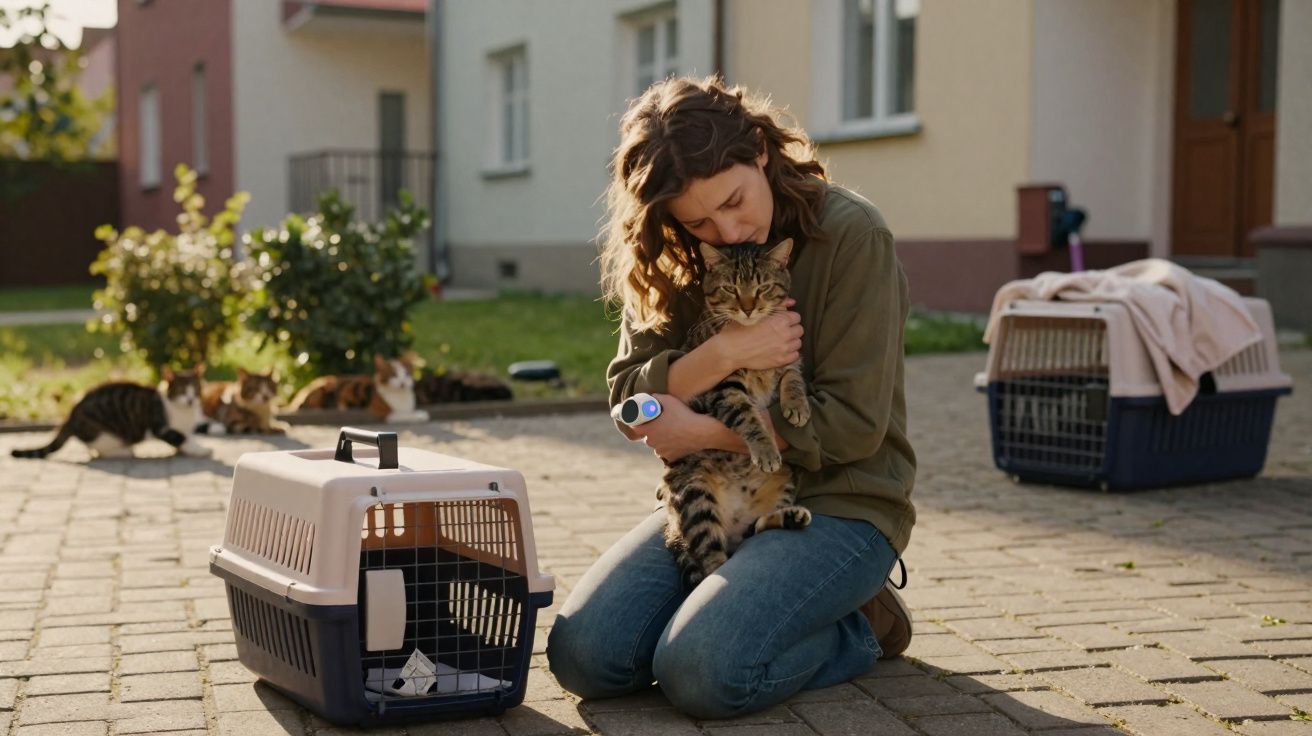
During a standard trap-and-neuter session in southern France, volunteers picked out one cat whose relaxed manner suggested there was more to him than the usual outdoor colony story.
At first, the animal welfare team assumed he was simply another garden stray. But a quick check with a microchip scanner transformed an ordinary day of trapping and neutering into a tale of loss, persistence and an unexpected reunion-two years after a stressful house move.
A quiet cat among wary strays
Coursan Cats, an association based in Coursan near Narbonne, spends its time monitoring free-roaming cats. Volunteers trap them, take them to a vet to be neutered and identified, and then return them to the area they came from. The cats continue living outdoors, but without producing litter after litter of kittens.
For local councils, these “community cats” are a practical way to steady numbers and cut down on noise, fighting and illness. For the association, the approach also helps prevent mistreatment and reduces pressure on already crowded shelters.
In 2024, the group carried out a neutering campaign on private land. At the outset, it followed the usual pattern: traps were set out in a garden where a small colony had settled. Most of the cats kept a cautious distance, which is typical of feral animals.
One black-and-white tomcat, however, behaved very differently. While the others scattered, he walked straight towards the volunteers with no sign of hesitation.
This cat was not nervous, not aggressive and not hiding. He looked at the volunteers as if he already knew people well.
He allowed the team to come close, to handle him, and to place him calmly into a carrier. For seasoned trappers, that sort of response often points to a cat that once lived in a home but has ended up outdoors.
The microchip that changed everything
At the veterinary clinic, each captured cat was anaesthetised and examined. The vet shaved a small patch of fur, checked for wounds and set up for the operation. For the black-and-white tom, the next step was to pass a microchip scanner over his neck and shoulder area.
The scanner beeped, and a number appeared.
In an instant, he was no longer just another unidentified stray. He now had an official ID, a registration record and a link to a family somewhere in France.
Thanks to the microchip, the vet pulled up the owner’s details in a national database and found a phone number and an old address in Coursan.
The volunteers rang the family listed. As they spoke, the background became clear: the owners had previously lived in Coursan but had since moved to the larger city of Béziers, roughly 30 kilometres away. During the upheaval of moving house, their cat had slipped out and disappeared.
They had looked for him-walking the streets, contacting shelters and alerting veterinary practices. Days became weeks, then months, and eventually they stopped believing he would ever return. Two years went by without any sign of him.
From moving-day chaos to two-year disappearance
Relocating with pets can be fraught with risk. Doors are left ajar, furniture is shifted around, and unfamiliar noises bounce off bare walls. Even an easy-going animal can panic and run. That appears to be what happened in Coursan.
Rather than travelling with his family to Béziers, the cat vanished amid boxes, open entrances and removal activity. He may have taken refuge in nearby gardens. Neighbours might have spotted him now and then, assuming he belonged to someone else.
As time passed, he seems to have become part of a semi-feral group living on private property. He adjusted to being outside, worked out where to find food and cover, and made it through two years alone in a town he once knew-without the people he had lived with.
His approachability during the trapping session suggests he never entirely lost confidence in humans. That trust, along with the microchip under his skin, ultimately offered him a way back.
How the reunion unfolded
When Coursan Cats got in touch, the former owners were astonished. Most people do not expect a missing pet to be found after two years-especially as a by-product of a broad neutering campaign.
They organised a trip back to Coursan. At the clinic, staff explained that a cat surviving outdoors could be thinner, more cautious, or slightly different in temperament.
Even so, reunions like this often follow a familiar sequence: an uncertain sniff, a measured stare, and then a sudden moment of recognition. While the precise details were kept private, the association confirmed that the cat was reunited with his family and that he left the garden colony behind for the comfort of home.
This unexpected outcome turned a simple neutering operation into a reminder that lost pets are not always gone forever.
Neutering campaigns with unexpected benefits
On the surface, the day’s objective was simple: trap, neuter, mark, release. In practice, community programmes in places like Coursan can have outcomes that reach well beyond population management.
Because teams routinely scan every cat for a microchip, they sometimes identify missing pets that would never make it to a shelter or veterinary surgery on their own. Hidden colonies can exist in private gardens, on industrial sites or in rural outbuildings.
In Coursan, cooperation between the association and the local council has been in place since 2019. Through this partnership, hundreds of cats have already been neutered. For the town, that translates into fewer abandoned litters and a healthier balance between residents and roaming animals.
For the cats themselves, neutering generally means calmer day-to-day life, fewer fight-related injuries and a reduced risk of certain illnesses. For families like the one involved here, the impact is even more intimate: a beloved companion returned against the odds.
What this story shows about microchipping
This case highlights how a device often no larger than a grain of rice can alter the course of a lost pet’s life. Once inserted under the skin, a microchip stores a unique number that can identify the animal permanently.
- It does not come off like a collar or tag can.
- Any vet or shelter can read it using a standard scanner.
- Databases connect the number to an owner’s name, telephone number and address.
- Owners can (and should) update those details after moving house or changing their number.
Without the microchip, the black-and-white tom would simply have been neutered and returned as another “free-roaming” colony cat, with no link to his previous life. Because he was chipped, he still had an identity, a past and people who had cared enough to register him.
Practical tips for avoiding moving-day disappearances
This story may prompt many pet owners to think about how they would handle a future move. A handful of straightforward precautions can greatly reduce the chance of a cat disappearing during the turmoil.
| Risky moment | What owners can do |
|---|---|
| Before the move | Microchip the cat, check vaccinations, and make sure your contact details are current in the database. |
| On packing days | Shut the cat in a separate room with food, water and a litter tray, well away from open doors. |
| Moving day itself | Put the cat into a secure carrier before the movers arrive; never open it outdoors. |
| First days in the new home | Keep the cat in one quiet room initially, then expand access gradually. |
Some charities also advise keeping cats indoors for several weeks after a move, giving them time to form a mental map of their new home before encountering unfamiliar roads, vehicles and scents.
Free-roaming cats and “TNR” explained
The work carried out by Coursan Cats is part of a broader approach used internationally, commonly referred to as “TNR”: trap, neuter, return. Rather than attempting to remove every stray cat, organisations aim to stabilise colonies by preventing new births and keeping an eye on welfare.
Once neutered, these cats tend to:
- Fight less, which reduces injuries and night-time noise.
- Range over smaller areas, lowering the risk of road traffic accidents.
- Discourage new unneutered cats from moving into the same territory.
The idea of “free cats” recognises that some animals are too wild-or too accustomed to outdoor life-to thrive in a flat. They can remain where they are, with basic human support such as food, water, veterinary treatment when necessary and, occasionally, a reunion like the one that returned a long-missing cat to his family.
Stories like this also show how multiple measures can complement one another. Neutering campaigns help manage numbers, microchips can reconnect pets with owners, and councils can provide funding or access to private sites. When it all comes together, even a two-year disappearance during a difficult house move can end not with unanswered questions, but with a phone call saying: “We think we’ve found your cat.”






Comments
No comments yet. Be the first to comment!
Leave a Comment