
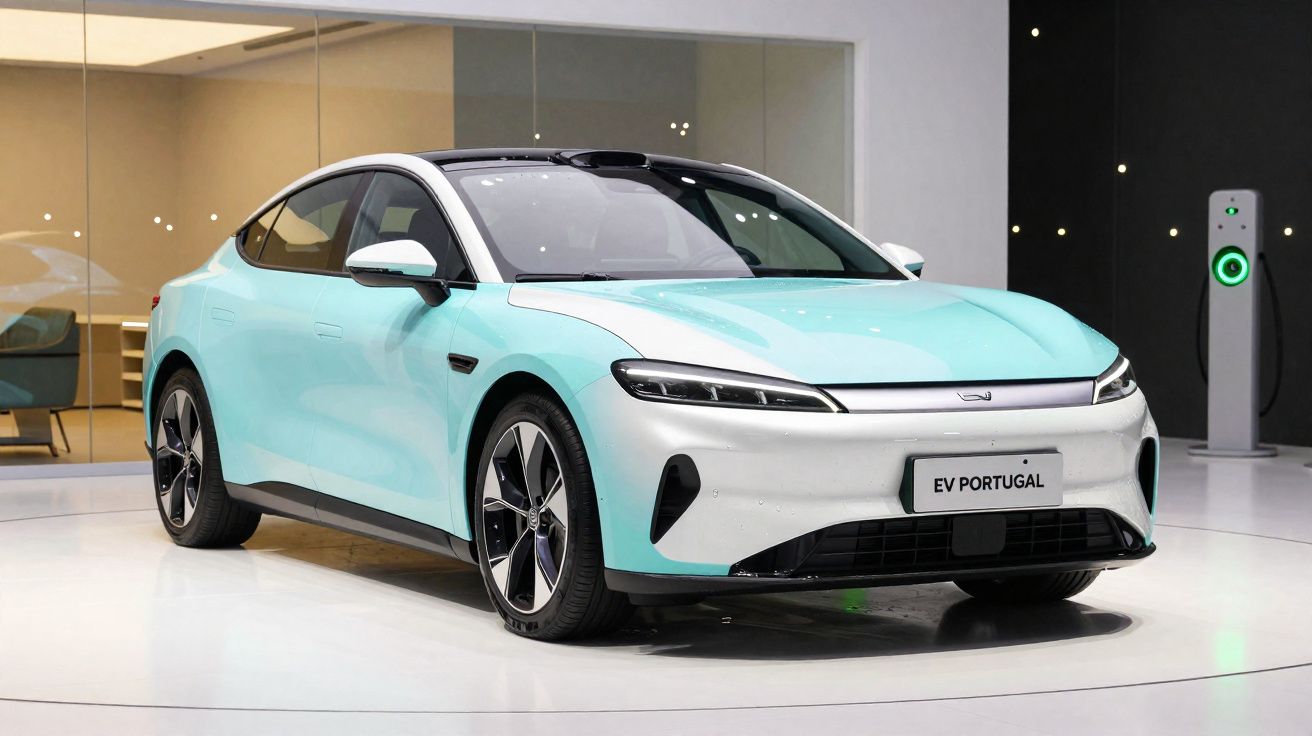
High purchase prices have long been - and still largely remain - one of the biggest barriers to buying an electric car. Even so, that picture is steadily changing: the choice keeps expanding, competition is intensifying, and prices have been edging down.
It’s true that electric cars have not yet reached the sought-after price parity with comparable petrol or diesel models, particularly at the budget end of the market. Even so, the latest arrivals are unquestionably a meaningful step in that direction.
With that in mind, we have put together this buying guide with the 10 cheapest brand-new electric cars currently on sale in Portugal.
Dacia Spring - from 16 900 euros
The Dacia Spring was among the first models in the new wave of more affordable EVs to reach the market. It is the cheapest option here, but it also sits among the cars with the shortest range on this list. For 2024 it received an update, bringing fresh exterior and interior styling, more technology, and additional safety equipment.
It is sold in four trims, where the key differences come down to equipment levels and electric motor output: 33 kW (45 hp) and 125 Nm in the entry version, versus 48 kW (65 hp) and 113 Nm in the remaining versions.
Across the range, the shared component is a battery with 26.8 kWh of usable capacity, quoted for up to 225 km of range (WLTP cycle). Pricing starts at 16 900 euros for the 45 hp Essential, rising to 18 900 euros, 19 900 euros and 20 300 euros for the Expression, Extreme and Cargo versions, respectively.
Leapmotor T03 - from 18 985 euros
The Leapmotor T03 is the smallest electric car from the Chinese brand that has only recently arrived in Europe, and it is already available in Portugal from 18 985 euros - we have tested it.
For money similar to a better-equipped Dacia Spring, the T03 brings more power, more range, and a stronger technology offering. Highlights include a 10.1″ infotainment screen, a panoramic roof, and multiple driver-assistance systems.
Offered with a single drivetrain, the Leapmotor T03 pairs a 70 kW (95 hp) electric motor producing 158 Nm with a 37.3 kWh battery. The stated range is 265 km (WLTP), or up to 395 km on the urban cycle.
BYD Dolphin Surf - from 20 890 euros
The BYD Dolphin Surf "landed" in Portugal a couple of months ago and made its first public appearance at the ECAR Show 2025. It is currently the most affordable electric model from the Chinese giant in Portugal, with prices starting at 20 890 euros.
Set against the Leapmotor T03, it stands out for its longer range, its onboard technology, and a more eye-catching design - although that last point is, of course, subjective.
In entry-level Active form, the Dolphin Surf uses a 65 kW (88 hp) motor with 175 Nm and a 30 kWh battery, delivering up to 220 km of range (WLTP). The Boost and Comfort versions move to a 43.2 kWh battery for up to 322 km on the combined WLTP cycle, or 507 km on the urban cycle. The top version also gains a stronger motor: 115 kW (156 hp) and 220 Nm.
Citroën ë-C3 - from 23 300 euros
If comfort is your priority in an EV, the Citroën ë-C3 is one of the most compelling options in this selection. Sitting in the B-segment supermini class, it adopts a crossover stance, with five seats and enough room to handle everyday needs.
Its sharp pricing comes in part from a focus on the essentials, although the options list is far from sparse - including items such as a 10.25″ touchscreen, automatic air conditioning and a rear parking camera.
A version priced below 20,000 euros is expected to launch this year - with a 30 kWh battery - but for now the line-up is limited to a 44 kWh battery feeding an 83 kW (113 hp) motor with 125 Nm. Claimed range is up to 314 km (WLTP), and pricing begins at 23 300 euros.
FIAT Grand Panda - from 23 550 euros
Despite its retro-futuristic design, which gives it a strong identity, the FIAT Grande Panda shares almost everything with the Citroën ë-C3, from its platform to its drivetrain.
That means the same 44 kWh LFP battery and the same 83 kW (113 hp) electric motor producing 125 Nm, for a quoted range of up to 320 km (WLTP cycle).
On pricing, the Italian crossover starts at 23 550 euros for the RED version, climbing to 26 550 euros for the better-equipped La Prima.
Hyundai Inster - from 24 900 euros
Hyundai’s Inster is the South Korean brand’s bet in the electric city-car space. Although it measures 3.8 metres in length, it leans heavily on interior practicality as its main selling point and also impresses with the ranges on offer. We have tested it too.
Two battery options are available: 42 kWh and 49 kWh, corresponding to WLTP ranges of 327 km and 370 km, respectively. Depending on version, motor output varies between 71 kW (97 hp) and 85 kW (115 hp).
As this list of the cheapest EVs makes clear, even though it is a city-focused model, its pricing places it among cars from the segment above. It starts at 24 900 euros (Comfort) and rises to 29 900 euros (Style Plus).
Renault 5 - from 24 900 euros
The Renault 5 is one of the most sought-after new EVs right now, thanks to its highly appealing design inspired by the original, a competitive price point, and strong technology content.
It is now offered in a new entry-level version called "Five", with prices from 24 900 euros. As standard, it combines a 70 kW (95 hp) electric motor with a 40 kWh battery, enabling up to 300 km of range (WLTP). In equipment terms, it stands out for including several driver-assistance features and a 10.1″ infotainment display (Google-based system).
If you need more range, there are versions that pair a 52 kWh battery with more powerful motors of up to 110 kW (150 hp), allowing the Renault 5 to cover up to 412 km between charges. In those specifications, however, the French hatchback’s price can comfortably exceed 30,000 euros.
Citroën ë-C3 Aircross - from 26 490 euros
The Citroën ë-C3 Aircross is the largest car in this line-up, but unlike the combustion versions, it cannot be configured with seven seats. The French SUV’s appeal has recently been strengthened by a longer-range version, adding almost 100 km and taking it to 400 km (WLTP).
Just like the ë-C3, it wins points for comfort, while this body style brings noticeably more space - with a 460-litre boot that better suits family needs. If you prefer a more Teutonic look, you can always consider its "German cousin", the Opel Frontera, with which it shares almost everything.
Priced from 26 490 euros, the entry versions keep the ë-C3’s 44 kWh battery and 83 kW (113 hp) electric motor, for a claimed range of up to 307 km (WLTP). With the 54 kWh battery fitted, range rises to 400 km and the price increases to 28 490 euros.
Dongfeng Box - from 26 790 euros
The new Dongfeng Box is the spearhead of Dongfeng’s debut in Portugal. The Chinese brand launched here at the end of 2024 and, for the time being, offers only this 100% electric supermini.
It impresses with cabin space, generous standard equipment (despite the lack of an FM radio), and restrained energy consumption, but when we tested it the performance and charging power left something to be desired.
It comes with a 70 kW (95 hp) motor, a 42 kWh battery and a WLTP range of up to 340 km. The promised starting price is 26 790 euros.
FIAT 500E - from 28 140 euros
Small, stylish and fully electric, the FIAT 500E arrived in 2020 and remains available only as an EV until a combustion engine option arrives, which is planned for 2026.
With four equipment levels, it can be specified with one of two set-ups: a 70 kW (95 hp) motor and a 21.3 kWh battery (range up to 190 km WLTP); or an 87 kW (118 hp) motor with a 37.3 kWh battery (up to 331 km WLTP).
When it comes to pricing, this is where the FIAT 500E is least admired. From 28 140 euros, the Italian city car is not only the most expensive model on this list, but also the one that offers the least space and, for the money, the shortest range.




Comments
No comments yet. Be the first to comment!
Leave a Comment