
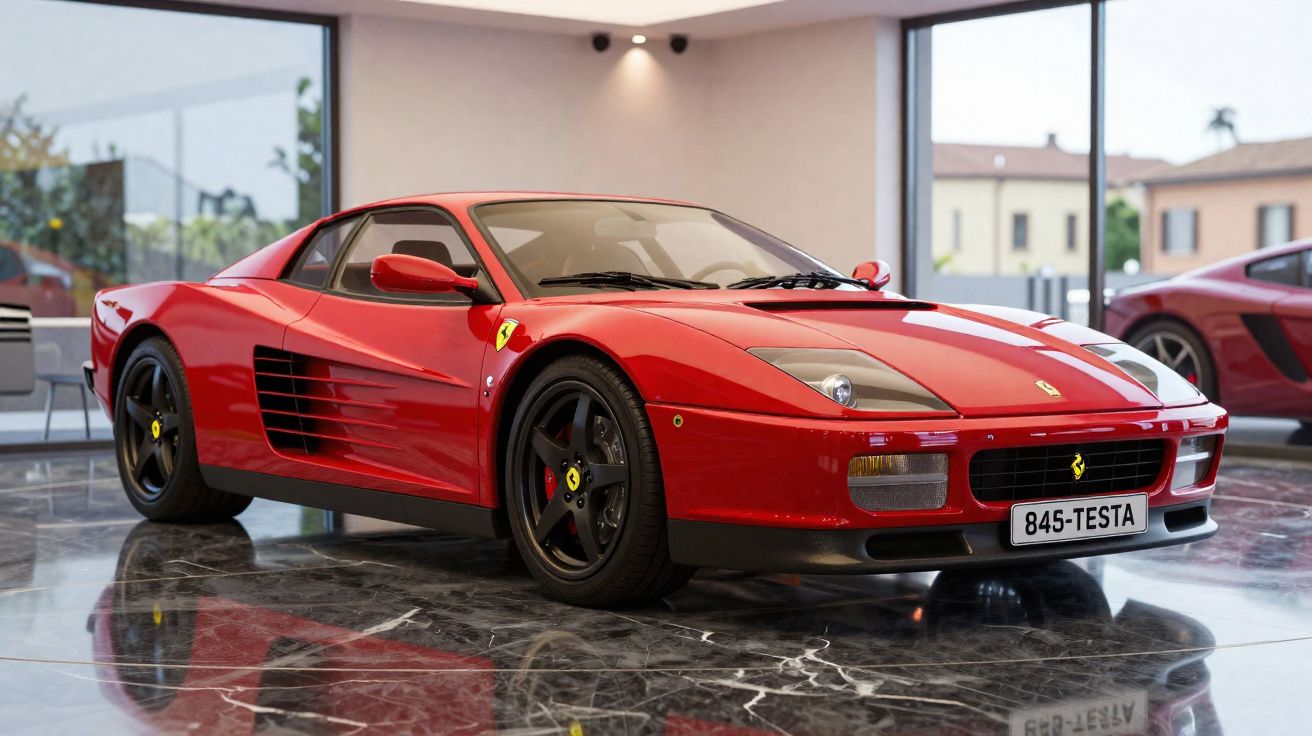
In 1984, Ferrari set out to honour the car with which it won the 1957 World Sportscar Championship, known as the 250 Testarossa - a reference to the camshaft covers painted red; literally, “red head”.
Through its various evolutions, the two-door coupé with a mid-rear V12 remained in production until 1996, although in its final years (1992–96) it wore different names: first 512 TR and later F512M.
The original engine - a 180º V12 - displaced 4.9 litres and produced 390 cv, enough to sprint to 100 km/h in 5.8s and continue on to a 290 km/h top speed. Figures that, today, naturally raise a smile - more affectionate than mocking.
Total production reached 9439 units (7177 Testarossa, 2261 512 TR and 501 512M), securing its status as a true myth in Ferrari and automotive history.
The first Testarossa without 12 cylinders
It now returns as the Ferrari 849 Testarossa, taking over from the SF90 Stradale. It is derived from that model and, in doing so, makes clear the reasoning behind many of its technical choices.
This is the first Testarossa not to use a V12. Instead, it adopts the SF90 Stradale’s plug-in hybrid set-up, combining a twin-turbo V8 with three electric motors, plus a high-voltage battery and an inverter.
On its own, the 4.0-litre twin-turbo V8 delivers 830 cv - 50 cv more than its predecessor - along with an equally striking specific output of around 208 cv/l.
It features a new turbocharger, the largest Ferrari has ever fitted to any of its cars, and a long list of redesigned parts: cylinder heads, block, exhaust manifolds, valve gear and even titanium bolts. The cooling system had to be strengthened (by 15%) to cope with the extra power.
The three electric motors add 220 cv, and when everything is combined the total comes to 1050 cv - a new all-time record for a series-production Ferrari (the F80 is more powerful, of course, but it is built in limited numbers).
Up to 25 km… of electric range
The plug-in hybrid powertrain is directly based on what we already know from the SF90 Stradale. Two of the three electric motors sit on the front axle and form the RAC-e system (Electronic Cornering Regulator), enabling the all-wheel-drive and torque-vectoring systems to maximise traction when powering out of bends. The third motor is mounted on the rear axle and operates in a similar way to the system used on the Scuderia Ferrari F1 car.
According to the Italian engineers, the brake regeneration strategy has been refined to improve pedal feel, aiming for a more progressive, natural intervention so that electric and hydraulic deceleration work together more coherently.
Battery and e-motor management strategies have been tuned to suit the four driving modes selected via the eManettino on the steering wheel: eDrive, Hybrid, Performance and Qualifying.
In eDrive mode, the Ferrari 849 Testarossa can cover up to 25 km running purely on electricity (at up to 130 km/h), drawing energy from a 7.45 kWh lithium-ion battery. It is positioned to ensure a low centre of gravity and what the marque considers the ideal weight distribution, with a slight rear bias: 45% front and 55% rear.
Devastating performance
And speaking of weight, the 849 Testarossa quotes the same 1570 kg dry weight as the SF90 Stradale, despite its gains in power and performance, thanks to the use of even lighter materials. That was key to claiming the title of Ferrari with the best power-to-weight ratio ever: 1.5 kg/cv.
The performance figures are - and it is almost redundant to say so - sensational. A top speed of more than 330 km/h, less than 2.3s from 0 to 100 km/h - quicker than the SF90 XX Stradale -, just 6.35s from 0 to 200 km/h, and only 28.5 m required to stop from 100 km/h are among the standout numbers.
A lap of the Fiorano circuit takes 1min17.5s. Where does that place it? It becomes the third-fastest ever, behind only the F80 (1min15.3s) and the SF90 XX (1min17.3s), while also being 1.5 seconds quicker than its direct predecessor, the SF90 Stradale.
The gearshift strategy, inherited from the SF90 XX Stradale, has been reworked to heighten the sound impact in sporty driving. A new engine calibration, together with combustion-chamber pressure, maximises acoustic intensity when the accelerator pedal is released. This feature activates at medium loads and revs, delivering the distinctive race-style sound associated with gear changes. From the Manettino’s “Race” position onwards, shifts become even more extreme.
One of Ferrari’s biggest priorities during development of the 849 Testarossa was to deliver a soundtrack closer to that of previous 12-cylinder models. The tone of the updated twin-turbo V8 has been amplified across the rev range, with particular attention paid to low and mid frequencies.
The aim was that, as it approaches the 8300 rpm limiter, the power should arrive explosively, immersing occupants in a mix of sound, acceleration and vibration - an effect emphasised by the engine’s flat-plane crankshaft.
415 kg of aerodynamic downforce
The main aerodynamic targets for the Ferrari 849 Testarossa were to optimise thermal performance and increase downforce. Inspiration and reference points came from historic and modern racing solutions, including those seen on the 512 S, 512 M and FXX-K.
The outcome? The 849 Testarossa generates total downforce of 415 kg at 250 km/h, an increase of 25 kg compared with the SF90 Stradale.
The active rear spoiler, developed from the SF90 Stradale and the 296 GTB, is integrated into the bodywork and operated by a kinematic solution that is 2 kg lighter.
It can switch between Low Drag and High Downforce settings in under a second - and in the latter configuration it helps generate up to 100 kg of downforce at 250 km/h.
Dynamics evolved from the SF90
The 849 Testarossa’s dynamic set-up uses the SF90 Stradale as its reference point, with an emphasis on increased power, grip and tyre response, braking effectiveness, and the evolution of electronic controls via the digital Ferrari Integrated Vehicle Estimator (FIVE).
This system creates a “digital twin” that mirrors the car’s behaviour in real time, using real measurements (acceleration, etc.). FIVE can estimate performance characteristics that cannot be measured directly - such as yaw rate and yaw angle - with minimal error margins, improving the operation of traction control, the differential and the e4WD system.
The suspension has also been retuned. The increase in lateral performance versus the SF90 Stradale is 3%, thanks to the new tyres, which also enabled a 35% reduction in spring weight. Body roll has been cut by 10%.
Modern yet nostalgic
The team led by Flavio Manzoni aimed to balance sculptural forms with graphic elements, while also creating a synergy between cues from the past and futuristic lines.
Vertical and transverse lines produce a new visual theme inspired by aeronautics and 1970s Sport-Prototypes, while the front end features structured volumes that recall certain Ferraris from the 1980s.
Manzoni is particularly proud of the three-dimensional modelling of the doors, described as “never before achieved in a series-production car, redefining the relationship between the bodywork and the exterior of the cabin”. The panel is made from a single casting in an aluminium alloy.
Inside, there is a blend of berlinetta layout with a horizontal dashboard and the cockpit feel of a single-seat racing car. The upper section has a floating effect, with “C”-shaped air vents framed in aluminium. Between the upper and lower sections sits a contrasting horizontal band that integrates the main controls and the passenger display.
The steering wheel combines digital and analogue functions, while retaining the F80’s mechanical controls, including the iconic engine start button.
The lower part of the dashboard is defined by two sail-like architectural motifs (a theme also echoed in the doors) that incorporate various controls.
On the central tunnel, secondary controls are arranged in a more rational, minimalist manner. The seats are offered in two versions: one focused on comfort and another with a more sporting character, featuring a carbon-fibre structure.
Spider: conquering the sky
The Spider version was revealed alongside the coupé. It comes with a retractable hard top that can be opened or closed electrically in just 14 seconds at speeds of up to 45 km/h.
To maximise comfort, an innovative wind deflector has been fitted behind the seats, designed to minimise turbulence and preserve the driving experience with the roof down.
It captures airflow entering above the side window via inlets integrated into the seat backrest, then redirects it to the lower part of the seat through two lower outlets.
Another obvious difference is the bridge on the rear decklid which, with the roof closed, guides airflow towards the rear and the active spoiler, ensuring the downforce generated matches that of the 849 Testarossa coupé.
When it arrives and how much it will cost
The new Ferrari 849 Testarossa can already be ordered, but prices have not yet been announced. Given that the SF90 Stradale, when it launched, was already nudging half a million euros, it would be surprising if the 849 Testarossa started for less.


Comments
No comments yet. Be the first to comment!
Leave a Comment