
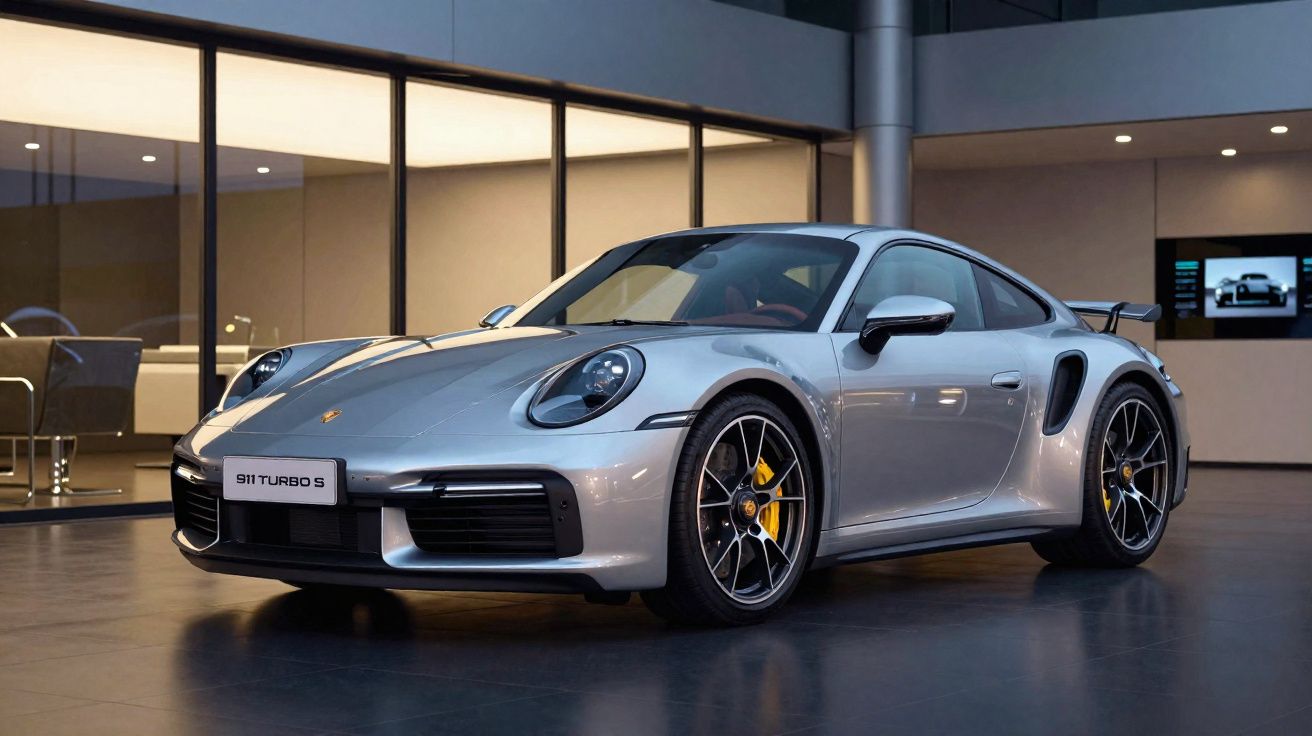
Porsche has already made it clear it will never release a fully electric 911, but that does not mean steering clear of electrification. Last year brought the first hybrid 911 (the Carrera GTS), and now the German brand has applied the same approach to the all-conquering 911 Turbo S (992.2).
And it really is “all-conquering”: this is the most powerful production Porsche 911 ever built. For the first time, the 3.6-litre flat-six breaks through the 700 hp mark.
To be exact, peak output stands at 711 hp (between 6500 rpm and 7000 rpm), which is 61 hp more than before. Maximum torque, meanwhile, remains a hefty 800 Nm, but it is now delivered across a broader rev range: from 2300 rpm to 6000 rpm, whereas the predecessor served it up between 2500 rpm and 4000 rpm.
What has changed?
To achieve these gains, the 2026 911 Turbo S adopts the same 400 V hybrid system used in the Carrera GTS. Known as T-Hybrid, it has been further tailored specifically for the Turbo S.
The key difference is that this version uses two electric turbochargers (eTurbo) rather than one, aiming to make throttle response as instantaneous as possible. The high-voltage battery keeps the same 1.9 kWh capacity, and the eight-speed PDK gearbox integrates an electric motor, sending power to the PTM (Porsche Traction Management) all-wheel-drive system.
All of this translates into even more crushing performance, while also keeping fuel consumption and emissions slightly more in check. The sprint to 100 km/h is now dispatched in 2.5s (-0.2s) and it reaches 200 km/h in just 8.4s (-0.5s). Top speed, however, has been trimmed to 322 km/h; previously it managed 330 km/h.
It is both more powerful and heavier (+85 kg, 1800 kg in total) and the hybrid system is geared more towards performance than efficiency, yet the 2026 911 Turbo S still posts “only” 11.8–11.6 l/100 km (coupé), which is 0.6 l/100 km better than before. CO2 emissions of 266–262 g/km are also, unsurprisingly, lower: down by 26 g/km.
14 seconds quicker at the Nürburgring
Alongside the debut of a hybrid powertrain, the Porsche 911 Turbo S gains new tyres, with the rears now 10 mm wider at 325/30 ZR 21. Up front it retains 255/35 ZR 20. The front ceramic-composite brakes (PCCB) get new pads, while the rear discs grow in diameter from 390 mm to 410 mm. At the front, they remain 420 mm. These are the largest brakes ever fitted to a two-door Porsche.
Aerodynamics have been refined as well. There are new vertical front fins - as on the 911 Carrera GTS - plus an active front diffuser. They work alongside the previous car’s active components: a variable front lip and a rear wing that can extend and alter its angle. Together, these changes help cut aerodynamic drag by 10%.
Thanks to the T-Hybrid system, the 2026 911 Turbo S can also be specified with the PDCC (Porsche Dynamic Chassis Control) system featuring standard hydraulic control. It uses interconnected active anti-roll bars where pressure is built up via oil volume flow. The aim is to curb body roll and sharpen agility.
Another benefit of the 400 V hybrid setup is the optional front-axle lift system, which now operates much faster than before.
The combined effect - more power, quicker response, and improvements to both dynamics and aerodynamics - was proven on the toughest stage of all: the Nürburgring. In autumn 2024, Porsche set a 7min03.92s lap in a lightly camouflaged test prototype. That is 14 seconds quicker than the outgoing model, despite the extra ballast.
When does it arrive and how much does it cost?
It has only just been revealed, but the 2026 Porsche 911 Turbo S can already be ordered in Portugal, with prices starting at €324,121 for the coupé. The 911 Turbo S Cabriolet costs more, starting at €339,324. First deliveries in Europe are expected at the beginning of 2026.
That price already includes the Sport Chrono Package, which adds a tyre temperature display, a specifically tuned PASM suspension, an electro-hydraulic PDCC mount, and a titanium sports exhaust system.
Naturally, there is plenty of scope to go overboard with Porsche Exclusive Manufaktur customisation for the 2026 911 Turbo S: more than 100 exterior colours, Turbo Exclusive Design wheels with carbon “blades” painted in Neodymium, a visible carbon-fibre roof, carbon-fibre side air intakes, and so on. It even extends to carbon-fibre wiper arms that are 50% lighter.






Comments
No comments yet. Be the first to comment!
Leave a Comment