
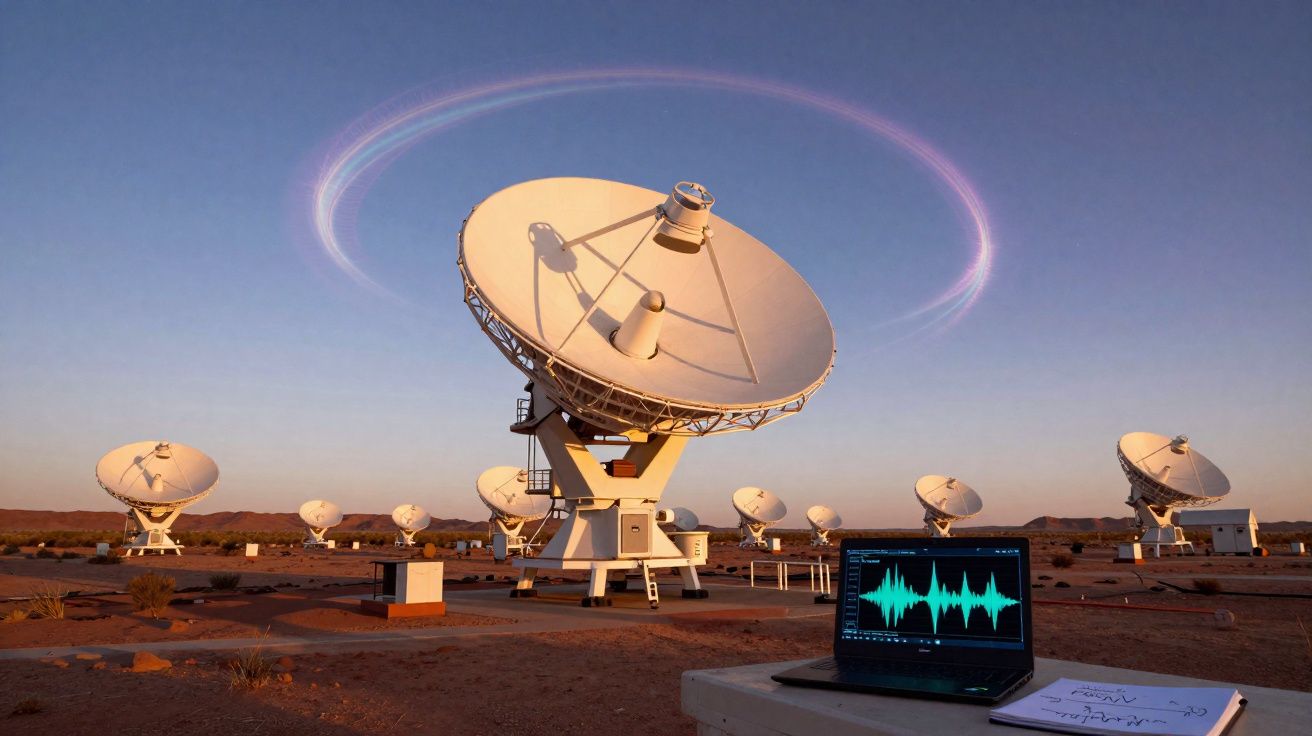
In South Africa, a radio telescope has picked up a signal that was emitted around eight billion years ago. It comes from two galaxies in the act of colliding, was boosted on its journey by a cosmic “magnifying glass”, and outstrips every previous record in its class. Behind the striking detection is not only good fortune, but also a new approach that researchers plan to use to uncover thousands of similar “lasers from space” in future.
How a cosmic coincidence made a record signal possible
At the centre of the story is a distant object with the matter-of-fact label HATLAS J142935.3-002836. We see this galaxy as it was when the Universe was only about five billion years old-less than half its current age. From that era, it launched a tightly focused radio signal into space.
That emission travelled more than eight billion light-years-over half the observable span of the Universe-before reaching the antennas of the MeerKAT radio telescope in South Africa. Under normal circumstances, radiation from so far away would be smeared out and far too faint to detect.
"Only an extremely favourable alignment of three celestial objects made the observation possible at all."
The key is that a second, very massive galaxy lies between the distant source and Earth, almost exactly along the line of sight. Its gravity warps the surrounding space-and with it, the path taken by the radio waves. This effect is known as gravitational lensing.
Much like a magnifying glass, the intervening galaxy amplifies the incoming signal, concentrates it, and makes it appear brighter than it should at such an enormous distance. Without this three-part cosmic line-up-source, “lens”, and Earth positioned nearly on one straight line-the signal would simply have remained invisible.
A team led by astrophysicist Marcin Glowacki at the University of Pretoria identified this rare configuration within data from the MeerKAT Absorption Line Survey. Their preliminary results, available on the arXiv preprint server, describe a natural chance experiment that allows researchers to probe regions otherwise far beyond measurement limits.
MeerKAT: giant radio ears in the Karoo Desert
The discovery was made using MeerKAT in South Africa. The facility comprises 64 dishes spread across the arid Karoo landscape. Working together, they function as a virtual giant telescope with exceptionally fine sensitivity to radio waves.
MeerKAT monitors large areas of the southern sky almost continuously. Particular attention goes to regions where gravitational lenses are likely-such as areas rich in massive galaxies or galaxy clusters. It is precisely in these zones that researchers hope to catch amplified signals like this one.
- Location: Karoo Desert, South Africa
- Number of antennas: 64 individual dishes
- First operations: late 2010s
- Strength: high sensitivity to extremely weak radio waves
- Role: precursor to, and building block of, the future Square Kilometre Array (SKA)
In April 2025, the array recorded an unusually bright signal. The follow-up analysis indicated it originated in a region where two galaxies are effectively crashing into each other. In that environment, an exceptionally energetic phenomenon is produced: a hydroxyl megamaser.
When galaxies collide and ignite a cosmic “laser”
The physical source of the record-setting emission sounds modest at first: hydroxyl molecules-compounds made of one oxygen and one hydrogen atom (OH). What matters is where those molecules reside: right inside a violent galaxy collision.
When two galaxies meet, their gas and dust clouds mix. Vast reservoirs of gas are compressed, while shock fronts and shock waves ripple through the chaos. Under these extreme conditions, OH molecules are driven into a highly excited state.
If the circumstances are right, the molecules emit radio waves-not randomly, but in an intensified, tightly directed beam. The mechanism is broadly comparable to a laser, except it operates at radio wavelengths. Specialists call it a maser (Microwave Amplification by Stimulated Emission of Radiation). When the output becomes particularly powerful, it is termed a megamaser.
"In the case of HATLAS J142935, researchers are even talking about a possible 'gigamaser'-a new, even more extreme category."
The measured luminosity exceeds that of every hydroxyl megamaser known so far. Glowacki’s team therefore proposes placing the object in a class of its own. The label “gigamaser” is intended to underline just how much more energetic this signal is compared with typical examples.
Starburst factory: hundreds of Suns per year
The reason for the extraordinary brightness lies in the pace of star formation within the merging system. Estimates suggest the colliding galaxies are producing several hundred solar masses of new stars per year. In the Milky Way, the figure is only about one to two solar masses annually.
Such intense “starburst” episodes generate abundant radiation and shock activity that continually excites the OH molecules. As a result, the maser effect can remain active, shining through space like a cosmic beacon.
What researchers can learn from the radio signal
Radio waves from the gigamaser carry a wealth of information. They indicate where dense molecular gas sits within the merging galaxy, how fast it is moving, and how strongly it is concentrated. For astrophysicists, this provides a way to map the inner regions of extremely distant galaxies.
Especially compelling is how maser detections connect to the broader story of galactic evolution. Galaxy mergers play a central part in how large galaxies assemble and change over billions of years. Each new maser discovery adds another piece to the puzzle-revealing how often such mergers occur and how violent they can be.
Because optical telescopes quickly run into limitations in dusty environments, radio observatories offer a clear advantage: radio waves pass through dust comparatively well. That allows radio observations to reach zones that are completely hidden at visible wavelengths.
MeerKAT as a trailblazer: the hunt for thousands of hidden masers begins
This discovery is considered the first hydroxyl gigamaser made visible with the help of a gravitational lens. That exact combination-a powerful maser that is intrinsically too distant, plus a cosmic magnifying effect-now serves as the template for further finds.
Astrophysicists expect the Universe to be full of similar maser sources that are simply too faint to stand out without amplification. Once gravitational lensing enters the picture, these otherwise invisible objects move within reach of modern radio telescopes.
MeerKAT also functions as a proving ground for a much larger effort: the Square Kilometre Array (SKA). In the coming years, thousands of antennas are due to be installed across South Africa and Australia, with a combined collecting area of about one square kilometre. That should increase sensitivity to faint radio waves by roughly a factor of ten.
"With the SKA, researchers want to build an almost complete register of distant masers-from the nearby cosmos to the earliest epochs of galaxy formation."
Future observing campaigns will concentrate more deliberately on sky regions containing massive galaxy clusters, because these environments produce particularly strong gravitational lenses. In this way, nature itself can be used as an amplification network spread throughout the cosmos.
What terms like gravitational lens and maser actually mean
Many technical expressions sound abstract at first, but they can be visualised. A gravitational lens is comparable to a block of glass that distorts a lamp behind it and increases its brightness in certain places. Instead of glass, it is the gravity of a galaxy or a galaxy cluster that causes the distortion.
A maser works, in essence, in a similar way to a laser pointer on a desk: particles are pumped into an excited state and then release their energy at once as coherent, concentrated radiation. The differences are the wavelength (microwaves rather than visible light) and the scale-clouds spanning light-years are involved instead of a beam just millimetres across.
Opportunities and limits of this technique
Combining gravitational lenses, maser signals and highly sensitive radio telescopes opens up fresh views of the early Universe. Researchers can extract data on:
- distribution of cold, molecular gas in very distant galaxies
- speed and dynamics in galaxy collisions
- star-formation rates across cosmic timescales
- influence of mergers on the growth of galactic nuclei
At the same time, there are hurdles. Gravitational lenses occur only in certain regions of the sky, and their impact depends strongly on the detailed structure of the lensing galaxy. The observations therefore have to be “unlensed” with complex models to reconstruct the source’s original brightness and structure.
Even so, the detection of an eight-billion-year-old gigamaser highlights the potential of this method. What currently looks like a lucky one-off could, within a few years, become routine work for major radio telescopes-and fundamentally shift how we observe the distant past of the Universe.






Comments
No comments yet. Be the first to comment!
Leave a Comment